The Big Problem of Small Change

The Big Problem of Small Change

François R. Velde / François RVelde / Thomas J. Sargent / Thomas JSargent

74,22 €
IVA incluido
Disponible
Editorial:
Princeton University Press
Año de edición:
2003
Materia
Historia de la economía
ISBN:
9780691116358
74,22 €
IVA incluido
Disponible

Selecciona una librería:

  • Librería Samer Atenea
  • Librería Aciertas (Toledo)
  • Kálamo Books
  • Librería Perelló (Valencia)
  • Librería Elías (Asturias)
  • Donde los libros
  • Librería Kolima (Madrid)
  • Librería Proteo (Málaga)

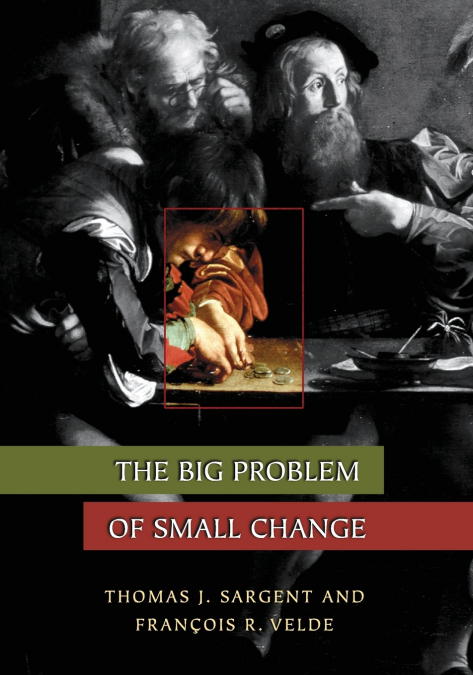
The Big Problem of Small Change offers the first credible and analytically sound explanation of how a problem that dogged monetary authorities for hundreds of years was finally solved. Two leading economists, Thomas Sargent and François Velde, examine the evolution of Western European economies through the lens of one of the classic problems of monetary history--the recurring scarcity and depreciation of small change. Through penetrating and clearly worded analysis, they tell the story of how monetary technologies, doctrines, and practices evolved from 1300 to 1850; of how the 'standard formula' was devised to address an age-old dilemma without causing inflation. One big problem had long plagued commodity money (that is, money literally worth its weight in gold): governments were hard-pressed to provide a steady supply of small change because of its high costs of production. The ensuing shortages hampered trade and, paradoxically, resulted in inflation and depreciation of small change. After centuries of technological progress that limited counterfeiting, in the nineteenth century governments replaced the small change in use until then with fiat money (money not literally equal to the value claimed for it)--ensuring a secure flow of small change. But this was not all. By solving this problem, suggest Sargent and Velde, modern European states laid the intellectual and practical basis for the diverse forms of money that make the world go round today. This keenly argued, richly imaginative, and attractively illustrated study presents a comprehensive history and theory of small change. The authors skillfully convey the intuition that underlies their rigorous analysis. All those intrigued by monetary history will recognize this book for the standard that it is.
Artículos relacionados

  • Foreign Banks and Global Finance in Modern China
    Ghassan Moazzin
    ...
    Disponible

    41,39 €

  • F.U.B.A.R. From Inflation to Hyperinflation
    Pawlo Lawriw
    Inflation and hyperinflation results in F.U.B.A.R on an epic scale. It can cause social and economic collapse and war and in short, change history- for the worse. If you are worried about inflation, who is not, then F.U.B.A.R. (F****d Up Beyond All Recognition) FROM INFLATION TO HYPERINFLATION is a work that you need to read.Some observers now wonder as society suffers from hig...
    Disponible

    18,47 €

  • Scarce and Valuable Economical Tracts
    John Ramsay McCulloch
    This volume, Scarce and Valuable Economical Tracts, was edited by John Ramsay McCulloch and originally published in 1859. It contains essays on political economy written by: Nicholas Barbon, Daniel Defoe, Henry Elking, Thomas Wise, Benjamin Franklin, Anne Robert Jacques Turgot, James Anderson, Alexander Schomberg, Joseph Townsend, Edmund Burke, and Archibald Bell.In her entry o...
    Disponible

    17,77 €

  • The Winding Road to the Welfare State
    George R. Boyer
    How did Britain transform itself from a nation of workhouses to one that became a model for the modern welfare state? The Winding Road to the Welfare State investigates the evolution of living standards and welfare policies in Britain from the 1830s to 1950 and provides insights into how British working-class households coped with economic insecurity. George Boyer examines the ...
    Disponible

    46,98 €

  • Joseph Alois Schumpeter
    Wolfgang F. Stolper
    In this major scholarly study of the life of Joseph A. Schumpeter, one of the great intellectual figures of the twentieth century, the distinguished economist Wolfgang Stolper delves into the mind of his former teacher, exploring the development of his ideas and, especially, their influence on politics and public policy. After reflecting briefly on Schumpeter the man, Stolper e...
    Disponible

    110,15 €

  • An Economic History of the Iberian Peninsula, 700-2000
    ...
    Disponible

    234,66 €