
Inicio > Humanidades > Historia > Historia militar > The Battle of Ipsus 301 B.C.
The Battle of Ipsus 301 B.C.

The Battle of Ipsus 301 B.C.

Antonios athenaeus

22,99 €
IVA incluido
Disponible
Editorial:
Antonios athenaeus
Año de edición:
2026
Materia
Historia militar
ISBN:
9798235093171
22,99 €
IVA incluido
Disponible

Selecciona una librería:

  • Librería Samer Atenea
  • Kálamo Books
  • Librería Elías (Asturias)
  • Librería Kolima (Madrid)
  • Librería Proteo (Málaga)

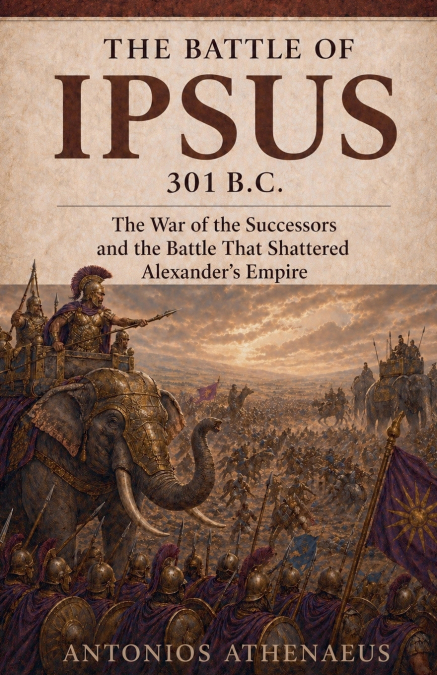
At Ipsus, victory was not decided by strength alone-but by control of the battlefield.In 301 B.C., the successors of Alexander the Great faced one another in a decisive struggle that would determine the fate of his empire. No longer united by conquest, his generals turned their armies against each other in a war defined by ambition, rivalry, and the question of who would inherit power. At Ipsus, Antigonus Monophthalmus sought to impose unity by force. Opposing him stood a coalition led by Seleucus and Lysimachus, prepared not just to resist-but to break him permanently.This book examines the Battle of Ipsus not simply as a large-scale clash of Hellenistic armies, but as a decisive operational contest shaped by maneuver, coordination, and timing. It analyzes the deployment of phalanxes, the decisive role of cavalry on the flanks, and above all the use of war elephants as an instrument of battlefield control rather than shock alone. The battle was not won in a single moment of impact, but through the isolation of forces and the collapse of command cohesion.At the center stands Antigonus-experienced, ambitious, and determined to reunite Alexander’s empire under his rule. Opposing him, Seleucus emerges as the architect of victory, using discipline, patience, and tactical awareness to exploit a critical opportunity. Demetrius’ aggressive cavalry charge, initially successful, ultimately removed a decisive force from the battlefield, allowing the coalition to reshape the fight. The engagement that followed was not symmetrical-it was controlled.Ipsus demonstrates a fundamental principle of warfare: battles are often decided not by destruction, but by separation. When forces lose the ability to support one another, even the strongest formation becomes vulnerable. Antigonus did not lose because his army was weaker-he lost because it was divided at the decisive moment.Drawing on ancient sources including Diodorus Siculus, Plutarch, and Appian, this study reconstructs the battle with clarity and analytical discipline. The volume includes:• Strategic background of the Wars of the Successors• Detailed analysis of army composition and command structure• Step-by-step reconstruction of the battle phases• Tactical diagrams illustrating maneuver and engagement• Chronological timeline of the Ipsus campaign• Operational and strategic lessons applicable to modern warfareWritten for readers of military history, strategy, and classical warfare, this volume moves beyond narrative to examine how coordination, timing, and battlefield control determine victory.Ipsus was not merely a battle.It was the moment Alexander’s empire ceased to exist-and the Hellenistic world was born.


Artículos relacionados

  • Waterloo Betrayed
    Stephen M. Beckett / Stephen MBeckett
    THIS BOOK HAS BEEN SUPERCEDEDSee Operations of the Armée du Nord : 1815, The Analysis for the definitive guide of French operations in 1815.   Discover why Napoleon really lost the Waterloo Campaign Napoleon was betrayed during 1815 There is no doubt of this. The Traitors admitted as much, and the Allied powers documented their acts. In the immediate aftermath of Napoleon's...
  • The Price They Paid
    Michael Putzel
    The Price They Paid is the stunning and dramatic true story of a legendary helicopter commander in Vietnam and the flight crews that followed him into the most intensive helicopter warfare ever-and how that brutal experience has changed their lives in the forty years since the war ended. ...
    Disponible

    11,07 €

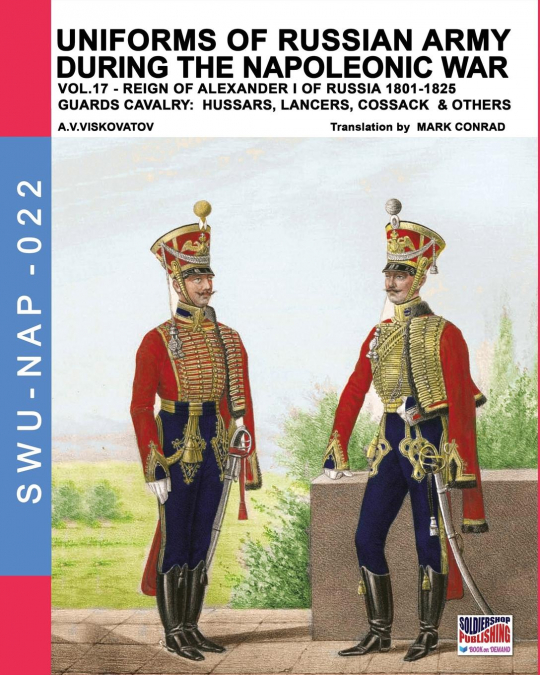
  • Uniforms of Russian army during the Napoleonic war vol.17
    Aleksandr Vasilevich Viskovatov / Mark Conrad
    This volume is related to the Russian Army during the zar Alexander I era, and are about the Guard cavalry regiments (part 1). Compiled at Saint Petersburg during the year from 1837 and 1851, the Historical Description of the Clothing and Arms of the Russian Army has had an enormous impact and great importance for the study on the history of Russian costume and uniformology dev...
    Disponible

    40,78 €

  • Cyber Warfare and Cyber Terrorism
    ...
  • Armed Robotic Systems Emergence
    Robert j. Bunker / Robert jBunker
    The fielding of armed robotic systems--droids and drones that are teleoperated, semi-autonomous, and even autonomous--has been slowly but surely transitioning from pure science fiction into military reality on the battlefields of the early 21st century. These systems currently have no artificial intelligence (AI) whatsoever and, in most cases, are simply operated by soldiers (a...
    Disponible

    8,64 €

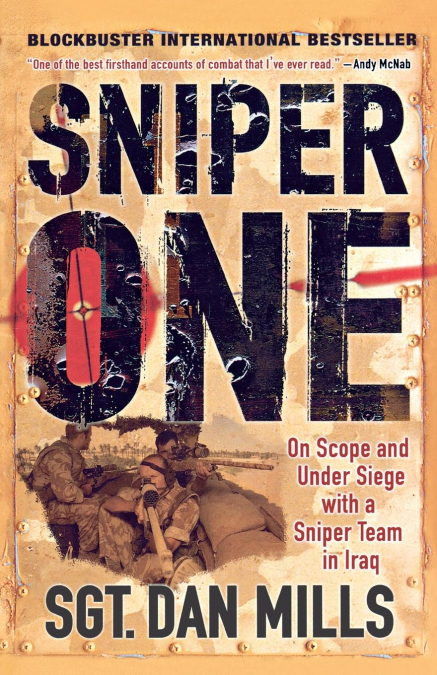
  • SNIPER ONE
    DAN MILLS
    ...
    Disponible

    18,71 €

Otros libros del autor

  • The Siege of Syracuse 414-413 B.C.
    Antonios athenaeus
    The Siege of Syracuse was the campaign that destroyed one of the greatest military expeditions ever launched by Athens.In 415 B.C., at the height of the Peloponnesian War, Athens dispatched an immense armada to Sicily. What began as an ambitious attempt to expand Athenian power soon became a two-year struggle for Syracuse, the most powerful Greek city in Sicily. By 413 B.C., th...
    Disponible

    23,19 €

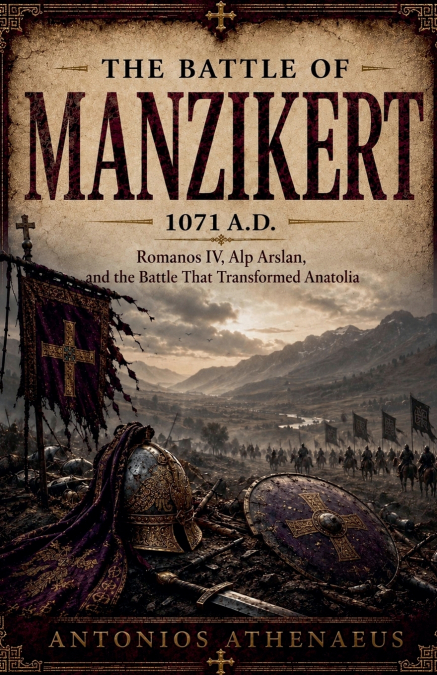
  • The Battle of Manzikert 1071 A.D.
    Antonios athenaeus
    At Manzikert, the struggle for the eastern frontier became a crisis that would transform the future of Byzantium.In 1071 A.D., Emperor Romanos IV Diogenes led a major imperial army across Anatolia to recover Manzikert and Khliat and restore Byzantine control near Lake Van. While Romanos advanced from the west, the Seljuk sultan Alp Arslan abandoned his campaign in Syria and mov...
    Disponible

    23,28 €

  • The Battle of Megalopolis 331 B.C.
    Antonios athenaeus
    The Battle of Megalopolis was Sparta’s last great attempt to break Macedonian supremacy in Greece.In 331 B.C., while Alexander the Great was campaigning deep within the Persian Empire, King Agis III of Sparta launched a major revolt against Macedonian rule. After years of preparation and diplomacy, Agis gathered Spartan, Peloponnesian, and mercenary forces to challenge the poli...
    Disponible

    23,29 €

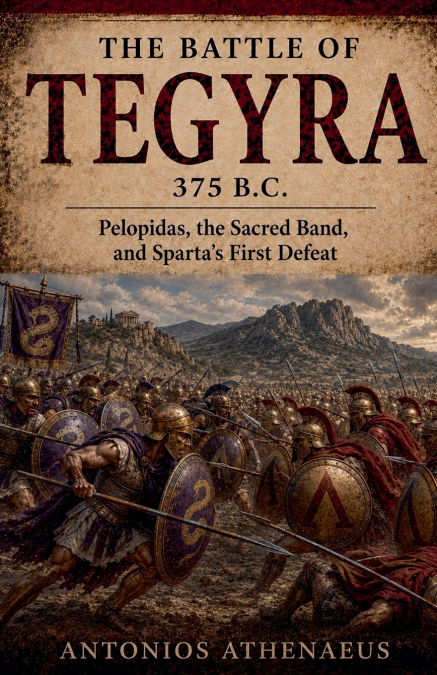
  • The Battle of Tegyra 375 B.C.
    Antonios athenaeus
    The Battle of Tegyra marked the first open-field defeat of a Spartan army by a smaller Greek force.In 375 B.C., only four years before the decisive Battle of Leuctra, Pelopidas led a small Theban force against Orchomenus, hoping to exploit the temporary absence of its Spartan garrison. Forced to abandon the operation after learning that reinforcements had already entered the ci...
    Disponible

    23,28 €

  • The Battle of Nineveh 627 A.D.
    Antonios athenaeus
    At Nineveh, the fate of the Sasanian Empire-and the survival of the Eastern Roman Empire-was decided.In 627 A.D., Emperor Heraclius led one of the most daring campaigns of Late Antiquity deep into the heart of the Sasanian Empire. Refusing to remain on the defensive after years of devastating Persian invasions, he carried the war across Armenia into northern Mesopotamia, forcin...
    Disponible

    22,71 €

  • The Battle of Coronea 394 B.C.
    Antonios athenaeus
    The Battle of Coronea marked the moment Sparta preserved its supremacy against the greatest challenge of the Corinthian War.In 394 B.C., only weeks after the Battle of Nemea, King Agesilaus II returned from his victorious campaign in Asia Minor to confront the growing anti-Spartan coalition in Boeotia. Determined to prevent his enemies from uniting their full strength, he march...
    Disponible

    23,08 €