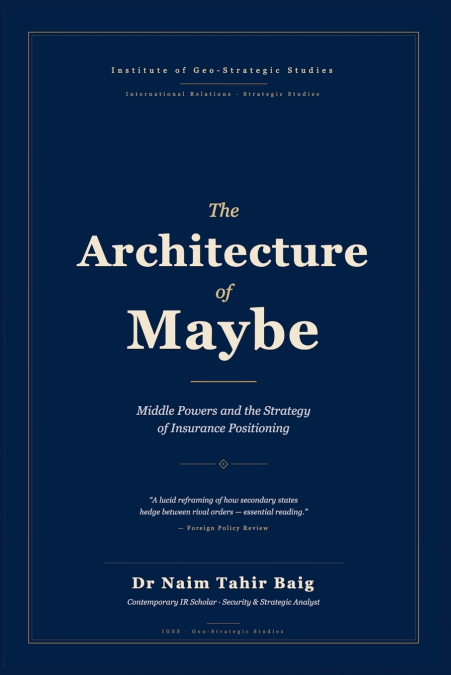

The Architecture of Maybe

The Architecture of Maybe

Naim Tahir Baig

67,61 €
IVA incluido
Disponible
Editorial:
Institute of Geo-Strategic Studies
Año de edición:
2026
Materia
Relaciones internacionales
ISBN:
9798235940253
67,61 €
IVA incluido
Disponible

Selecciona una librería:

  • Librería Samer Atenea

  • Kálamo Books
  • Librería Elías (Asturias)
  • Librería Kolima (Madrid)
  • Librería Proteo (Málaga)

Book DescriptionThe Architecture of MaybeInsurance Positioning and the Middle-Power Equilibrium of the Twenty-First CenturyDr Naim Tahir BaigAbout the BookIn the second half of the 2020s, a striking pattern has emerged across the international system. Six structurally dissimilar states - South Korea, Turkey, Saudi Arabia, the United Arab Emirates, Vietnam, and Poland - have converged on the same foreign-policy playbook in the same five-year window. None of them coordinated. None of them share regime type, region, capability tier, or ideological framework. And yet all of them are doing the same thing: building deliberate, asymmetric portfolios that distribute security commitments toward one superpower and economic commitments toward the other, sustained through bureaucratic continuity or carefully constructed national-identity narratives, and managed across leadership transitions through institutional rather than personal mechanisms.Drawing on contemporary international relations theory, country-level empirical research across three regions, and original primary-source analysis through May 2026, Dr Naim Tahir Baig argues that what the academic literature has called hedging and what diplomats have more privately called insurance has matured, in this period, into a structurally rational equilibrium strategy that the dominant predictions of structural realism did not anticipate.The book introduces the concept of insurance positioning - a refinement and extension of Cheng-Chwee Kuik’s small-state hedging framework - specified through four formal elements: domain separation, asymmetric depth, bounded transgression, and capacity investment at the seam. Each element is given observable indicators, falsification conditions, and operational thresholds. The framework is then tested across the six primary cases, against three negative cases (Indonesia, Brazil, and South Africa) that face the structural condition but lack the requisite state capacity, and through a formal falsification test on India that predicts its emerging trajectory toward full membership in the class.The book’s central diagnosis is structural. The international system in the 2020s is characterized by a bipolar core nested within a multipolar periphery - a configuration in which two superpowers dominate compute, finance, naval reach, and formal security architecture, while regional powers retain genuine but bounded agency. Neither superpower can supply, alone, the full bundle that a substantial middle power requires. The rational response to this condition is not binary alignment, as the dominant 'forced to choose' literature has predicted, but the deliberate construction of asymmetric portfolios that exploit the seam between the two great powers’ domains of monopoly.What follows is a careful empirical reconstruction of how six different states are doing this. The South Korea chapter examines Seoul’s pioneering bifurcated strategy, the THAAD episode, and the resilience of the architecture through the Yoon martial-law crisis. The Turkey chapter analyzes the S-400 episode as the canonical case of calibrated transgression and offers an explicit specification of what makes a transgression calibrated rather than reckless. The Saudi Arabia and UAE chapter compares two operationally distinct Gulf variants of the same underlying logic. The Vietnam chapter treats bamboo diplomacy as the minimum-viable expression of insurance positioning. The Poland chapter shows how the strategy generalizes to an EU/NATO frontline state where the relevant competition is not US-China but US-Brussels. The five comparative chapters synthesize a common playbook across the six cases.

Artículos relacionados

  • Realism in Practice
    The purpose of this book is to appraise the current relevance and validity of realism as an interpretative tool in contemporary International Relations. All chapters of the book are animated by a theoretical effort to define the conceptual aspects of realism and attempt to establish whether the tradition still provides the necessary conceptual tools to scholars.The chapters add...
    Disponible

    20,36 €

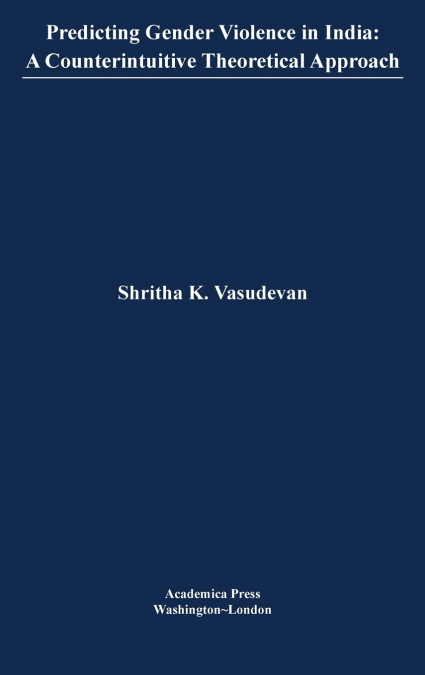
  • Predicting gender violence in India
    Shritha K Vasudevan
    In this provocative new book, Shritha Vasudevan argues that feminist international relations (IR) theory has inadvertently resulted in a biased worldview, the very opposite of what feminist IR set out to try to rectify. This book contests theoretical presumptions of Western feminist IR and attempts to reformulate it in contexts of non-Western cultures. Vasudevan deftly utilizes...
  • Contemporary security issues in Africa
    Isiaka Alani Badmus / Lere Amusan
    In volume, an emerging generation of African scholars examines specific states in Africa where instability is the order of the day. Considerations of African instability are highly relevant in today’s world, where one examines the types of regimes that were put in place after the Cold War and their effects on Africa. Multiparty systems introduced in Africa, rather than bringing...
  • Chronicles of the first and second chechen wars
    Ilya Milyukov
    Presented by Russian author and attorney Ilya Milyukov, Chronicles of the First and Second Chechen War presents the main events of the First (1994-1996) and Second (1999-2009) Wars in Chechnya, Russia’s deadliest conflicts since World War II. The First War began in December 1994 and lasted for one year and nine months, ending in August 1996. There were two major urban battles -...
  • Political instability in Africa
    Isiaka Alani Badmus / Lere Amusan
    This book offers broad-gauged analyses of the causes, nature, and changing patterns of armed conflict in Africa as well as the reasons for these patterns. It also situates conflicts that have been haunting the African continent since the time of decolonization within the various theoretical schools such as 'new war,' 'economic war,' 'neo-patrimonial,' and 'globalization.' It be...
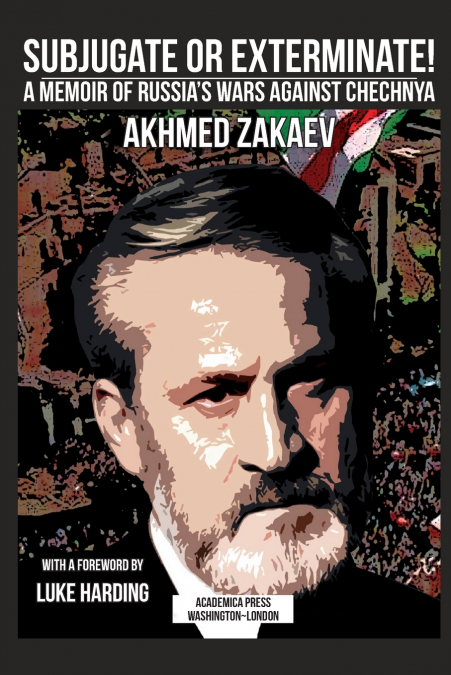
  • Subjugate or exterminate!
    Akhmed Zakaev / Arch Tait
    Foreword by Luke HardingAkhmed Zakaev is a symbol of the indomitable will of the Chechen nation. In this important memoir, he tells the story of the Chechen struggle as he experienced it, describing the conflict in human terms and providing a detailed documentary record of little known or badly understood events that will be of benefit to historians for generations to come.- Da...
    Disponible

    41,63 €

Otros libros del autor

  • The Orbit After Ambiguity
    Naim Tahir Baig
    SPACE SECURITY & ARMS CONTROLThe Orbit After AmbiguityHow the US Admitted It Has Weapons in SpaceThe first narrative account of what changed when the United States stopped keeping its space weapons secret.On September 14, 2026, the Secretary of the Air Force told a Washington audience that the United States 'has on-orbit space control weapons capable of defending the joint forc...
    Disponible

    73,95 €

  • The Stilwell Bypass
    Naim Tahir Baig
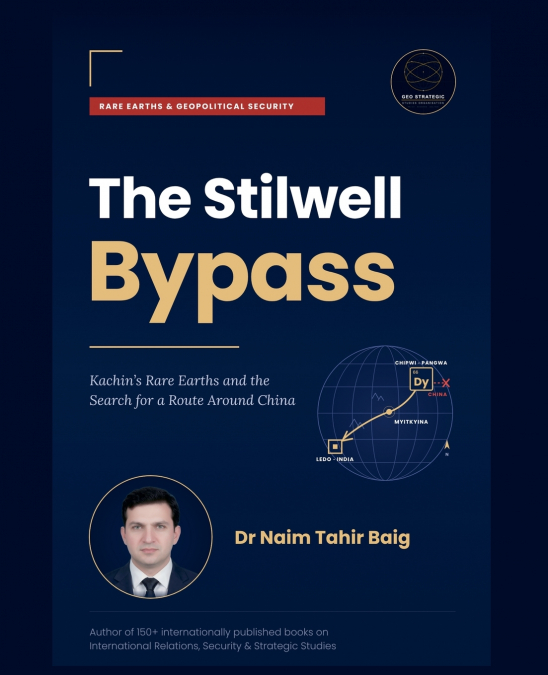
    In 1942 the United States Army pushed a road out of Ledo, in Assam, toward China. More than eighty years later, a question hangs over the same ground: could a different cargo travel part of that route, heavy rare earths dug from the clay hills of Kachin State in northern Myanmar and carried not east into China, as they are now, but west, toward India and toward separation plant...
    Disponible

    74,68 €

  • Extinction by Extraction?
    Naim Tahir Baig
    What we choose when we choose our mineralsEvery wind turbine, electric vehicle, guided missile and smartphone depends on a group of metals most people have never heard of. Rare earth elements make the modern world’s energy, defense and computing systems possible. They also come from some of the most toxic, concentrated and politically contested supply chains on Earth.Extinction...
    Disponible

    73,62 €

  • Theory in the Interregnum
    Naim Tahir Baig
    Theory in the InterregnumWhich International Relations Theory Explains What in a World of Fraying RulesBy Naim Tahir BaigThe liberal international order is fraying, and every school of International Relations claims to have seen it coming. Theory in the Interregnum asks a sharper question: which theory explains what? Dr Naim Tahir Baig argues that no new grand theory has displa...
    Disponible

    70,52 €

  • Rules of the Strong, Rules of the Many
    Naim Tahir Baig
    Rules of the Strong, Rules of the ManyAuthorship, Membership and the Ratchet of International Norms from Antiquity to the PresentBy Dr Naim Tahir BaigWho writes the rules of international order, and who do those rules protect? Rules of the Strong, Rules of the Many argues that international norms move in two rhythms at once. Authorship, meaning who writes and interprets the rul...
    Disponible

    75,59 €

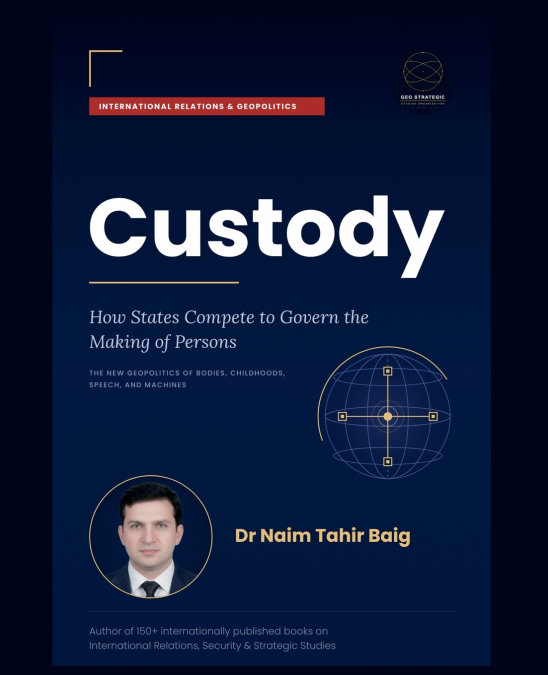
  • Custody
    Naim Tahir Baig
    CustodyHow States Compete to Govern the Making of PersonsBy Dr Naim Tahir Baig States everywhere are claiming a new kind of authority: the right to act as guardian over how their citizens are formed. A South Korean subsidy to raise the birth rate, an Australian ban on social media for under-16s, a Brazilian court order against a platform and a Chinese rule for generative AI loo...
    Disponible

    75,54 €