
Inicio > Humanidades > Historia > The Archaeological Impact of the late-19th and early-20th century fossils diggings in Southern England
The Archaeological Impact of the late-19th and early-20th century fossils diggings in Southern England

The Archaeological Impact of the late-19th and early-20th century fossils diggings in Southern England

Bernard O’Connor

14,96 €
IVA incluido
Disponible
Editorial:
Lulu Press
Año de edición:
2021
Materia
Historia
ISBN:
9781716179297
14,96 €
IVA incluido
Disponible

Selecciona una librería:

  • Librería Samer Atenea
  • Librería Aciertas (Toledo)
  • Kálamo Books
  • Librería Perelló (Valencia)
  • Librería Elías (Asturias)
  • Donde los libros
  • Librería Kolima (Madrid)
  • Librería Proteo (Málaga)

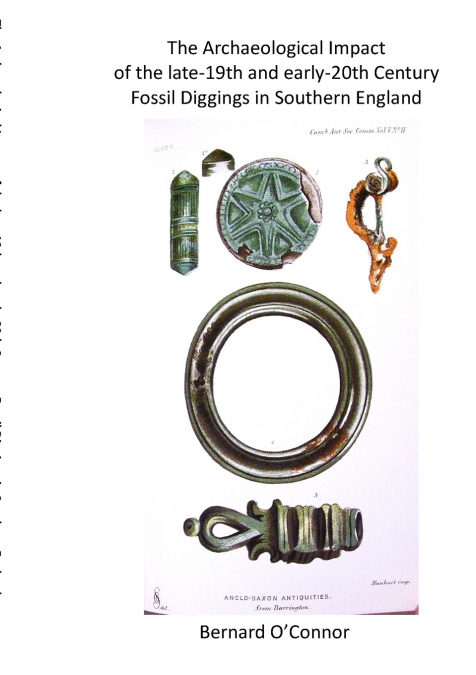
Following a cliff collapse in Felixstowe in 1842 that revealed of fossils deposit which Charles Darwin’s Cambridge tutor thought resembled prehistoric droppings, a new industry developed to exploit them. Rev. John Henslow thought they were coprolites, fossilised dinosaur dung, similar to those discovered at Lyme Regis. As animal and human droppings were being used as a manure on the fields, chemical analysis of the Felixstowe fossils showed them to be rich in phosphate, a mineral essential for plant growth, Suffolk manure manufacturers bought these fossils, ground them to a powder and dissolved them in sulphuric acid to make superphosphate, the world’s first artificial chemical manure. It was a lucrative business and demand for the Suffolk fossils increased.When a similar bed was found in Burwell was tested and found to have a higher phosphate content, the industry spread to Cambridgeshire, expanded into Hertfordshire, Bedfordshire, Buckinghamshire and Oxfordshire. Manure manufacturers across the country wanted coprolites.Open cast mining in pits down to 60 feet in places led to tens of thousands of acres being dug. During these operations, the ’coprolite’ diggers uncovered numerous articles of archaeological interest, mostly grave sites but also hidden hoards. Some diggers ’pocketed’ the finds and sold them on the market as there was a huge interest amongst Victorian archaeologists and antiquarians. Sometimes the landowner claimed the finds and kept them in their drawing room cabinet. Professors and students of archaeology were interested in the finds and published academic papers in their journals. Whilst some finds were donated to the country’s new University museums, others were purchased by their curators. One digger made enough from selling his ’finds’ to buy himself a pub.Bernard O’Connor, who has researched the geological, historical, economic and social impact of the fossil diggings, has compiled accounts of the archaeological discoveries across Southern England, illustrating them with images from contemporary journals.

Artículos relacionados

  • Raising Freedom's Banner
    Paul Harris
    World wide history of peaceful street demonstrations from their earliest beginning in eighteenth century England to their use throughout the world in the twenty-first century. Describes why some demonstration movements succeeded and others failed. Contrasts demonstrations within the law with civil disobedience demonstrations. Describes Peterloo, the Chartists, the Suffragettes,...
    Disponible

    23,59 €

  • Waipi’o Valley
    Jeffrey L. Gross
    Waipi’o Valley: A Polynesian Journey from Eden to Eden recounts the remarkable migrations of the Polynesians across a third of the circumference of the earth. Their amazing journey began from Kalana i Hau’ola, the biblical “Garden of Eden” located along the shore of the Persian Gulf, extended to the Indus River Valley of ancient Vedic India, to Egypt where some ancestors of the...
  • Floralia
    June Rainsford Butler
    A century characterized by a growing interest in science, the opportunity for travel, and leisure for gardening furnishes the setting for Butler’s book. The rise of landscape gardening in England is traced, and the origin and history of its most famous gardens are given. The close relation between England and America in the field of horticulture is also discussed.Originally pub...
    Disponible

    61,20 €

  • President Wilson’s Addresses
    Woodrow Wilson
    'These addresses of President Woodrow Wilson are almost entirely concerned with political affairs, and more specifically with defining Americanism. Yet they also show that even as he moved from academia to the heights of politics, Wilson retained something of the teacher’s interest in showing the relation between specific instances and the general forms of thought or action of ...
  • The Story of my Life
    John Albert Macy
    The Story of My Life, is Helen Keller’s autobiography detailing her early life, especially her experiences with Anne Sullivan. The book is dedicated to inventor Alexander Graham Bell. The dedication reads, 'To ALEXANDER GRAHAM BELL Who has taught the deaf to speak and enabled the listening ear to hear speech from the Atlantic to the Rockies, I dedicate this Story of My Life.' ...
  • The Story of My Life Vol. 6 Spanish Passions
    Giacomo Casanova
    Casanova was an Italian adventurer and author from the Republic of Venice. His autobiography, Histoire de ma vie (Story of My Life), is regarded as one of the most authentic sources of the customs and norms of European social life during the 18th century. He has become so famous for his often complicated and elaborate affairs with women that his name is now synonymous with 'wom...

Otros libros del autor

  • Resisting Vengeance
    Bernard O’Connor
    This documentary history provides a detailed overview of Allied intelligence efforts during World War II, focusing heavily on gathering information about Germany’s V-weapon program, specifically the V-1 flying bomb and V-2 rocket. The sources describe the broad methods of British intelligence, including diplomatic and military intelligence gathering, as well as covert operation...
    Disponible

    39,69 €

  • Resistance in the Nantes area before and after D-Day
    Bernard O’Connor
    This documentary history provides an extensive overview of Secret Intelligence Service and Special Operations Executive (SOE) activities in Nantes and German-occupied Northwest France during World War II, primarily focusing on agent recruitment, training, deployment, and operational challenges. The collection highlights the experiences of agents like Jean-Baptiste Legeay, Edwar...
    Disponible

    46,07 €

  • British Intelligence on the Breton Nationalists, the Abwehr and the Sicherheitdiest in France during the Second World War
    Bernard O’Connor
    This compilation of British intelligence documents, primarily from MI5 and MI6, offers a detailed look into the espionage and counter-espionage efforts during the Second World War, specifically concerning Breton Nationalists aligned with Germany. The records focus on the interrogations of Patrick Guerin and Guy Vissault de Coetlogon, both recruited by the German Abwehr and Sich...
    Disponible

    37,28 €

  • The CLAM Mission
    Bernard O’Connor
    Allied intelligence services, including Britain’s Secret Intelligence Service (SIS/MI6) and Special Operations Executive (SOE), collaborated extensively with France’s Bureau Central de Renseignements et d’Action (BCRA) to conduct critical sabotage operations in occupied France. This collaboration involved shared training facilities and coordinated missions.Agents like Pierre Bo...
    Disponible

    21,05 €

  • Marcel Baudrou and Lucie Quesnel
    Bernard O’Connor
    In late August 1944, a French couple residing in St. Brieuc, Brittany, were reported by local residents for occupying a house requisitioned by the Germans. Marcel Baudrou informed a local resistance leader that he possessed a wireless set belonging to the Germans and was willing to allow the Allies to use him to transmit false messages.Following questioning by French police, Am...
    Disponible

    24,81 €

  • CORA 104 and 134
    Bernard O’Connor
    .On 11 November 1944 two Italian men were stopped by American soldiers walking on the road from Modena to Pistoia, a city in Tuscany. They gave their names as Federico Ponti and Carlo Bianchini. As American and British Security Officers had already learned from Italians that the German Intelligence Service had stay-behind networks in most North Italian cities, they were on the ...
    Disponible

    17,45 €