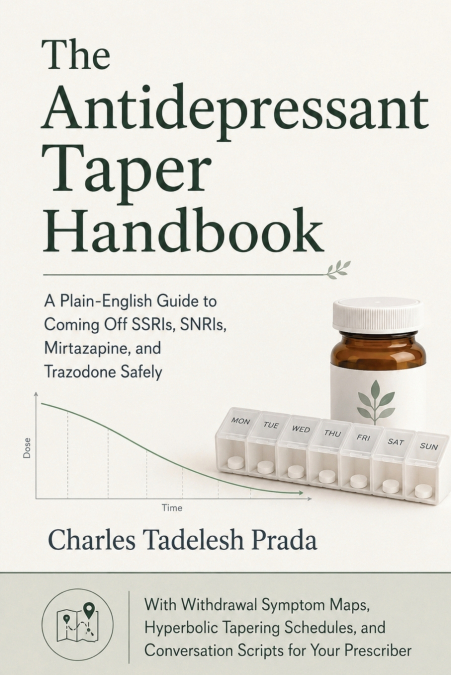

The Antidepressant Taper Handbook

The Antidepressant Taper Handbook

Charles Tadelesh Prada

16,97 €
IVA incluido
Disponible
Editorial:
Staten House
Año de edición:
2026
ISBN:
9798905991936
16,97 €
IVA incluido
Disponible

Selecciona una librería:

  • Librería Samer Atenea
  • Kálamo Books
  • Librería Elías (Asturias)
  • Librería Kolima (Madrid)
  • Librería Proteo (Málaga)

Standard tapering advice was drawn up before the science caught up The advice most patients still receive on how to come off an antidepressant (halve the dose for two weeks, then stop) was written before researchers understood what happens at low doses. For a large number of long-term users, it does not work, and the withdrawal that follows is often mistaken for the return of the original condition. What this book offers The Antidepressant Taper Handbook is a plain-English guide to coming off SSRIs, SNRIs, mirtazapine, and trazodone at a pace the nervous system can absorb. It explains the pharmacology in language a non-specialist can follow, gives drug-specific tapering schedules based on the current hyperbolic framework, maps the withdrawal symptoms that can appear, and walks readers through the decisions that arise along the way. Why this book is different Written by a registered mental health practitioner, this handbook focuses on the practical work of tapering rather than on the argument for or against medication itself. It covers ten commonly prescribed drugs with example schedules for each: sertraline, escitalopram, citalopram, fluoxetine, paroxetine, venlafaxine, duloxetine, desvenlafaxine, mirtazapine, and trazodone. It sets out formulation strategies for reaching small doses, clear rules for when to hold, slow, or reinstate, and an honest treatment of protracted withdrawal for the minority of readers who develop it. Scripted conversations for the prescriber appointment, a symptom-tracking log, a withdrawal-versus-relapse decision aid, and a bead-counting worksheet with a venlafaxine worked example are included as practical reference tools. Who this book is for This book is for readers who are on a long-term antidepressant and want to try coming off; who have attempted a taper and found the standard advice did not work; who are supporting a partner or family member through the process; or who are clinicians looking for a patient-facing reference they can share with the people in their care. A structured guide to a difficult decision For readers who want to understand antidepressant tapering with clarity and confidence, this book provides a practical path forward, grounded in the current science and paced to what the nervous system can actually follow.

Artículos relacionados

  • Genetic, Epigenetic, Environmental, and Pharmacological Models for Neuroscience, Neurologic Diseases, and Psychiatric Disorders
    Masaru Tanaka
    The Special Issue, 'Genetic, Epigenetic, Environmental, and Pharmacological Models for Neuroscience, Neurologic Diseases, and Psychiatric Disorders: Advancement in Bench-to-Bedside Translational Research,' delves into the complexities of neurological and psychiatric disorders, which affect millions worldwide. Despite advances, the etiology and pathogenesis of these disorders re...
  • Theories in Psychiatry
    Niall McLaren
    Psychiatry has to be taken seriously. An ever-increasing proportion of the population are prescribed long-term, powerful psychiatric drugs on opinions only, with no evidence of brain pathology. People who have broken no laws can be taken from their homes, locked in cells, stripped and drugged indefinitely, leaving them no practical means of regaining their civil rights. Niall M...
  • Commemorative Issue Celebrating the 20th Anniversary of the Alzheimer’s Foundation of America
    Alzheimer’s disease (AD) is a progressive neurodegenerative disorder that affects the lives of millions of people and their families around the globe. It results in a relentless decline in cognitive function, loss of judgment, change in personality, and neuropsychiatric and behavioral symptoms. Pathologic features characteristic of AD are deposition in the brain of two types of...
  • Better Than Prozac
    Samuel H. Barondes
    ...
    Disponible

    30,42 €

  • Life with a Partner or Spouse with Asperger Syndrome (ASD)
    Kathy Marshack
    'Going Over the Edge?' is a one-of-a-kind 'Asperger Syndrome' book on the Amazon best-seller list for books on Behavioral Disorders. The Anniversary Edition is one of a five-part series of Dr. Marshack’s books, 'ASPERGER SYNDROME' & Relationships: Five Books to Help You Reclaim, Refresh, and Perhaps Save Your Life.The Anniversary edition of Dr. Marshack’s classic has been augme...
    Disponible

    24,15 €

  • Single Session Thinking and Practice in Global, Cultural, and Familial Contexts
    Single Session Thinking and Practice teaches readers how to implement single session approaches by encouraging practitioners and clients to collaborate in making the most of every encounter. ...
    Disponible

    73,92 €

Otros libros del autor

  • The Antipsychotic Patient and Family Handbook
    Charles Tadelesh Prada
    A Plain-English Handbook for Patients and Families The prescription arrives with a leaflet, and the leaflet does not answer the questions that will actually come up. Which drug was chosen, and why. What side effects to watch for. How to raise weight gain, sexual side effects, or restlessness at an appointment where the prescriber does not raise them first. What This Book Delive...
    Disponible

    16,70 €