 Librería Samer Atenea
 Kálamo Books
 Librería Elías (Asturias)
 Librería Kolima (Madrid)
 Librería Proteo (Málaga)
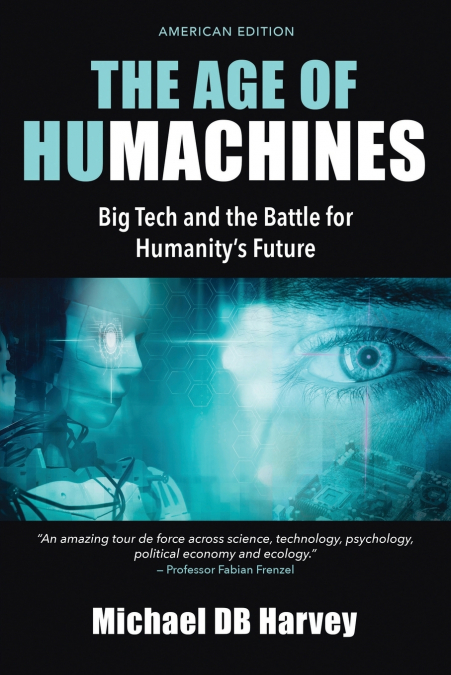
We are living through the biggest psychological experiment in human history, and almost no one agreed to it. That is the alarm Michael D.B. Harvey sounds in The Age of Humachines. Harvey, a pioneer of interactive media technology in the 1980s before becoming an existential psychotherapist and organizational psychologist, looks at the booms in AI, robotics, biotechnology, and genetics and sees a single coordinated project he calls 'humachination.' Led by a cabal of powerful computer-scientist billionaires, it aims to humanize machines and mechanize humans until the line between them disappears. And Big Tech is selling the whole thing as the answer to every human problem, promising to automate our troubles away. Harvey calls that sales pitch 'tricknology,' and he shows how it props up an economy that cannot survive without endless growth on a finite planet. Treating humanity as an organization making choices about its future, Harvey asks who is really steering, and whether the founders in charge are the good actors they claim to be. He examines machines that make our decisions, deliver our care, fight our wars, and re-engineer the human brain, body, and genome, raising the specter of designer children and a genetically divided species. For readers of Shoshana Zuboff, Naomi Klein, and Jason Hickel, this is tech criticism with an ecological and psychological backbone. And unlike many warnings, it offers a way out. With a foreword by ecologist David W. Orr, Harvey closes by mapping the Ecocene, an ecological democracy built on degrowth, a steady state economy, and cooperation over competition. 6