

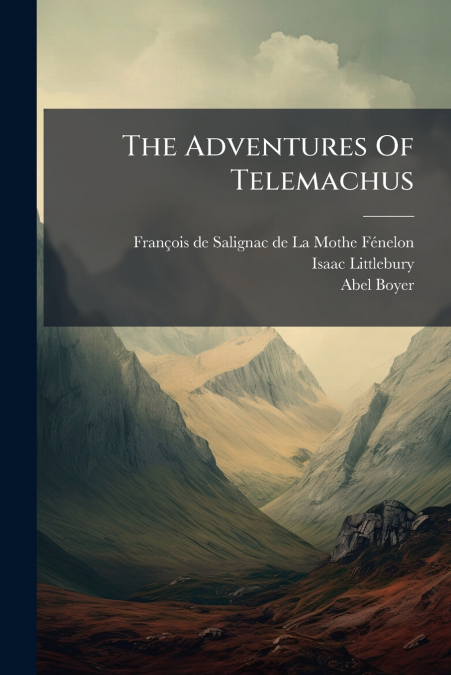
Abel Boyer / Isaac Littlebury / François de Salignac de la Mothe Fénel
 Librería Samer Atenea
 Kálamo Books
 Librería Elías (Asturias)
 Librería Kolima (Madrid)
 Librería Proteo (Málaga)
'The Adventures of Telemachus' by François de Salignac de La Mothe Fénelon, translated by Isaac Littlebury and Abel Boyer, is a timeless classic that reimagines and expands upon the world of Homer’s Odyssey. The story follows Telemachus, the son of Ulysses, on his epic journey in search of his long-lost father. Guided by the wise Mentor, who is actually the goddess Minerva in disguise, Telemachus navigates treacherous seas, encounters mythical creatures, and faces moral dilemmas that test his courage and virtue.More than just an adventure story, 'The Adventures of Telemachus' is a profound exploration of kingship, justice, and the education of a prince. Fénelon uses the narrative to critique the excesses of the French court and to advocate for a more enlightened and virtuous rule. With its rich prose, vivid imagery, and enduring themes, this book offers both a thrilling journey and a thought-provoking reflection on the nature of power and the importance of moral leadership.This work has been selected by scholars as being culturally important, and is part of the knowledge base of civilization as we know it. This work was reproduced from the original artifact, and remains as true to the original work as possible. Therefore, you will see the original copyright references, library stamps (as most of these works have been housed in our most important libraries around the world), and other notations in the work.This work is in the public domain in the United States of America, and possibly other nations. Within the United States, you may freely copy and distribute this work, as no entity (individual or corporate) has a copyright on the body of the work.As a reproduction of a historical artifact, this work may contain missing or blurred pages, poor pictures, errant marks, etc. Scholars believe, and we concur, that this work is important enough to be preserved, reproduced, and made generally available to the public. We appreciate your support of the preservation process, and thank you for being an important part of keeping this knowledge alive and relevant.





