 Librería Samer Atenea
 Kálamo Books
 Librería Elías (Asturias)
 Librería Kolima (Madrid)
 Librería Proteo (Málaga)
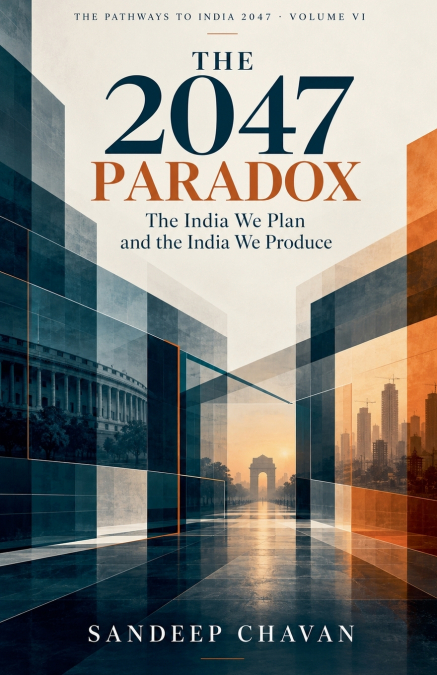
What if India achieves everything it plans for 2047-and becomes something it never intended?India is preparing for an extraordinary national transformation. Greater prosperity, advanced technologies, stronger industries, modern infrastructure, improved institutions, and expanded opportunities form the foundation of its ambitions for the centenary of independence.But an important question remains largely unexplored.What kind of society will emerge from the combined consequences of these achievements?A country can succeed in education, employment, technological development, infrastructure, and economic growth while encountering unexpected consequences when these systems interact.An institution may achieve its targets without resolving the wider problem it was established to address. Technological connectivity may expand faster than meaningful cooperation. Economic prosperity may provide greater freedom while creating new expectations and dependencies. Private services may become increasingly sophisticated while shared institutional capabilities develop at a different pace.None of these possibilities makes progress undesirable. But they challenge the assumption that successful developments automatically combine into a successful society.In The 2047 Paradox, independent researcher and author Sandeep Chavan examines the distance between national intentions and the social reality those intentions may produce.Moving beyond conventional development forecasts, the book investigates how India’s changing economic, technological, institutional, and social environments may influence the people and society emerging by 2047.Across fourteen chapters, it explores:Why success can change the meaning of success itself.How education, family, identity, attention, and urban environments shape everyday life.Why individual systems can meet their targets while collective difficulties remain unresolved.How technological capability can expand without equally effective arrangements for responsibility and correction.Why some costs of development travel beyond the institutions that report its benefits.Whether India could become a commercially sophisticated 'supermarket society' offering extraordinary private choices alongside uneven shared capabilities.The investigation culminates in four conditional versions of India that could emerge by 2047: a country where prosperity and shared capability reinforce one another; a supermarket society; an archipelago of exceptional achievements with uneven connections to the wider economy; and an India capable of recognizing and correcting the contradictions produced by its own development.These are not predictions. They are possibilities to be examined through evidence, assumptions, emerging signals, and alternative explanations.The book also includes practical appendices featuring a Paradox Test, an India 2047 Evidence Dashboard, a framework for examining conditional futures, research methodology, and essential analytical concepts.Written for thoughtful general readers, professionals, educators, researchers, executives, policymakers, and everyone interested in India’s future, The 2047 Paradox offers a serious but accessible examination of development beyond conventional success and failure narratives.It is neither a criticism of India’s ambition nor an assurance that every ambition will succeed.It is an invitation to examine what those ambitions may produce when millions of individual decisions, institutions, markets, and technologies begin interacting.Because the India we plan and the India we produce may not be the same.