Inicio > Humanidades > Filosofía > Tesoro castellano del primer diccionario de América
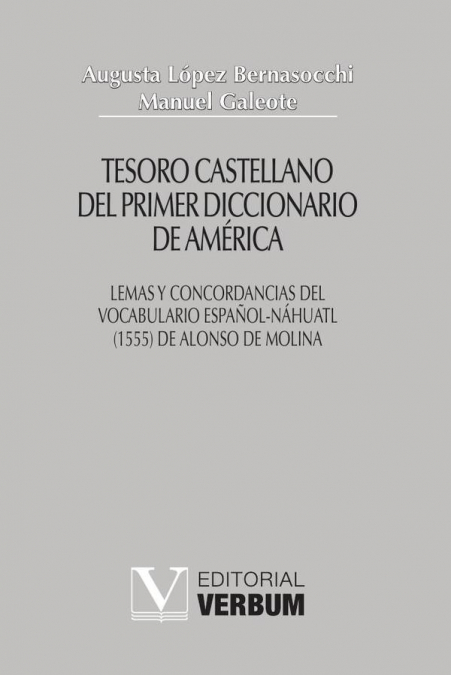
Tesoro castellano del primer diccionario de América

Tesoro castellano del primer diccionario de América

Augusta López Bernasocchi / Manuel Galeote

35,00 €
IVA incluido
Disponible
Editorial:
Editorial Verbum (PA)
Año de edición:
2010
Materia
Filosofía
ISBN:
9788479624859
35,00 €
IVA incluido
Disponible

Selecciona una librería:

  • Librería Samer Atenea
  • Librería Aciertas (Toledo)
  • Kálamo Books
  • Librería Perelló (Valencia)
  • Librería Elías (Asturias)
  • Donde los libros
  • Librería Kolima (Madrid)
  • Librería Proteo (Málaga)

Fray Alonso de Molina ocupa un lugar de honor en la Lingüística Misionera de tradición hispánica por confeccionar el diccionario bilingüe, que da origen al Tesoro que el lector tiene entre manos. Su Vocabulario castellano-náhuatl (1555) –un “incunable americano” (Menéndez Pidal)– fue “vocabulario de urgencia” para la comunicación de religiosos e indígenas y testimonio de las preocupaciones renacentistas por la lengua, incluso fuera del Viejo Continente. Como un Nebrija de las Indias, Molina completó la labor de sus maestros Olmos y Sahagún.Culminó un Arte de la lengua mexicana y tres diccionarios (castellano-náhuatl y náhuatl-castellano de 1555 y 1571) nunca superados ni superables.La presente recopilación, lematizada y con las concordancias del vocabulario castellano contribuye al conocimiento minucioso del olvidado diccionario, que estableció las equivalencias entre el caudal léxico del español que arribó al Nuevo Mundo y el vocabulario de una lengua indoamericana que jamás había conocido la ortografía. En consecuencia, este Tesoro está llamado a convertirse en fuente historicolingüística para revisar los diccionarios etimológicos y completar el anhelado Diccionario histórico del español, justo cuando se cumplen quinientos años del nacimiento de Molina (1510-2010). La metodología, los datos y el esfuerzo editorial que subyace en estas páginas brindan una potente herramienta, que enriquecerá el corpus documental para la Historia de la Lengua Española en América, desde una perspectiva histórica y etimológica.
Artículos relacionados

  • Introduction to a Future Way of Thought
    Kostas Axelos / Kenneth Mills
    'Technologists only change the world in various ways in generalized indifference; the point is to think the world and interpret the changes in its unfathomability, to perceive and experience the difference binding being to the nothing.'Anticipating the age of planetary technology Kostas Axelos, a Greek-French philosopher, approaches the technological question in this book, firs...
    Disponible

    18,58 €

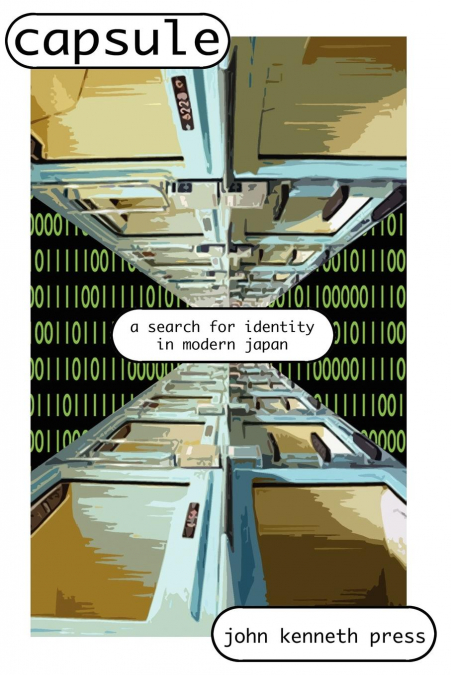
  • Capsule
    John Kenneth Press
    Join John and Adam as they wander the mean streets of Japan on a psychedelic fueled search for identity. While fun for the average reader, this book could also serve as a philosphy textbook because of its ordered exploration of sources of identity. Ultimately this trip through nationalist attacks, sex, and drugs, will take you to a better understanding of yourself and your pl...
    Disponible

    11,51 €

  • If you look at it long enough...
    Paul Hallam
    Originally written for an academic journal, If you look at it long enough... is primarily a personal account of Paul Hallam’s recollections of “self-abuse” through the consumption of porn over several decades. Challenging the familiar form of an “academic essay,” this autobiographical narrative raises several questions in relation to our contemporary morals related to sex in ge...
    Disponible

    11,30 €

  • The Teachers of Gurdjieff
    Rafael Lafort / Rafael Lefort
    When The Teachers of Gurdjieff was first published more than 50 years ago, it made a considerable stir. George Ivanovich Gurdjieff had been one of the most famous mystics in the West in the first half of the 20th century - a teaching master who had many fashionable and influential pupils. He had a striking appearance and manner of teaching, and his teaching proved to be very in...
    Disponible

    20,45 €

  • Manifesto of the Communist Party
    Karl Marx
    The Communist Manifesto was first published on February 21, and it is one of the world’s most influential political tracts. Commissioned by the Communist League and written by communist theorists Karl Marx and Friedrich Engels, it laid out the League’s purposes and program. The Manifesto suggested a course of action for a proletarian (working class) revolution to overthrow the ...
  • The Art of Literature
    Arthur Schopenhauer
    Collected here are eight short essays, On Authorship, On Style, On the Study of Latin, On Men of Learning, On Thinking for Ones Self, On Criticism, On Reputation, On Genius, by the world renowned philosopher Arthur Achopenhauer. ...