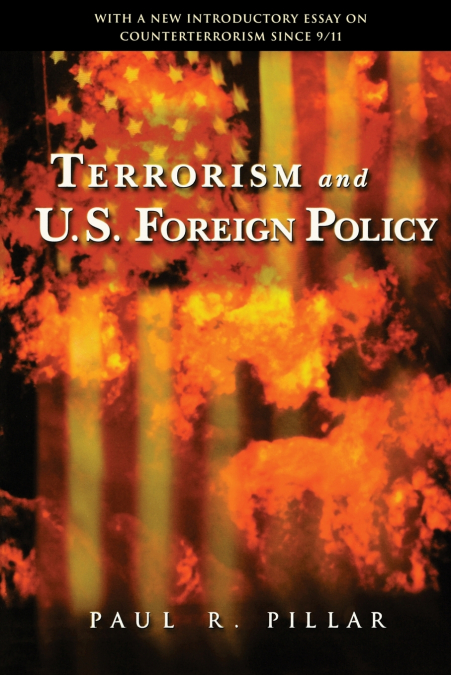

Terrorism and U.S. Foreign Policy

Terrorism and U.S. Foreign Policy

Paul R. Pillar

33,99 €
IVA incluido
Disponible
Editorial:
Bloomsbury Publishing plc
Año de edición:
2003
Materia
Terrorismo, lucha armada
ISBN:
9780815770770
33,99 €
IVA incluido
Disponible

Selecciona una librería:

  • Librería Samer Atenea
  • Librería Aciertas (Toledo)
  • Kálamo Books
  • Librería Perelló (Valencia)
  • Librería Elías (Asturias)
  • Donde los libros
  • Librería Kolima (Madrid)
  • Librería Proteo (Málaga)

'The United States government-backed by the overwhelming support of the American public-takes a hard line against international terrorism. The tenets of official U.S. counterterrorist policy are: make no concessions or deals with terrorists; bring them to justice for their crimes; isolate and apply pressure on states that sponsor terrorism; and bolster the counterterrorist capabilities of countries willing to work with the United States. While these tenets are sound principles, their application, specifically overseas, raises difficult questions. Does the ''no deal'' policy actually deter terrorists acts? Are there cases where agreements might reduce terrorism, while advancing other U.S. interests? Do isolation and pressure really force offending states to alter their support for terrorists? What factors affect the willingness, not just the capability, of foreign governments to help the United States in counterterrorism? In this critical study, a career CIA officer provides a guide to constructing and executing counterterrorist policy, urging that it be formulated as an integral part of broader U.S. foreign policy. In the first four chapters, Paul R. Pillar identifies the necessary elements of counterterrorist policy, he examines why the United States is a prime terrorist target, and he reveals why the counterterrorist policies that seem strongest are not always the most effective. Chapter 5 examines the widely varying nature of terrorist groups and the policy tools most appropriately applied to them. Chapter 6 focuses on states that sponsor terrorism (including Iran, Libya, North Korea, and Cuba), along with those that enable it to occur (particularly Greece and Pakistan). Pillar examines ways in which the American public's perspective toward terrorism can actually constrain counterterrorist policy, and he concludes that terrorism cannot be ''defeated'' only reduced, attenuated, and to some degree, controlled. The final chapter summarizes his recommendations f'
Artículos relacionados

  • The Principles of The Counter Terrorism Process
    David Gawel
    The prevailing principle of counter-terrorism is that it is now a shared responsibility of government and the community. This shift places all organisations on the front line, effectively creating a new guard of counter-terrorism professionals. This book by counter-terrorism expert Dr David Gawel APM, is a practical guide for those organisations and theiremployees who find them...
    Disponible

    26,28 €

  • Boko Haram
    Alexander Thurston
    A comprehensive history of one of the world’s deadliest jihadist groupsBoko Haram is one of the world’s deadliest jihadist groups. It has killed more than twenty thousand people and displaced more than two million in a campaign of terror that began in Nigeria but has since spread to Chad, Niger, and Cameroon. This is the first book to tell the full story of this West African af...
    Disponible

    26,25 €

  • Spying Blind
    Amy B. Zegart
    In this pathbreaking book, Amy Zegart provides the first scholarly examination of the intelligence failures that preceded September 11. Until now, those failures have been attributed largely to individual mistakes. But Zegart shows how and why the intelligence system itself left us vulnerable. Zegart argues that after the Cold War ended, the CIA and FBI failed to adapt to the ...
    Disponible

    49,87 €

  • How Terrorism Ends
    Audrey Kurth Cronin
    “A landmark study."—Robin Wright, The New YorkerWhy every terrorist movement comes to an end—and how this history can help us combat today’s terrorist threatsAmid the fear following 9/11 and more recent terror attacks, it is easy to forget the most important fact about terrorist campaigns: they always come to an end—and often far more quickly than expected. Contrary to what man...
    Disponible

    40,14 €

  • Terrorism and Homeland Security
    Matthew Lippman
    The updated edition of the textbook that offers student-friendly coverage of the major topics in terrorism studies by one of the leading scholars in the field.The years since 9/11 have witnessed a rapid rise in terrorism-related courses, programs, research centers, journals, and books. The second edition of Terrorism and Homeland Security gathers these intellectual insights and...
    Disponible

    157,23 €

  • Terrorism and Counter-Terrorism. An Africa Perspective.
    A.N.T. Eguavoen / T.A. Imobighe
    Seven Africanist scholars from the African Strategic and Peace Research Group in Nigeria here address the threat of terrorism in the context of the global strategic climate. The study is against the background of the altered shape of the global security equation, and the devalued utility of the notion of security through state-centric military preparedness. They posit that fail...
    Disponible

    72,39 €