Inicio > Matemáticas y ciencia > Matemáticas > Probabilidad y estadística > Tackling the Inverse Problem for Non-Autonomous Systems
Tackling the Inverse Problem for Non-Autonomous Systems

Tackling the Inverse Problem for Non-Autonomous Systems

Tomislav Stankovski

135,80 €
IVA incluido
Disponible
Editorial:
Springer Nature B.V.
Año de edición:
2015
Materia
Probabilidad y estadística
ISBN:
9783319032917
135,80 €
IVA incluido
Disponible

Selecciona una librería:

  • Librería Samer Atenea
  • Librería Aciertas (Toledo)
  • Kálamo Books
  • Librería Perelló (Valencia)
  • Librería Elías (Asturias)
  • Donde los libros
  • Librería Kolima (Madrid)
  • Librería Proteo (Málaga)

This thesis presents a new method for following evolving interactions between coupled oscillatory systems of the kind that abound in nature. Examples range from the subcellular level, to ecosystems, through climate dynamics, to the movements of planets and stars. Such systems mutually interact, adjusting their internal clocks, and may correspondingly move between synchronized and non-synchronized states. The thesis describes a way of using Bayesian inference to exploit the presence of random fluctuations, thus analyzing these processes in unprecedented detail. It first develops the basic theory of interacting oscillators whose frequencies are non-constant, and then applies it to the human heart and lungs as an example. Their coupling function can be used to follow with great precision the transitions into and out of synchronization. The method described has the potential to illuminate the ageing process as well as to improve diagnostics in cardiology, anesthesiology and neuroscience, and yields insights into a wide diversity of natural processes.

Artículos relacionados

  • ENGINEERING UNCERTAINTY AND RISK ANALYSIS
    Sergio E. Serrano
    An integrated coverage of probability, statistics, Monte Carlo simulation, inferential statistics, design of experiments, systems reliability, fitting random data to models, analysis of variance, stochastic processes, and stochastic differential equations for engineers and scientists. The author for first time presents an introduction to the broad field of applied engineering u...
    Disponible

    134,56 €

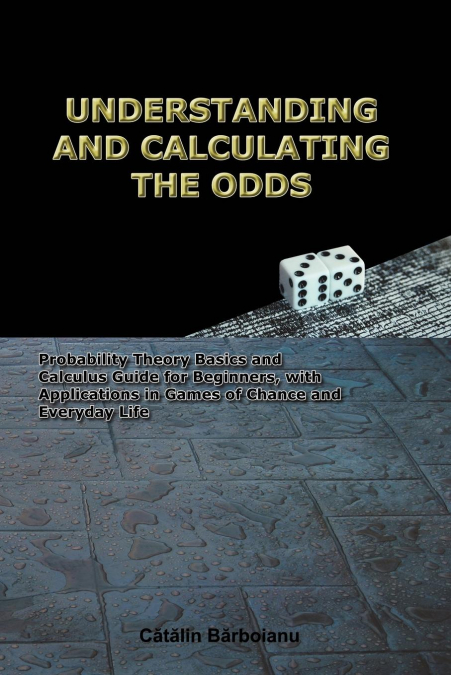
  • UNDERSTANDING AND CALCULATING THE ODDS
    Catalin Barboianu
    Man’s daily life is full of decisional situations. Whether we have math skills or not, we frequently estimate and compare probabilities, sometimes without realizing it, especially when making decisions. But probabilities are not just simple numbers attached objectively or subjectively to events, as they perhaps look, and their calculus and usage is highly predisposed to qualita...
    Disponible

    31,61 €

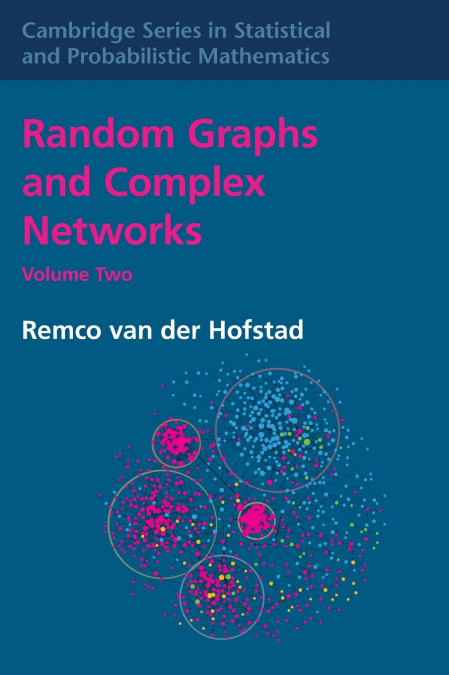
  • Random Graphs and Complex Networks
    Remco van der Hofstad
    ...
  • Introduction to Malliavin Calculus
    David Nualart / Eulalia Nualart
    ...
    Disponible

    60,35 €

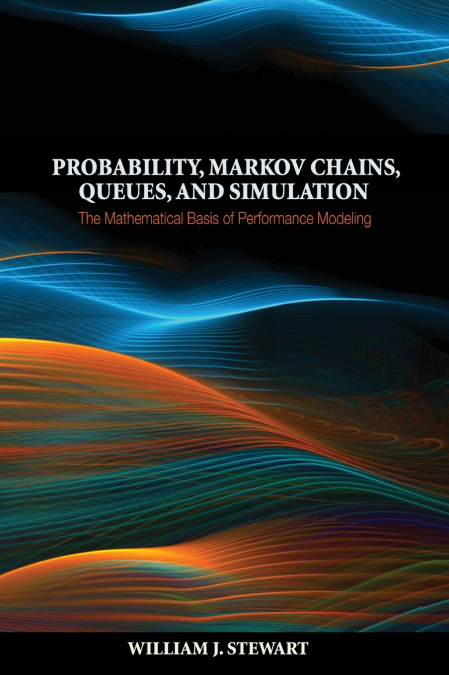
  • Probability, Markov Chains, Queues, and Simulation
    William J. Stewart
    Probability, Markov Chains, Queues, and Simulation provides a modern and authoritative treatment of the mathematical processes that underlie performance modeling. The detailed explanations of mathematical derivations and numerous illustrative examples make this textbook readily accessible to graduate and advanced undergraduate students taking courses in which stochastic process...
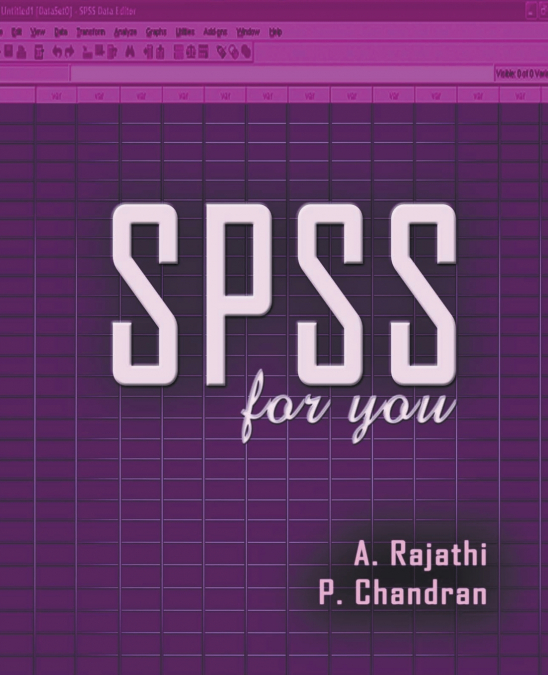
  • SPSS for you
    A. Rajathi / P. Chandran
    In an era where statistical analysis underpins breakthroughs across all fields, the importance of mastering statistical software cannot be overstated. 'SPSS for you' emerges as a pivotal resource for anyone keen to navigate the complexities of statistical analysis with ease and precision. Drawing from over 25 years of teaching experience, practical guidance in statistical analy...
    Disponible

    29,30 €

Otros libros del autor

  • Tackling the Inverse Problem for Non-Autonomous Systems
    Tomislav Stankovski
    This thesis presents a new method for following evolving interactions between coupled oscillatory systems of the kind that abound in nature. Examples range from the subcellular level, to ecosystems, through climate dynamics, to the movements of planets and stars. Such systems mutually interact, adjusting their internal clocks, and may correspondingly move between synchronized ...