 Librería Samer Atenea
 Kálamo Books
 Librería Elías (Asturias)
 Librería Kolima (Madrid)
 Librería Proteo (Málaga)
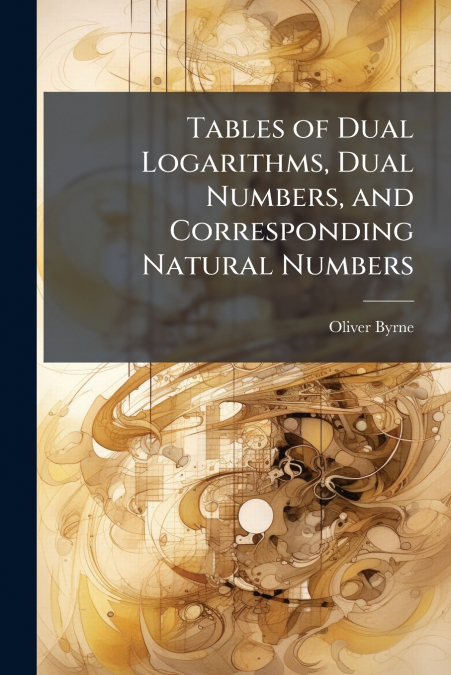
Tables of Dual Logarithms, Dual Numbers, and Corresponding Natural Numbers, by Oliver Byrne, presents meticulously calculated tables designed for advanced mathematical applications. This work, originally published in 1867, provides proportional parts of differences for single digits and extends to eight places of decimals, offering unparalleled precision for its time. Byrne’s expertise in mathematics and his dedication to accuracy are evident throughout this volume, making it an invaluable resource for scholars and practitioners in fields requiring precise logarithmic calculations. The tables facilitate complex computations involving dual numbers, essential in various scientific and engineering disciplines. This edition ensures that Byrne’s significant contribution remains accessible to modern researchers and enthusiasts, preserving a vital piece of mathematical history.This work has been selected by scholars as being culturally important, and is part of the knowledge base of civilization as we know it. This work was reproduced from the original artifact, and remains as true to the original work as possible. Therefore, you will see the original copyright references, library stamps (as most of these works have been housed in our most important libraries around the world), and other notations in the work.This work is in the public domain in the United States of America, and possibly other nations. Within the United States, you may freely copy and distribute this work, as no entity (individual or corporate) has a copyright on the body of the work.As a reproduction of a historical artifact, this work may contain missing or blurred pages, poor pictures, errant marks, etc. Scholars believe, and we concur, that this work is important enough to be preserved, reproduced, and made generally available to the public. We appreciate your support of the preservation process, and thank you for being an important part of keeping this knowledge alive and relevant.