
Surfactants

Surfactants

Bob Aveyard

137,77 €
IVA incluido
Consulta disponibilidad
Editorial:
Oxford University Press
Año de edición:
2019
Materia
Química física
ISBN:
9780198828600

Selecciona una librería:

  • Librería Samer Atenea
  • Librería Aciertas (Toledo)
  • Kálamo Books
  • Librería Perelló (Valencia)
  • Librería Elías (Asturias)
  • Donde los libros
  • Librería Kolima (Madrid)
  • Librería Proteo (Málaga)

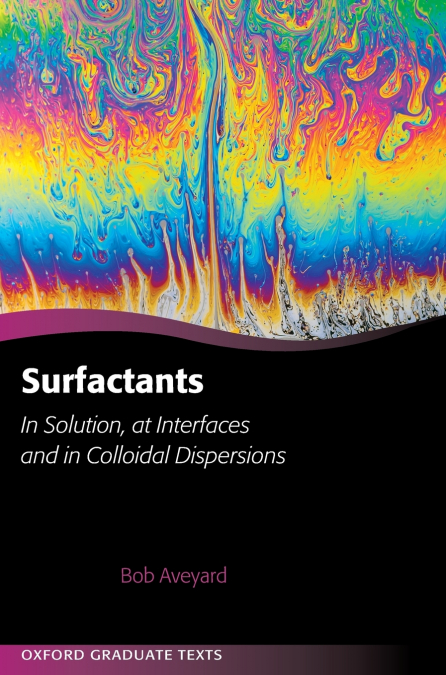
Surfactants... today you have probably eaten some, or rubbed others on your body. Plants, animals (including you) and microorganisms make them, and many everyday products (e.g. detergents, cosmetics, foodstuffs) contain them. Surfactant molecules have one part which is soluble in water and another which is not. This gives surfactant molecules two valuable properties: 1) they adsorb at surfaces (e.g. of an oil droplet in water), and 2) they stick together (aggregate) in water. The aggregates (micelles) are able to dissolve materials not soluble in water alone, and adsorbed surfactant layers, at the surfaces of particles or (say) oil droplets in water, stop the particles or drops sticking together. This is why stable emulsions such as milk do not separate into layers. This book treats the basic physical chemistry and physics underlying the behaviour of surfactant systems. In this book, you will first learn about some background material including hydrophobic hydration, interfacial tension and capillarity (Section I). Discussion of surfactant adsorption at liquid/fluid and solid/liquid interfaces is given in Section II, and includes thermodynamics of adsorption, dynamic and rheological aspects of liquid interfaces and the direct characterisation of surfactant monolayers. In Section III, a description is given of surfactant aggregation to give micelles, lyotropic liquid crystals, microemulsions and Winsor systems. There follows a discussion of surface forces and the way they confer stability on lyophobic colloids and thin liquid films (Section IV). Various dispersions stabilised by adsorbed surfactant or polymer (including solid in liquid dispersions, emulsions and foams) are considered in Section V. The wetting of solids and liquids is explored in Section VI. Like surfactants, small solid particles can adsorb at liquid/fluid interfaces, form monolayers and stabilise emulsions and foams. Such behaviour is covered in Section VII. It is assumed the reader has a knowledge of undergraduate physical chemistry, particularly chemical thermodynamics, and of simple physics. Mathematics (elementary algebra and calculus) is kept at a level consistent with the straightforward derivation of many of the equations presented.

Artículos relacionados

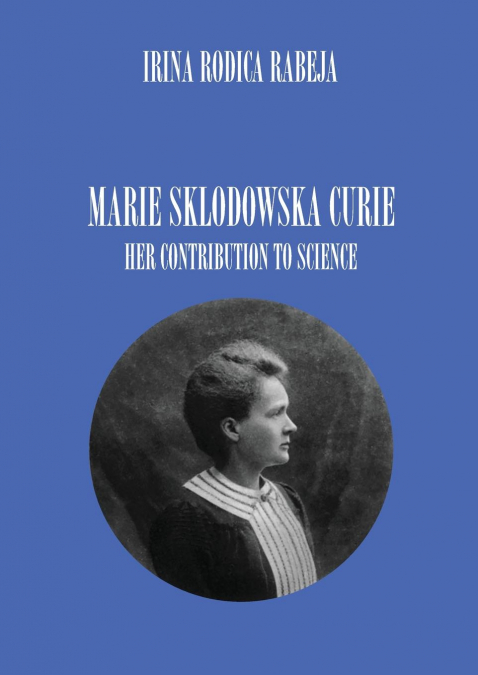
  • MARIE SKLODOWSKA CURIE
    Irina Rodica Rabeja
    Marie Sklodowska Curie (7 November 1867 – 4 July 1934) was one of the greatest scientific minds that brought a fundamental contribution in science opening the door to the understanding/knowledge of the structure of the atom in the 20th century.                 Marie Sklodowska Curie’s hypothesis that the spontaneous emission of powerful rays by some chemical elements, emission ...
    Disponible

    89,28 €

  • COMPUTER SIMULATIONS OF MOLECULES AND CONDENSED MATTER
    En-Ge Wang / LI XIN-ZHENG / Xin-Zheng Li / XIN-ZHENG LI & EN-GE WANG
    This book provides a relatively complete introduction to the methods used in computational condensed matter. A wide range of electronic structure theories are introduced, including traditional quantum chemistry methods, density functional theory, many-body perturbation theory, and more. Molecular dynamics simulations are also discussed, with extensions to enhanced sampling and ...
  • APPLIED THEORETICAL ORGANIC CHEMISTRY
    DEAN J TANTILLO / TANTILLO DEAN J
    This book provides state-of-the-art information on how studies in applied theoretical organic chemistry are conducted. It highlights the many approaches and tools available to those interested in using computational chemistry to predict and rationalize structures and reactivity of organic molecules. Chapters not only describe theoretical techniques in detail, but also describe ...
  • ELECTROANALYTICAL METHODS
    S Rani
    'Electroanalytical Methods' is a pivotal text that offers a comprehensive exploration of electrochemistry and its numerous applications across a wide array of scientific disciplines, including earth science, life science, physical science, biochemistry, and pharmaceutical chemistry. This book is an invaluable resource for chemistry graduates, underlining the increasing necessit...
    Disponible

    18,75 €

  • Advances in the Preparation, Properties and Application of Polyurethane, Cellulose and Their Composites
    Due to their excellent properties, polyurethane, cellulose and their composites have become widely used in previously unimagined areas. Given the fast-increasing consumption in recent years, the demand for advanced polyurethane- and cellulose-based composites is rapidly growing. Accordingly, this Special Issue seeks to showcase research papers, short communications and review a...
  • QUANTUM FIELD THEORY
    PORTER RICHARD N / RICHARD N PORTER
    This introduction to quantum field theory (QFT) is written by a physical chemist for physical chemists, chemical physicists, and other non-physicists with knowledge of quantum theory but who want to explore ways in which they might use the power of QFT in their investigations. This book starts where many graduate courses in quantum theory that are offered to chemistry students ...