
Inicio > Economía, finanzas, empresa y gestión > Economía > Macroeconomía > Stock-Flow-Consistent Models and Institutional Variety
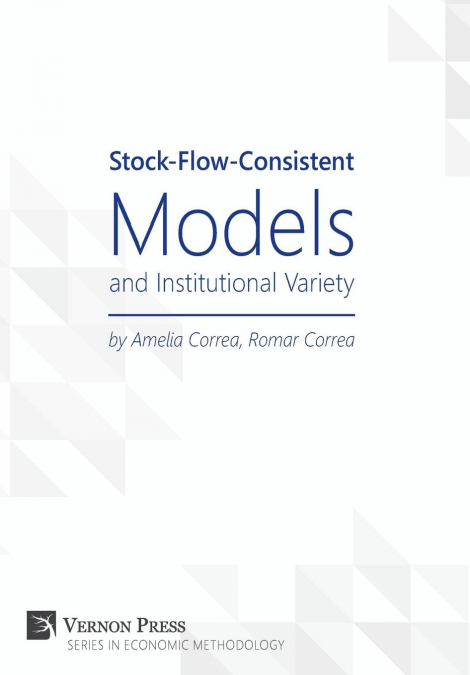
Stock-Flow-Consistent Models and Institutional Variety

Stock-Flow-Consistent Models and Institutional Variety

Stock-Flow-Consistent Models and Institutional Variety

Amelia Correa / Romar Correa

74,79 €
IVA incluido
Consulta disponibilidad
Editorial:
Vernon Art and Science
Año de edición:
2017
Materia
Macroeconomía
ISBN:
9781622731817

Selecciona una librería:

  • Librería Samer Atenea
  • Librería Aciertas (Toledo)
  • Kálamo Books
  • Librería Perelló (Valencia)
  • Librería Elías (Asturias)
  • Donde los libros
  • Librería Kolima (Madrid)
  • Librería Proteo (Málaga)

Methodology usually irritates economists. They prefer to get on with the job and do structural economics. The term always means general equilibrium. The story is told of consumers and producers making choices about consumption, work, investment, and so on. The grand finale is clearing of all markets. The plot is essentially devoid of money and banking. The language, though, is flexible enough to incorporate these elements and post-financial crisis, the best minds have been hard at work stretching the script in order to do so. We, on the other hand, hark back to another approach to structure that regards the economy as a whole as a set of interrelated real and monetary circuits. The principles at work are both logical (balance-sheet accounting) and historical (the economy in thrall to the rhythms of the cycle) and empirical (connections with national income statistics). We deal with identities. Consequently, they are incontrovertible. The relationships are connected by so-called stock-flow norms. These numbers can vary over time and space. Their uses are varied and will include ranges that they must fall within to ensure the stability of certain difference equation representations of our economies. In contrast, the community is used to norms imported or imposed from Basel or the IMF. Despite the popular connotations of the term ‘accounting’, the approach is fecund for proposing novel institutional practices to be transplanted into modern economies for welfare-maximizing ends. Their force is their origins in arithmetic. General equilibrium (anti-general equilibrium) tends to be strong on technique (critique) but weak when it comes to recommending non-trivial policy. Finally, most macroeconomists tend to think in closed-economy terms, the ‘foreign’ being the mirror of ‘home’. What might be the connections between two institutionally varied economies that are thrown together by the dynamics of globalization?    
Artículos relacionados

  • Introduction to Dynamic Macroeconomic General Equilibrium Models
    José Luis Torres Chacon
    This book offers an introductory step-by-step course in Dynamic Stochastic General Equilibrium modelling. Modern macroeconomic analysis is increasingly concerned with the construction, calibration and/or estimation and simulation of Dynamic General Equilibrium (DGE) models. The book is intended for graduate students as an introductory course to DGE modelling and for those econo...
    Disponible

    61,40 €

  • International Education and the Next-Generation Workforce
    Wei Wang
    Education is the first stage in developing a viable, dynamic, and long-lived global economy. Unfortunately, in times of economic hardship, educational programs, teacher salaries, and extracurricular opportunities are often the first to be cut. International Education and the Next-Generation Workforce: Competition in the Global Economy presents a detailed discussion of present e...
  • Macroeconomic Policies of Developed Democracies
    Robert J Franzese Jr
    ...
  • End Of The Road
    Louis Holder
    This book is about the mismanagement of Western economies in pursuit of political power, which resulting devastation will have to be borne by future generations. The book establishes that postponement is no longer doable and lays out the hard choices ahead causing much misery and agony.Although not fully recognized because of masking by asset bubbles, which are spun/sold as in...
    Disponible

    16,42 €

  • The Darwin Economy
    Robert H. Frank
    What Charles Darwin can teach us about building a fairer societyWho was the greater economist-Adam Smith or Charles Darwin? The question seems absurd. Darwin, after all, was a naturalist, not an economist. But Robert Frank, New York Times economics columnist and best-selling author of The Economic Naturalist, predicts that within the next century Darwin will unseat Smith as the...
    Disponible

    22,42 €

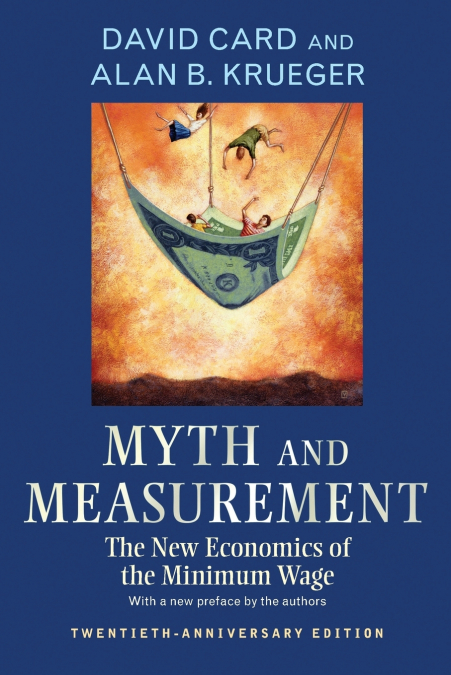
  • Myth and Measurement
    Alan B. Krueger / David Card
    From David Card, winner of the Nobel Prize in Economics, and Alan Krueger, a provocative challenge to conventional wisdom about the minimum wageDavid Card and Alan B. Krueger have already made national news with their pathbreaking research on the minimum wage. Here they present a powerful new challenge to the conventional view that higher minimum wages reduce jobs for low-wage ...
    Disponible

    39,64 €

Otros libros del autor

  • Stock-Flow-Consistent Models and Institutional Variety
    Amelia Correa / Romar Correa
    Methodology usually irritates economists. They prefer to get on with the job and do structural economics. The term always means general equilibrium. The story is told of consumers and producers making choices about consumption, work, investment, and so on. The grand finale is clearing of all markets. The plot is essentially devoid of money and banking. The language, though, is ...
    Disponible

    63,40 €