 Librería Samer Atenea
 Kálamo Books
 Librería Elías (Asturias)
 Librería Kolima (Madrid)
 Librería Proteo (Málaga)
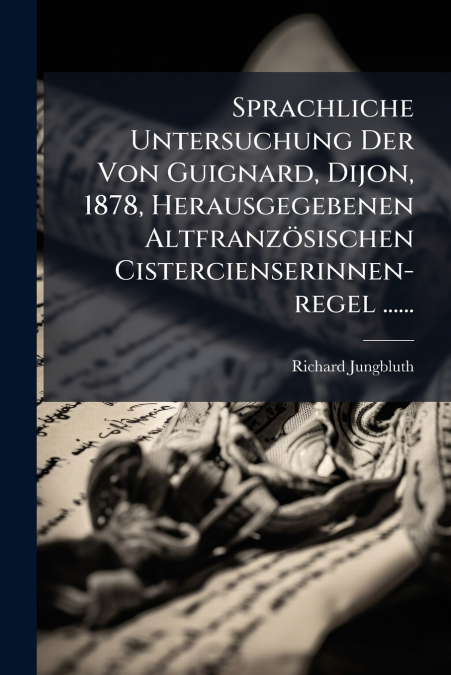
Sprachliche Untersuchung Der Von Guignard, Dijon, 1878, Herausgegebenen Altfranzösischen Cistercienserinnen-regel ist eine detaillierte linguistische Analyse der altfranzösischen Zisterzienserinnenregel, die von Guignard in Dijon im Jahr 1878 herausgegeben wurde. Dieses Werk von Richard Jungbluth untersucht die sprachlichen Eigenheiten und historischen Entwicklungen des Altfranzösischen anhand eines bedeutenden religiösen Textes. Die Studie bietet Einblicke in die mittelalterliche französische Sprache und die spezifischen sprachlichen Konventionen, die in religiösen Kontexten verwendet wurden. Gelehrte und Studierende der historischen Linguistik, der französischen Sprache und der Geschichte des Zisterzienserordens werden diese gründliche Untersuchung als wertvolle Ressource betrachten. Die Analyse beleuchtet die subtilen Nuancen des Altfranzösischen und bietet einen tieferen Einblick in die sprachlichen und kulturellen Hintergründe des Mittelalters.This work has been selected by scholars as being culturally important, and is part of the knowledge base of civilization as we know it. This work was reproduced from the original artifact, and remains as true to the original work as possible. Therefore, you will see the original copyright references, library stamps (as most of these works have been housed in our most important libraries around the world), and other notations in the work.This work is in the public domain in the United States of America, and possibly other nations. Within the United States, you may freely copy and distribute this work, as no entity (individual or corporate) has a copyright on the body of the work.As a reproduction of a historical artifact, this work may contain missing or blurred pages, poor pictures, errant marks, etc. Scholars believe, and we concur, that this work is important enough to be preserved, reproduced, and made generally available to the public. We appreciate your support of the preservation process, and thank you for being an important part of keeping this knowledge alive and relevant.