 Librería Samer Atenea
 Kálamo Books
 Librería Elías (Asturias)
 Librería Kolima (Madrid)
 Librería Proteo (Málaga)
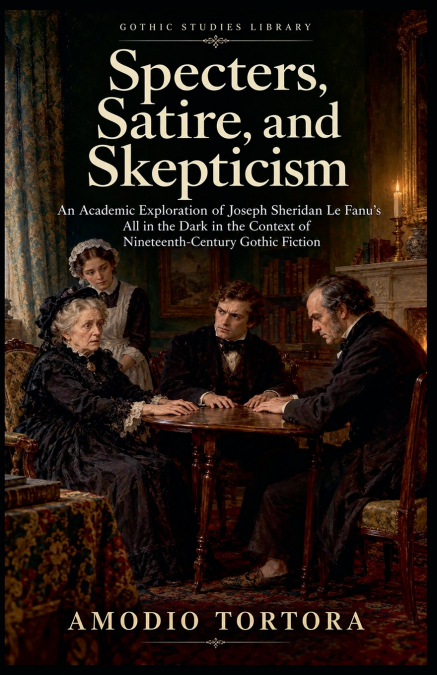
Unpublished work - First edition: Year 2026.Specters, Satire, and Skepticism reassesses Joseph Sheridan Le Fanu’s All in the Dark, showing how the novel transforms the conventions of nineteenth-century Gothic fiction into an inquiry into belief, perception, and responsibility. Across ten chapters, Amodio Tortora explores the uneasy coexistence of domestic comedy, supernatural apprehension, romantic uncertainty, and grief, arguing that the novel’s apparent departures from terror are central to its force.At the heart of the study stands Gilroyd Hall, where William Maubray’s dependence on his capricious aunt, Dinah Perfect, intertwines with his changing attachment to Violet Darkwell. This familiar household becomes a place of uncertainty as spiritualist enthusiasm gives questionable messages the power to shape ordinary lives. Tortora examines how generosity can become possessiveness, how gratitude can inhibit dissent, and how sincerely held convictions can impose restrictions on those whose futures remain subject to another person’s authority.The book examines the séance as a social process through which testimony is produced. Animated tables, ambiguous movements, accommodating witnesses, and authoritative interpretations expose the distance between apparent agreement and independent evidence. Dinah’s reading, Winnie Dobbs’s deference, and Dr. Drake’s inconsistent conduct show how expectations, hierarchy, and the desire for reassurance help sustain belief. Satire emerges as a means of scrutinising these mechanisms while preserving an awareness of the vulnerability and distress that make them persuasive.William’s nocturnal experiences bring the inquiry into the relationship between consciousness and the body. Shadows, sounds, dreams, and unexplained disturbances acquire terrifying significance under the pressure of suggestion. The discovery that the supposed phantom is William himself, acting in his sleep, replaces an external persecutor with the limits of self-knowledge. The study shows that this explanation does more than dissolve a mystery: it demonstrates why honest testimony can remain unreliable and why effective skepticism must account for experience rather than simply dismiss it.Extending this argument, Tortora connects the haunting to the novel’s courtship plot, where incomplete information and emotional investment turn uncertainty into conviction. He examines narrative authority, delayed recognition, the circulation of spiritualist publications, and the relation between religious assurance and practical inquiry. Comparisons with Uncle Silas, Carmilla, and other works situate All in the Dark within a varied Gothic practice in which dependence, enclosed spaces, and compromised interpretation take different narrative forms.The closing discussions assess the novel’s artistic strengths, unevenness, critical reception, and possibilities for visual adaptation without confusing resemblance or hypothetical potential with documented influence. Dinah’s death introduces a limit that rational explanation cannot overcome: familiar possessions and surviving words preserve attachment while confirming irreversible absence. Her final instruction releases William from an earlier restriction, giving the dead an enduring presence through memory and an act of care.Written for scholars and general readers, this volume presents skepticism as an ethical discipline grounded in attentive observation, revisable judgment, and respect for others’ freedom. It illuminates a Gothic world in which mysteries can be explained, yet affection, loss, and the uncertainty of human understanding last.