 Librería Samer Atenea
 Kálamo Books
 Librería Elías (Asturias)
 Librería Kolima (Madrid)
 Librería Proteo (Málaga)
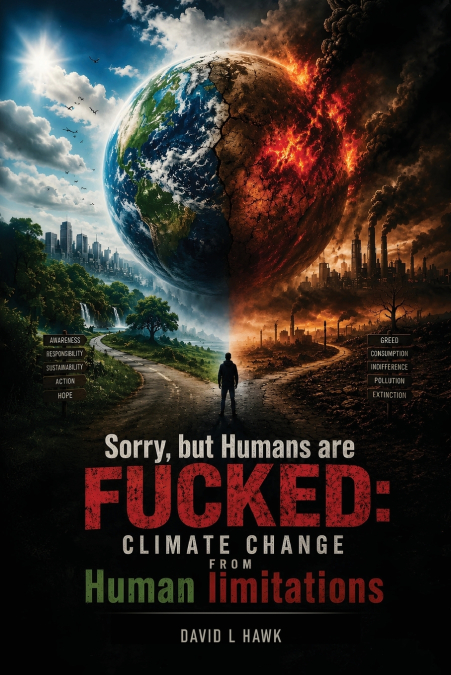
What happens when the greatest threat to the planet is not simply climate change, but the way humans think, lead, and respond to it?In Sorry, but Humans are FUCKED: Climate Change from Human Limitations, David L. Hawk delivers an unconventional examination of environmental deterioration and the human choices that accelerate it. Combining first-person experience, decades of inquiry, historical research, and sharp, often dark humor, Hawk questions whether the institutions created to protect society are capable of confronting the damage caused by business as usual.Drawing on his account of a multinational environmental research project conducted in Sweden during the 1970s, Hawk revisits early warnings about industrial pollution and a changing climate. He reflects on the work of nineteenth-century scientist Eunice Newton Foote, the environmental concerns raised by industry scientists, and the difficulties of translating scientific knowledge into meaningful action.But this book is not only about atmospheric carbon or environmental policy. It is about people: our attachment to short-term rewards, our resistance to change, and our confidence in leadership, legal systems, and economic models that may reinforce the problems they claim to solve. Through episodes from his life in agriculture, military service, academia, and international research, Hawk examines the tension between human ambition and the natural systems that make human life possible.The provocative title expresses the book’s central concern: humanity may be approaching consequences that cannot be managed through familiar solutions alone. Hawk challenges readers to reconsider assumptions about progress, regulation, responsibility, and what it would mean to pursue a genuinely different relationship with nature.Part environmental critique, part research-based reflection, and part fiercely personal commentary, this nonfiction work is intended for adult readers interested in climate change, environmental policy, systems thinking, corporate responsibility, and the future of human society.