 Librería Samer Atenea
 Kálamo Books
 Librería Elías (Asturias)
 Librería Kolima (Madrid)
 Librería Proteo (Málaga)
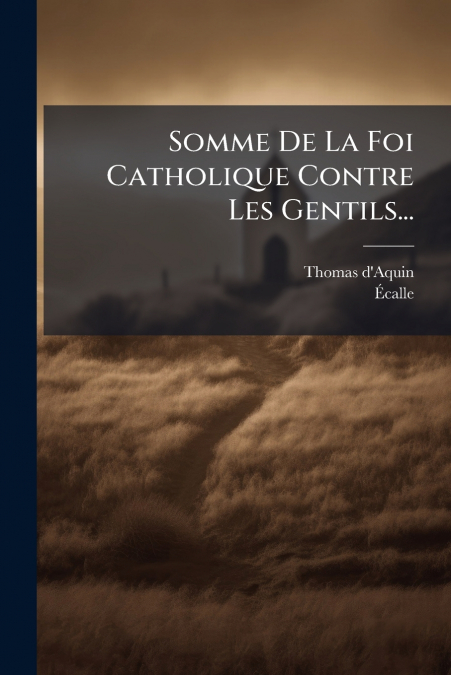
Summa Contra Gentiles (also known as Summa de fide catholica contra Gentiles) is a major work of Catholic theology by Thomas Aquinas, written between 1259 and 1265. It is structured as a reasoned argument against specific beliefs of non-Christian religions of the time. The complete Latin text is included in this edition.Aquinas employs philosophical reasoning and arguments to explain and defend core tenets of the Catholic faith. Unlike his Summa Theologica, intended as a guide for theology students, the Summa Contra Gentiles is aimed at a broader audience, particularly those unfamiliar with Christian thought. The work covers a wide range of topics, including the nature of God, creation, morality, and the afterlife. Its enduring value lies in its rigorous application of reason to theological questions and its defense of Catholic doctrine against alternative viewpoints.This work has been selected by scholars as being culturally important, and is part of the knowledge base of civilization as we know it. This work was reproduced from the original artifact, and remains as true to the original work as possible. Therefore, you will see the original copyright references, library stamps (as most of these works have been housed in our most important libraries around the world), and other notations in the work.This work is in the public domain in the United States of America, and possibly other nations. Within the United States, you may freely copy and distribute this work, as no entity (individual or corporate) has a copyright on the body of the work.As a reproduction of a historical artifact, this work may contain missing or blurred pages, poor pictures, errant marks, etc. Scholars believe, and we concur, that this work is important enough to be preserved, reproduced, and made generally available to the public. We appreciate your support of the preservation process, and thank you for being an important part of keeping this knowledge alive and relevant.