 Librería Samer Atenea
 Kálamo Books
 Librería Elías (Asturias)
 Librería Kolima (Madrid)
 Librería Proteo (Málaga)
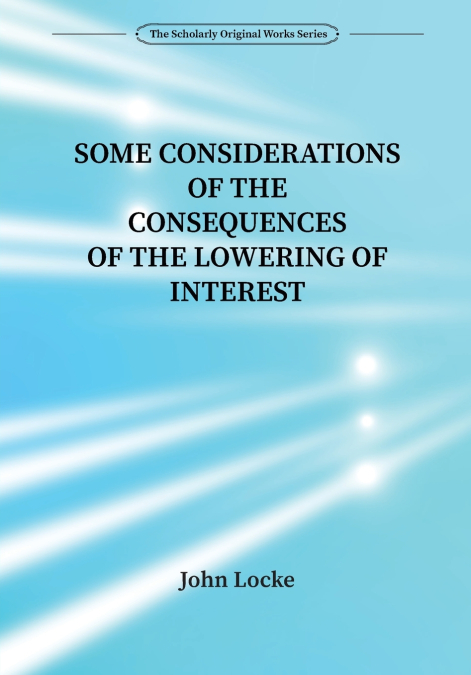
A foundational text of classical economics-Locke’s classic on interest and money, guiding you through the economic logic behind interest rates and currency value.古典经济学的奠基之作,洛克论利息与货币的经典文献,带你读懂利率与币值背后的经济逻辑。This is the economic masterpiece of John Locke, the renowned 17th-century English philosopher and economist, first published in 1691. Presented as a letter to a Member of Parliament, the book comprises two main parts: on interest and on the value of money. Locke strongly opposed the government’s attempt to artificially lower the legal interest rate (from 6% to 4%) by statute, arguing that interest rates are determined by the quantity of money or capital and cannot be effectively legislated, and that such intervention would lead to perjury and disrupt trade. On money, he opposed the government’s artificial raising of the nominal value of coinage. Developing the ideas of William Petty, the work anticipates modern economic concepts such as the velocity of money, Gresham’s law ('bad money drives out good'), money illusion, monetary policy lags, and the relationship between trade balances and capital flows, making it a foundational text in the formation of classical political economy.本书是17世纪英国著名哲学家、经济学家约翰·洛克(John Locke)的经济学代表作,首次出版于1691年。全书以写给一位议员的书信形式呈现,分为论利息与论货币价值两大部分。洛克在书中极力反对政府以法律手段人为降低利息(当时试图将法定利率从6%降至4%),认为利率的高低由货币量或资本量决定,法律无法强行干预,否则将引发伪誓、扰乱贸易等不良后果。在货币部分,他反对政府人为提高铸币的表面价值。该书在发展威廉·配第观点的基础上,提出了货币流通速度、劣币驱逐良币、货币幻觉、货币政策时滞、贸易经常账户与资本流动等现代经济学耳熟能详的概念雏形,是古典政治经济学形成期的重要文献。