 Librería Samer Atenea
 Kálamo Books
 Librería Elías (Asturias)
 Librería Kolima (Madrid)
 Librería Proteo (Málaga)
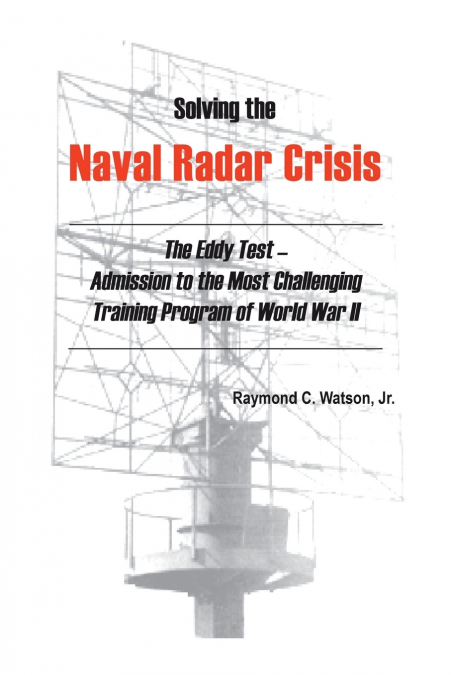
Radar, including its maintenance, was a dark secret throughout World War II. After the war, radar per se received much publicity, but the Navy’s program for selecting and preparing personnel to become electronics specialists - one of the most challenging training activities of all times - has remained almost unknown. Noted scientist/historian Louis Brown made no mention of the program in his highly acclaimed book, A Radar History of World War II. He subsequently commented, 'It is an omission that I greatly regret, especially because it is the kind of history that I value.'This book has been written to finally document the history of this program. It is especially intended for the few remaining men who participated in this activity and their descendants. It should also be of interest to the huge number of persons whose careers have been greatly influenced by aftereffects of the war’s electronic miracles, as well as to students and others in broadening their knowledge of electronics evolution. Radar was first demonstrated at the Naval Research Laboratory, and the U.S. fleet had its initial operational system in 1939. It was then directed that radar be incorporated on all major ships. At the time of Japan’s attack on Pearl Harbor, however, only 79 sets had been installed on the Navy’s approximately 2,000 vessels. In the then-existing Navy and Marine forces, only a few hundred men were qualified in advanced electronics and essentially none in radar. Further, President Roosevelt had ordered huge increases in ships, aircraft, and submarines; many thousands of highly qualified personnel would be needed to maintain the associated electronics. Thus, there was a crisis in naval electronics, especially radar.The crisis was solved through the Electronics Training Program - an activity of almost unbelievable intensity, cramming the major topics of a standard electrical engineering curriculum into less than a year. The program began in mid-1942 as a combined effort of six engineering colleges and several highly advanced Navy schools. Captain William C. Eddy was largely responsible for its coordination. An admissions examination, commonly called the Eddy Test, was used in selecting the students.Chapters 1 and 2 review the evolution of electronics during the first four decades of the 20th century. Chapter 3 examines the avalanche of radar and the resulting crisis. Chapters 4, 5, and 6 cover in detail the Electronics Training Program -- its origin, curriculum, locations, facilities, and key personnel. Information on the many types of wartime electronic systems is given in Appendix I, and Appendix II summarizes radar developments in other countries. Extensive pictures are included throughout the book.During the war years, about 30,000 men made it through the Navy’s electronics training, corresponding roughly to 6 percent of those initially taking the Eddy Test and 35 percent of those admitted to the program. The final appendix of this book gives brief biographies of 33 representative graduates, members of what Tom Brokaw has called 'the greatest generation.'