

 Librería Samer Atenea
 Kálamo Books
 Librería Elías (Asturias)
 Librería Kolima (Madrid)
 Librería Proteo (Málaga)
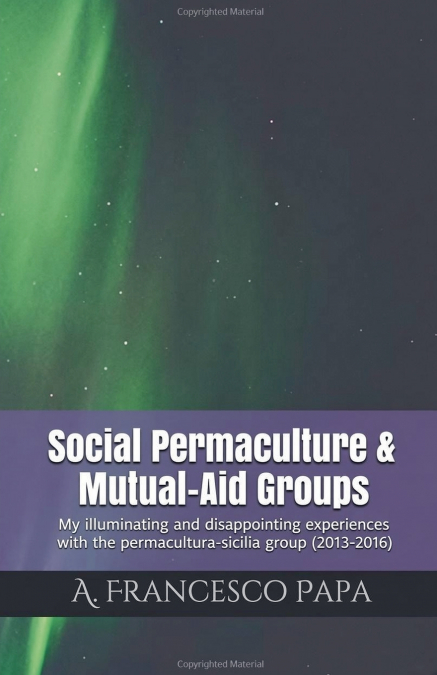
Permaculture is an admirable agro-social phenomenon, in recent years distorted by Wikipedia when it turns its third ethic into an elegant way of imposing on everyone-states and citizens alike-petty philosophies, in order to generate a sort of green nazism upheld by the scientific categories of the new Western ethical State. But originally it was not like this: permaculture was gentle, helpful, sweet, sagacious, fun, humble, intelligent, and in trepidant anticipation of man’s assent, and so I fell in love with it.It was a period both beautiful and ugly at once. Beautiful, because I learned that there existed and could still exist people eager to unite in order to nourish new ideals. Ugly, because what permaculture and permaculturists never tell you is that in order to be autonomous, safe, and serene on a piece of land, you always need the money-that-nobody-gives-you, a STARTING CAPITAL, on pain of remaining a wwoofer for life, a vagabond of the earth. Existential wandering thus becomes, for anyone who carelessly approaches these doctrines, a fate analogous to that of the permanent temp worker lost among the concrete labyrinths of Western cities. Oh no, this is a bad thing.This book recounts about ten experiences known as 'MUTUAL AID,' which took place in Sicily starting in 2012; meanwhile it substantiates the different perspective I have developed regarding a healthier and more reasonable, less confused and less anarchic way of developing ecological communities and ecovillages in an incredibly short-sighted, or hypocritical, historical moment. I then sedimented this philosophy-different from the original Australian one but in continuity with it-with the expression ’ORGANIC permaculture.’***What is a 'Mutual Aid Group'? How is it organized? Is it better to do as we please, anarchically, or to establish a common model and follow it? And what is permacUlture? How, when, and why transmute it into Mutual Assistance Groups: numerous, cohesive, operative, and at the same time free? Is it better to entrust Holmgren’s concept of 'CARE OF THE PERSON' to personal eco-mystical deepenings, to an international association, a national sect, or to a LOCAL GROUP-small, serious, self-organized, punctual, and above all non-mercenary in its action, that is, free of charge? These and other questions this text attempts to answer, because a permacUlture that fails to become SOCIOCULTURE is nothing but permacOlture, that is, the scientific study of an economical way of remaining ecologically on 'one’s own' land (usually inherited or purchased with the help of one’s parents).







