
Inicio > Economía, finanzas, empresa y gestión > Economía > Economía política > Small-Area Estimates of School-Age Children in Poverty
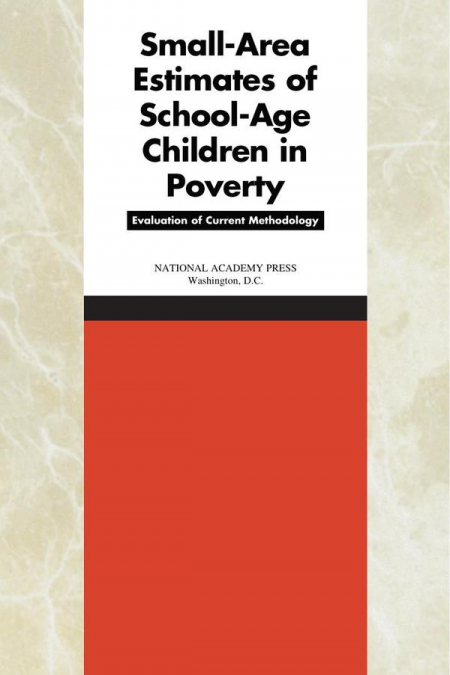
Small-Area Estimates of School-Age Children in Poverty

Small-Area Estimates of School-Age Children in Poverty

AA.VV

68,12 €
IVA incluido
Disponible
Editorial:
National Academies Press
Año de edición:
2001
Materia
Economía política
ISBN:
9780309073011
68,12 €
IVA incluido
Disponible

Selecciona una librería:

  • Librería Samer Atenea
  • Librería Aciertas (Toledo)
  • Kálamo Books
  • Librería Perelló (Valencia)
  • Librería Elías (Asturias)
  • Donde los libros
  • Librería Kolima (Madrid)
  • Librería Proteo (Málaga)

The Panel on Estimates of Poverty for Small Geographic Areas was established by the Committee on National Statistics at the National Research Council in response to the Improving America’s Schools Act of 1994. That act charged the U.S. Census Bureau to produce updated estimates of poor school-age children every two years for the nation’s more than 3,000 counties and 14,000 school districts. The act also charged the panel with determining the appropriateness and reliability of the Bureau’s estimates for use in the allocation of more than $7 billion of Title I funds each year for educationally disadvantaged children. The panel’s charge was both a major one and one with immovable deadlines. The panel had to evaluate the Census Bureau’s work on a very tight schedule in order to meet legal requirements for allocation of Title I funds. As it turned out, the panel produced three interim reports: the first one evaluated county-level estimates of poor school-age children in 1993, the second one assessed a revised set of 1993 county estimates; and the third one covered both county- and school district-level estimates of poor school-age children in 1995. This volume combines and updates these three reports into a single reference volume.

Artículos relacionados

  • Private Affluence and Public Squalor
    Paul L L Nevins / Paul L Nevins
    Are the values that Americans collectively hold destroying the American Dream? The answer to that question depends upon the answers to some very specific questions. What do we as citizens of the United States believe we owe to one another as citizens? What is the purpose of government? What is of the role of the private enterprise? What is the meaning of equal opportunity? To w...
    Disponible

    24,04 €

  • Of Privacy and Power
    Abraham L. Newman / Henry Farrell
    How disputes over privacy and security have shaped the relationship between the European Union and the United States and what this means for the futureWe live in an interconnected world, where security problems like terrorism are spilling across borders, and globalized data networks and e-commerce platforms are reshaping the world economy. This means that states’ jurisdictions ...
    Disponible

    30,80 €

  • Migration and Democracy
    Abel Escribà-Folch / Covadonga Meseguer / Joseph Wright
    How remittances-money sent by workers back to their home countries-support democratic expansionIn the growing body of work on democracy, little attention has been paid to its links with migration. Migration and Democracy focuses on the effects of worker remittances-money sent by migrants back to their home countries-and how these resources shape political action in the Global S...
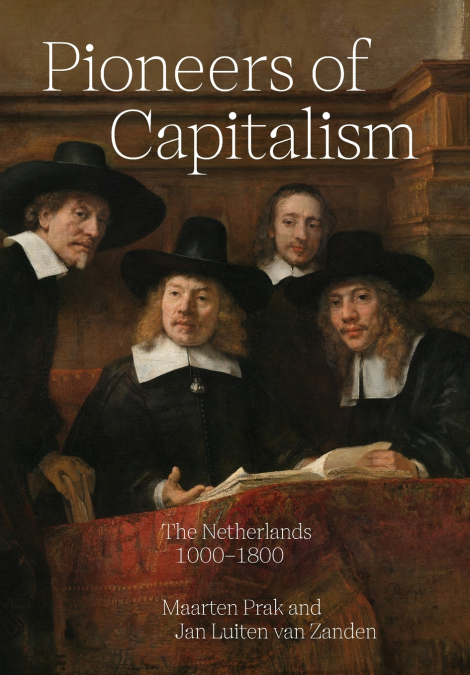
  • Pioneers of Capitalism
    Jan Luiten van Zanden / Maarten Prak / Ian Cressie
    How medieval Dutch society laid the foundations for modern capitalismThe Netherlands was one of the pioneers of capitalism in the Middle Ages, giving rise to the spectacular Dutch Golden Age while ushering in an era of unprecedented, long-term economic growth. Pioneers of Capitalism examines the formal and informal institutions in the Netherlands that made this economic miracle...
  • Pillars of Prosperity
    Timothy Besley / Torsten Persson
    How nations can promote peace, prosperity, and stability through cohesive political institutions'Little else is required to carry a state to the highest degree of opulence from the lowest barbarism, but peace, easy taxes, and a tolerable administration of justice; all the rest being brought about by the natural course of things.' So wrote Adam Smith a quarter of a millennium ag...
    Disponible

    57,93 €

  • Luxury Fever
    Robert H. Frank
    The turn of the twenty-first century witnessed a spectacular rise in gross consumption. With the super-rich setting the pace, everyone spent furiously in a desperate attempt to keep up. As cars and houses grew larger and more expensive, the costs were enormous--not only monetarily but also socially. Consumers spent more time at work and less time with their family and friends; ...
    Disponible

    35,97 €