

 Librería Samer Atenea
 Kálamo Books
 Librería Elías (Asturias)
 Librería Kolima (Madrid)
 Librería Proteo (Málaga)
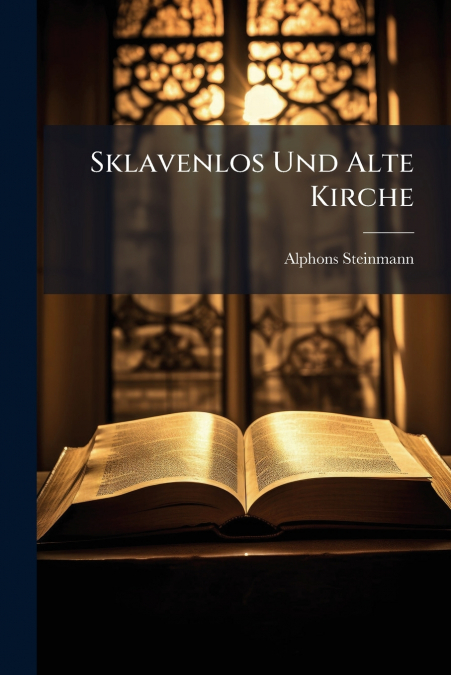
Sklavenlos Und Alte Kirche: Eine Historisch-Exegetische Studie Über Die Soziale Frage Im Urchristentum, by Alphons Steinmann, examines the social question of slavery in early Christianity through a historical and exegetical lens. This study, originally published in 1910, delves into the ancient church’s perspective on slavery, offering insights into the socio-economic conditions and ethical considerations of the time. Steinmann’s work provides a valuable historical analysis, exploring how early Christians grappled with the institution of slavery and its implications for their faith and community. The book explores relevant biblical passages and historical contexts to shed light on the complex relationship between Christian teachings and social realities in the Roman Empire. This is an important resource for scholars and readers interested in the history of Christianity, ancient social structures, and the development of Christian ethics.This work has been selected by scholars as being culturally important, and is part of the knowledge base of civilization as we know it. This work was reproduced from the original artifact, and remains as true to the original work as possible. Therefore, you will see the original copyright references, library stamps (as most of these works have been housed in our most important libraries around the world), and other notations in the work.This work is in the public domain in the United States of America, and possibly other nations. Within the United States, you may freely copy and distribute this work, as no entity (individual or corporate) has a copyright on the body of the work.As a reproduction of a historical artifact, this work may contain missing or blurred pages, poor pictures, errant marks, etc. Scholars believe, and we concur, that this work is important enough to be preserved, reproduced, and made generally available to the public. We appreciate your support of the preservation process, and thank you for being an important part of keeping this knowledge alive and relevant.





