 Librería Samer Atenea
 Kálamo Books
 Librería Elías (Asturias)
 Librería Kolima (Madrid)
 Librería Proteo (Málaga)
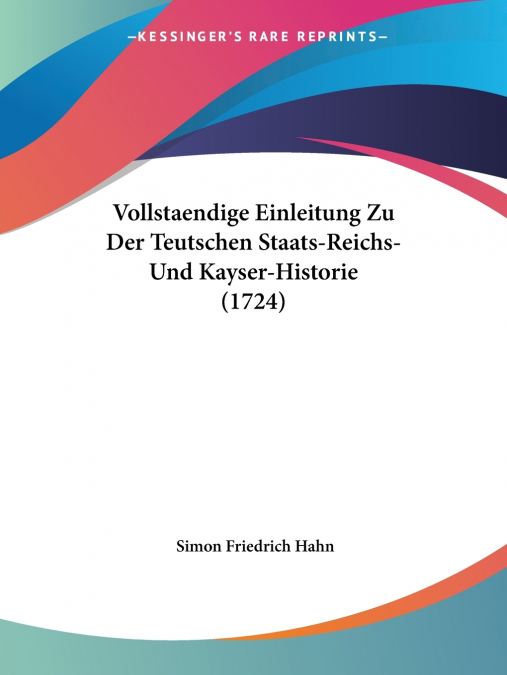
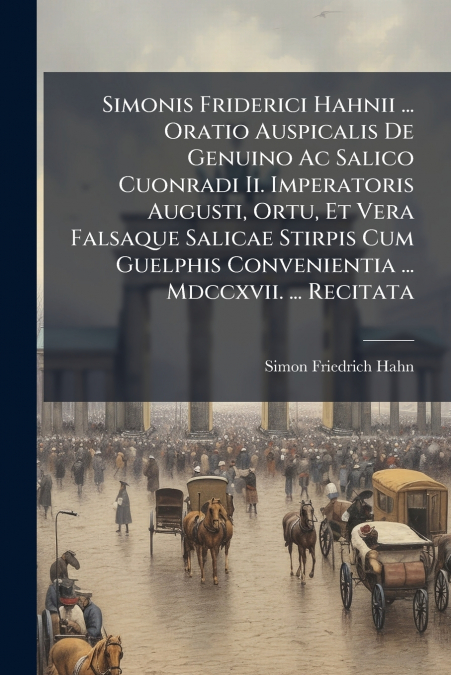
An augmented and annotated oration by Simon Friedrich Hahn, 'Simonis Friderici Hahnii ... Oratio Auspicalis De Genuino Ac Salico Cuonradi Ii. Imperatoris Augusti, Et Vera Falsaque Salicae Stirpis Cum Guelphis Convenientia ... Mdccxvii ... Recitata', explores the genuine and Salic origins of Conrad II, Holy Roman Emperor. First presented in 1717, this discourse delves into the Salic dynasty’s connections, both true and false, with the House of Welf. Hahn’s work provides insights into the intricate genealogical and political landscape of the period, offering a detailed examination of imperial lineage and its implications. This expanded edition includes necessary annotations that further clarify the historical context and arguments presented, making it a valuable resource for scholars and enthusiasts interested in German history, imperial studies, and dynastic relationships.This work has been selected by scholars as being culturally important, and is part of the knowledge base of civilization as we know it. This work was reproduced from the original artifact, and remains as true to the original work as possible. Therefore, you will see the original copyright references, library stamps (as most of these works have been housed in our most important libraries around the world), and other notations in the work.This work is in the public domain in the United States of America, and possibly other nations. Within the United States, you may freely copy and distribute this work, as no entity (individual or corporate) has a copyright on the body of the work.As a reproduction of a historical artifact, this work may contain missing or blurred pages, poor pictures, errant marks, etc. Scholars believe, and we concur, that this work is important enough to be preserved, reproduced, and made generally available to the public. We appreciate your support of the preservation process, and thank you for being an important part of keeping this knowledge alive and relevant.