
Inicio > > Redes y comunicaciones informáticas > Signal Processing for Telecommunications and Multimedia
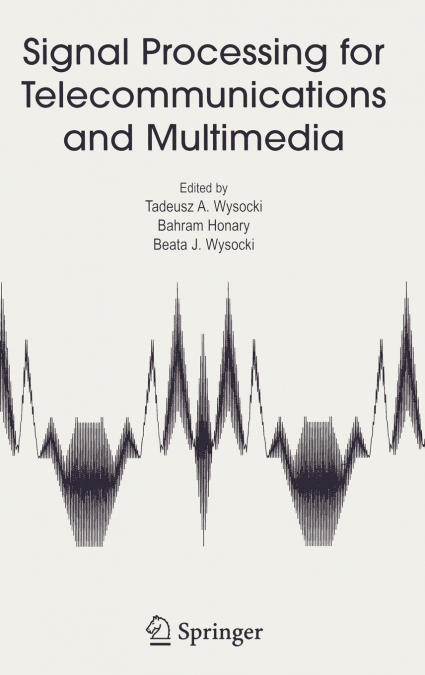
Signal Processing for Telecommunications and Multimedia

Signal Processing for Telecommunications and Multimedia


132,51 €
IVA incluido
Consulta disponibilidad
Editorial:
Springer Nature B.V.
Año de edición:
2004
Materia
Redes y comunicaciones informáticas
ISBN:
9780387228471

Selecciona una librería:

  • Librería Samer Atenea
  • Librería Aciertas (Toledo)
  • Kálamo Books
  • Librería Perelló (Valencia)
  • Librería Elías (Asturias)
  • Donde los libros
  • Librería Kolima (Madrid)
  • Librería Proteo (Málaga)

The unprecedented growth in the range of multimedia services offered these days by modern telecommunication systems has been made possible only because of the advancements in signal processing technologies and algorithms. In the area of telecommunications, application of signal processing allows for new generations of systems to achieve performance close to theoretical limits, while in the area of multimedia, signal processing the underlying technology making possible realization of such applications that not so long ago were considered just a science fiction or were not even dreamed about. We all learnt to adopt those achievements very quickly, but often the research enabling their introduction takes many years and a lot of efforts. This book presents a group of invited contributions, some of which have been based on the papers presented at the International Symposium on DSP for Communication Systems held in Coolangatta on the Gold Coast, Australia, in December 2003. Part 1 of the book deals with applications of signal processing to transform what we hear or see to the form that is most suitable for transmission or storage for a future retrieval. The first three chapters in this part are devoted to processing of speech and other audio signals. The next two chapters consider image coding and compression, while the last chapter of this part describes classification of video sequences in the MPEG domain.
Artículos relacionados

  • Next Generation Search Engines
    Recent technological progress in computer science, Web technologies, and the constantly evolving information available on the Internet has drastically changed the landscape of search and access to information. Current search engines employ advanced techniques involving machine learning, social networks, and semantic analysis. Next Generation Search Engines: Advanced Models for ...
  • Collaboration and the Semantic Web
    Collaborative working has been increasingly viewed as a good practice for organizations to achieve efficiency. Organizations that work well in collaboration may have access to new sources of funding, deliver new, improved, and more integrated services, make savings on shared costs, and exchange knowledge, information and expertise. Collaboration and the Semantic Web: Social Net...
  • Resource Allocation in Next-Generation Broadband Wireless Access Networks
    With the growing popularity of wireless networks in recent years, the need to increase network capacity and efficiency has become more prominent in society. This has led to the development and implementation of heterogeneous networks. Resource Allocation in Next-Generation Broadband Wireless Access Networks is a comprehensive reference source for the latest scholarly research o...
  • Advanced Topics in Information Technology Standards and Standardization Research, Volume 1
    Kai Jakobs
    ...
  • Data Warehouses and OLAP
    ...
  • Selected Readings on Database Technologies and Applications
    Terry Halpin
    Education and research in the field of database technology can prove problematic without the proper resources and tools on the most relevant issues, trends, and advancements. Selected Readings on Database Technologies and Applications supplements course instruction and student research with quality chapters focused on key issues concerning the development, design, and analysis ...