 Librería Samer Atenea
 Kálamo Books
 Librería Elías (Asturias)
 Librería Kolima (Madrid)
 Librería Proteo (Málaga)
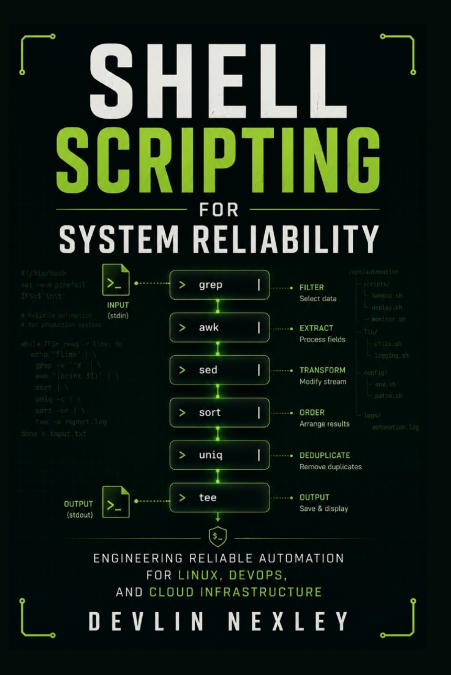
Modern infrastructure depends on automation. From deployment pipelines and cloud provisioning workflows to system maintenance and operational recovery procedures, shell scripts remain one of the most widely used mechanisms for controlling and orchestrating production environments. Yet many automation failures can be traced to scripts that were written for convenience rather than engineered for reliability, security, and long-term maintainability.This book approaches shell scripting as an infrastructure engineering discipline rather than a collection of command-line techniques. It examines how shell-based automation behaves in real production systems, where execution context, privilege boundaries, dependency management, failure handling, and operational safety are critical to system stability.Focusing on Linux, Unix, DevOps, and cloud-native environments, the book explores the underlying execution model of the shell, the mechanics of process creation and command evaluation, and the design principles required to build automation that remains predictable under scale, change, and failure conditions. Readers will learn how to construct modular scripts, manage execution flow, validate inputs, implement structured error handling, and develop automation patterns suitable for modern infrastructure operations.The book also addresses operational concerns frequently overlooked in traditional scripting resources, including observability, logging, portability across Unix environments, security hardening, secrets management, privilege control, and enterprise deployment requirements. Real-world infrastructure scenarios are used throughout to illustrate how shell scripting integrates with CI/CD systems, cloud platforms, deployment workflows, and large-scale operational environments.Inside, you will explore:Shell execution architecture and process behaviorCommand evaluation, expansion, and pipeline mechanicsVariables, quoting rules, and execution safetyConditional logic and control-flow designModular script architecture and reusable automation patternsError handling, failure propagation, and recovery strategiesInput validation and defensive scripting techniquesLogging, debugging, and operational observabilityFile system automation and batch-processing workflowsProcess management and background execution modelsScheduling and event-driven automation systemsCI/CD pipeline integration and deployment automationCloud infrastructure control through command-line interfacesSecure scripting practices and secrets managementProduction hardening, portability, and enterprise readinessDesigned for DevOps engineers, cloud engineers, system administrators, site reliability engineers, and infrastructure architects, this book provides a rigorous, implementation-focused examination of shell scripting as a production technology. Rather than teaching isolated commands, it equips readers with the engineering principles, operational patterns, and architectural understanding required to build reliable automation systems that can withstand the demands of modern infrastructure.