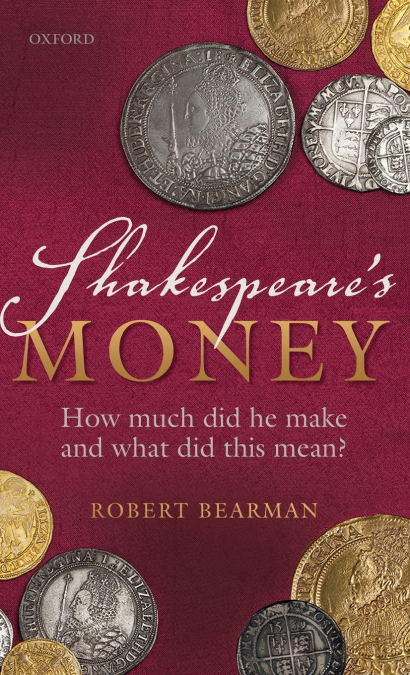

Shakespeare’s Money

Shakespeare’s Money

Robert Bearman

57,93 €
IVA incluido
Consulta disponibilidad
Editorial:
Oxford University Press
Año de edición:
2016
Materia
Estudios literarios: obras de teatro y dramaturgos
ISBN:
9780198759249

Selecciona una librería:

  • Librería Samer Atenea
  • Librería Aciertas (Toledo)
  • Kálamo Books
  • Librería Perelló (Valencia)
  • Librería Elías (Asturias)
  • Donde los libros
  • Librería Kolima (Madrid)
  • Librería Proteo (Málaga)

There is no doubting Shakespeare’s literary genius, immortalised in his published work. However, statements along these lines are frequently followed by laments of how little is known about this life. This is true if we wish to know about Shakespeare’s movements on even a month-by-month basis, or about his working practices and relationships with his theatrical fellows. However, too great an emphasis on this dearth of material not only leads to ill-informed comment that this is somehow ’suspicious’ but also tends to downgrade the importance of what material has survived, often dismissed instead simply as evidence of his business dealings which have little bearing on his creative work. However, this material does at least help us to evaluate how successful Shakespeare was in earning a living in a profession which, in his day, was far from mainstream. By calculating his income from theatrical sources and exploring how this affected his financial circumstances and his ability to invest for his and his family’s security, we can come to a better understanding of his social standing at different periods in his life, the most obvious evidence to his late sixteenth- and early seventeenth-century contemporaries of his success. Shakespeare undoubtedly died a man of comfortable means, but, as this book demonstrates, there is little to justify claims that he died possessed of great wealth. The circumstances of his daughters’ marriages are a sufficient indication that he had not achieved true gentlemanly status. Other evidence suggests that he had not broken convincingly into the ranks of leading figures even of a small market town. Moreover, following a period of increasing prosperity, these ’business records’ also reflect a declining income during the last ten years or so of his life and of his efforts to safeguard his assets. On the other hand, when compared with his father’s business failure, mainly the result of a loss of credit, it is clear that, consciously or unconsciously, Shakespeare had the good sense or foresight not to over-reach himself.
Artículos relacionados

  • Shakespeare’s identities
    James Driscoll
    No dramatist has treated identity in as many ways and in such depth as William Shakespeare. In Shakespeare’s Identities, James P. Driscoll shows how the Bard used history, comedy, tragedy, and romance to develop comprehensive treatments of personal identity.Driscoll’s innovative study examines four aspects of identity: the conscious, social, real, and ideal. Drawing on Jungian ...
    Disponible

    45,23 €

  • Shakespeare and Abraham
    Ken Jackson
    Shakespeare and Abraham shows how Shakespeare’s engagement with the biblical narrative of Abraham’s sacrifice of Isaac manifests in his plays. ...
  • William Shakespeare, Richard Barnfield, and the Sixth Earl of Derby
    Leo Daugherty
    This book is the first to argue that the Rival Poet of Shakespeare’s Sonnets is the well-known young Elizabethan writer Richard Barnfield (1574-1620), long suspected to have been one of Shakespeare’s 'private friends' (as they were termed by Francis Meres in 1598), with whom (as Meres also tells us) Shakespeare shared some of his sonnets. This is also the first book to argue th...
  • Shakespeare and the Dawn of Modern Science
    Peter D. Usher
    In Shakespeare and the Dawn of Modern Science, renowned astronomy expert Peter Usher expands upon his allegorical interpretation of Hamlet and analyzes four more plays, Love’s Labour’s Lost, Cymbeline, The Merchant of Venice, and The Winter’s Tale. With painstaking thoroughness, he dissects the plays and reveals that, contrary to current belief, Shakespeare was well aware of th...
  • The Comic Matrix of Shakespeare’s Tragedies
    Susan Snyder
    Comic elements in Shakespeare’s tragedies have often been noted, but while most critics have tended to concentrate on humorous interludes or on a single play, Susan Snyder seeks a more comprehensive understanding of how Shakespeare used the conventions, structures, and assumptions of comedy in his tragic writing. She argues that Shakespeare’s early mastery of romantic comedy de...
    Disponible

    47,54 €

  • Hamlet in Purgatory
    Stephen Greenblatt
    In Hamlet in Purgatory, renowned literary scholar Stephen Greenblatt delves into his longtime fascination with the ghost of Hamlet’s father, and his daring and ultimately gratifying journey takes him through surprising intellectual territory. It yields an extraordinary account of the rise and fall of Purgatory as both a belief and a lucrative institution--as well as a capacious...
    Disponible

    27,63 €