Inicio > > Ciencias de la computación > Scientific Computing
Scientific Computing

Scientific Computing

Bertil Gustafsson

85,69 €
IVA incluido
Consulta disponibilidad
Editorial:
Springer Nature B.V.
Año de edición:
2018
Materia
Ciencias de la computación
ISBN:
9783319698465

Selecciona una librería:

  • Librería Samer Atenea
  • Librería Aciertas (Toledo)
  • Kálamo Books
  • Librería Perelló (Valencia)
  • Librería Elías (Asturias)
  • Donde los libros
  • Librería Kolima (Madrid)
  • Librería Proteo (Málaga)

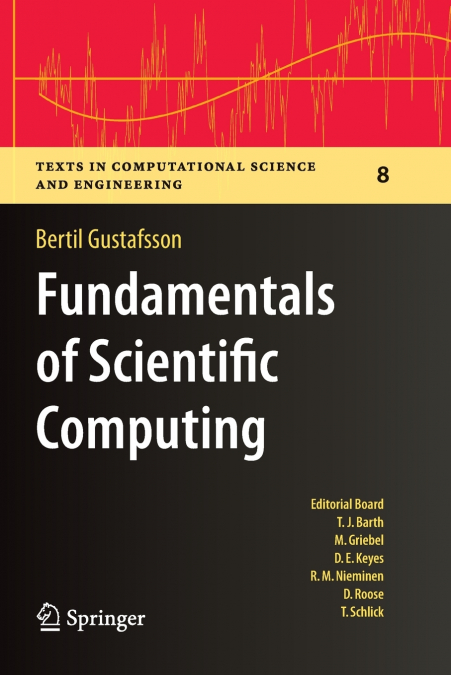
This book explores the most significant computational methods and the history of their development. It begins with the earliest mathematical / numerical achievements made by the Babylonians and the Greeks, followed by the period beginning in the 16th century. For several centuries the main scientific challenge concerned the mechanics of planetary dynamics, and the book describes the basic numerical methods of that time.  In turn, at the end of the Second World War scientific computing took a giant step forward with the advent of electronic computers, which greatly accelerated the development of numerical methods. As a result, scientific computing became established as a third scientific method in addition to the two traditional branches: theory and experimentation. The book traces numerical methods’ journey back to their origins and to the people who invented them, while also briefly examining the development of electronic computers over the years. Featuring 163 references and more than 100 figures, many of them portraits or photos of key historical figures, the book provides a unique historical perspective on the general field of scientific computing - making it a valuable resource for all students and professionals interested in the history of numerical analysis and computing, and for a broader readership alike.


Artículos relacionados

Otros libros del autor

  • Scientific Computing
    Bertil Gustafsson
    This book explores the most significant computational methods and the history of their development. It begins with the earliest mathematical / numerical achievements made by the Babylonians and the Greeks, followed by the period beginning in the 16th century. For several centuries the main scientific challenge concerned the mechanics of planetary dynamics, and the book describe...
    Disponible

    68,60 €

  • Fundamentals of Scientific Computing
    Bertil Gustafsson
    The book of nature is written in the language of mathematics -- Galileo Galilei How is it possible to predict weather patterns for tomorrow, with access solely to today’s weather data? And how is it possible to predict the aerodynamic behavior of an aircraft that has yet to be built? The answer is computer simulations based on mathematical models - sets of equations - that des...
    Disponible

    68,80 €

  • Fundamentals of Scientific Computing
    Bertil Gustafsson
    The book of nature is written in the language of mathematics  -- Galileo Galilei How is it possible to predict weather patterns for tomorrow, with access solely to today’s weather data? And how is it possible to predict the aerodynamic behavior of an aircraft that has yet to be built? The answer is computer simulations based...
  • High Order Difference Methods for Time Dependent PDE
    Bertil Gustafsson
    When are High Order Methods Effective?.- Well-posedness and Stability.- Order of Accuracy and the Convergence Rate.- Approximation in Space.- Approximation in Time.- Coupled Space-Time Approximations.- Boundary Treatment.- The Box Scheme.- Wave Propagation.- A Problem in Fluid Dynamics.- Nonlinear Problems with Shocks.- to Other Numerical Methods. ...
    Disponible

    170,51 €

  • High Order Difference Methods for Time Dependent PDE
    Bertil Gustafsson
    This book covers high order finite difference methods for time dependent PDE. It gives an overview of the basic theory and construction principles by using model examples. The book also contains a general presentation of the techniques and results for well-posedness and stability, with inclusion of the three fundamental methods of analysis both for PD...