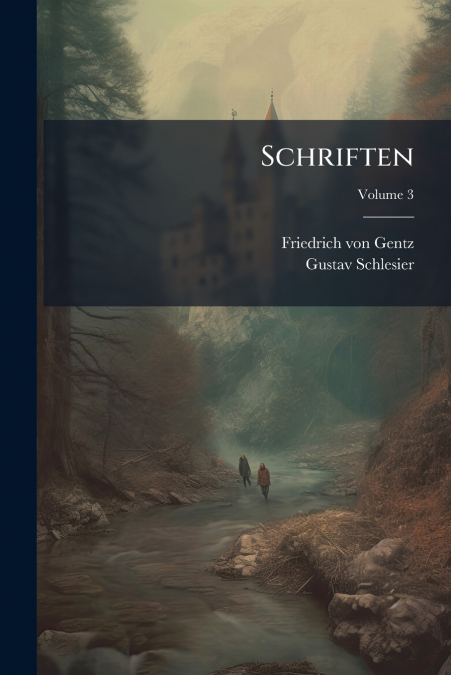
Friedrich von Gentz / Gustav Schlesier
 Librería Samer Atenea
 Kálamo Books
 Librería Elías (Asturias)
 Librería Kolima (Madrid)
 Librería Proteo (Málaga)
Schriften, Zweiter Theil presents a collection of shorter writings by Friedrich von Gentz, a prominent political theorist and commentator of the late 18th and early 19th centuries. This volume, part of a larger collection intended as a lasting tribute ('Ein Denkmal'), offers insights into Gentz’s engagement with the pressing political and social issues of his time. Edited by Gustav Schlesier, these essays provide a window into the intellectual debates surrounding the Napoleonic era and the subsequent restoration period in Europe.Gentz’s writings cover a range of topics, reflecting his conservative political philosophy and his role as a key advisor to leading statesmen. Readers interested in the history of political thought, the development of conservative ideology, and the intricacies of European diplomacy will find this volume to be a valuable resource. The collection showcases Gentz’s sharp analytical mind and his commitment to defending traditional institutions against the forces of revolution and change.This work has been selected by scholars as being culturally important, and is part of the knowledge base of civilization as we know it. This work was reproduced from the original artifact, and remains as true to the original work as possible. Therefore, you will see the original copyright references, library stamps (as most of these works have been housed in our most important libraries around the world), and other notations in the work.This work is in the public domain in the United States of America, and possibly other nations. Within the United States, you may freely copy and distribute this work, as no entity (individual or corporate) has a copyright on the body of the work.As a reproduction of a historical artifact, this work may contain missing or blurred pages, poor pictures, errant marks, etc. Scholars believe, and we concur, that this work is important enough to be preserved, reproduced, and made generally available to the public. We appreciate your support of the preservation process, and thank you for being an important part of keeping this knowledge alive and relevant.