 Librería Samer Atenea
 Kálamo Books
 Librería Elías (Asturias)
 Librería Kolima (Madrid)
 Librería Proteo (Málaga)
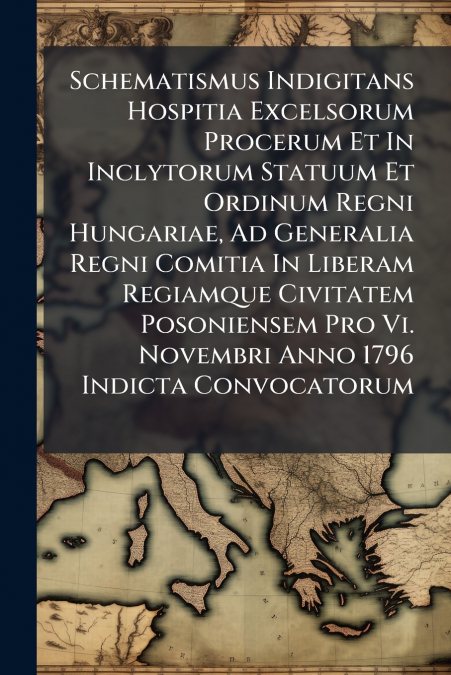
'Schematismus Indigitans Hospitia Excelsorum Procerum Et In Inclytorum Statuum Et Ordinum Regni Hungariae, Ad Generalia Regni Comitia In Liberam Regiamque Civitatem Posoniensem Pro Vi. Novembri Anno 1796 Indicta Convocatorum' is a historical document providing a detailed listing of accommodations for high-ranking nobles and representatives of the Kingdom of Hungary during the General Assembly convened in the free royal city of Posonium (present-day Bratislava) in November 1796. This rare publication offers valuable insights into the social and political structures of late 18th-century Hungary. It serves as a unique primary source for researchers and historians interested in Hungarian nobility, parliamentary proceedings, and the administration of the Habsburg Empire. The meticulous listing of residences provides a snapshot of the arrangements made for the assembly, reflecting the importance and logistical challenges of such gatherings.This work has been selected by scholars as being culturally important, and is part of the knowledge base of civilization as we know it. This work was reproduced from the original artifact, and remains as true to the original work as possible. Therefore, you will see the original copyright references, library stamps (as most of these works have been housed in our most important libraries around the world), and other notations in the work.This work is in the public domain in the United States of America, and possibly other nations. Within the United States, you may freely copy and distribute this work, as no entity (individual or corporate) has a copyright on the body of the work.As a reproduction of a historical artifact, this work may contain missing or blurred pages, poor pictures, errant marks, etc. Scholars believe, and we concur, that this work is important enough to be preserved, reproduced, and made generally available to the public. We appreciate your support of the preservation process, and thank you for being an important part of keeping this knowledge alive and relevant.