
Inicio > Matemáticas y ciencia > Química > Química física > Scanning Tunneling Microscopy II
Scanning Tunneling Microscopy II

Scanning Tunneling Microscopy II


65,93 €
IVA incluido
Disponible
Editorial:
Springer Nature B.V.
Año de edición:
1995
Materia
Química física
ISBN:
9783540585893
65,93 €
IVA incluido
Disponible

Selecciona una librería:

  • Librería Samer Atenea
  • Librería Aciertas (Toledo)
  • Kálamo Books
  • Librería Perelló (Valencia)
  • Librería Elías (Asturias)
  • Donde los libros
  • Librería Kolima (Madrid)
  • Librería Proteo (Málaga)

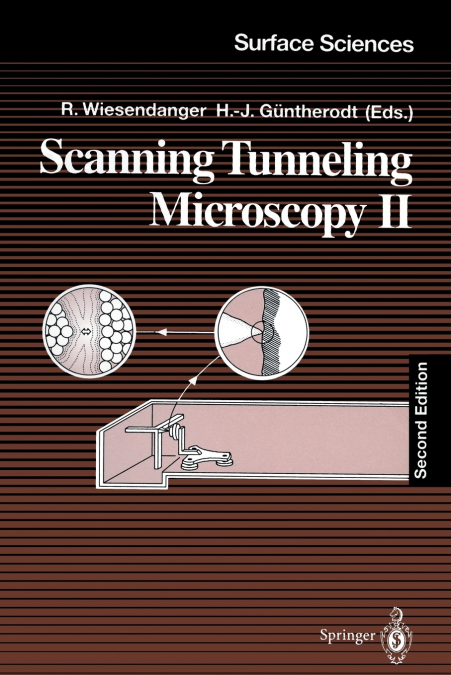
Scanning Tunneling Microscopy II, like its predecessor, presents detailed and comprehensive accounts of the basic principles and the broad range of applications of STM and related scanning probe techniques. The applications discussed in this volume come predominantly from the fields of electrochemistry and biology. In contrast to those in STM I, these studies may be performed in air and in liquids. The extensions of the basic technique to map other interactions are described in chapters on scanning force microscopy, magnetic force microscopy, and scanning near-field optical microscopy, together with a survey of other related techniques. Also discussed here is the use of a scanning proximal probe for surface modification. Together, the two volumes give a comprehensive account of experimental aspects of STM and provide essential reading and reference material. In this second edition the text has been updated and new methods are discussed.
Artículos relacionados

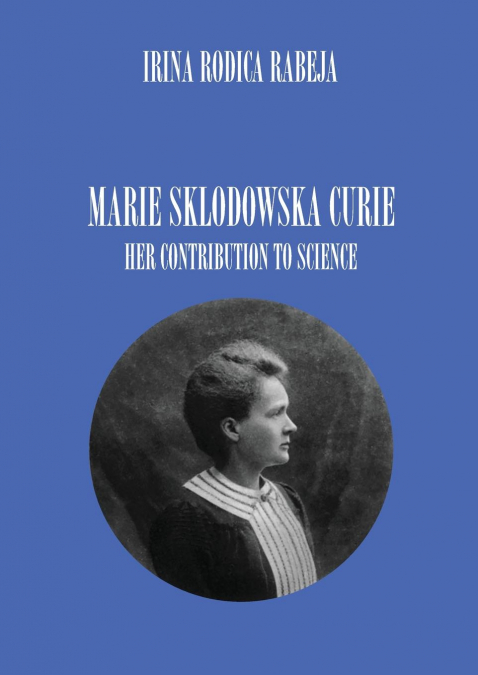
  • MARIE SKLODOWSKA CURIE
    Irina Rodica Rabeja
    Marie Sklodowska Curie (7 November 1867 – 4 July 1934) was one of the greatest scientific minds that brought a fundamental contribution in science opening the door to the understanding/knowledge of the structure of the atom in the 20th century.                 Marie Sklodowska Curie’s hypothesis that the spontaneous emission of powerful rays by some chemical elements, emission ...
    Disponible

    89,28 €

  • COMPUTER SIMULATIONS OF MOLECULES AND CONDENSED MATTER
    En-Ge Wang / LI XIN-ZHENG / Xin-Zheng Li / XIN-ZHENG LI & EN-GE WANG
    This book provides a relatively complete introduction to the methods used in computational condensed matter. A wide range of electronic structure theories are introduced, including traditional quantum chemistry methods, density functional theory, many-body perturbation theory, and more. Molecular dynamics simulations are also discussed, with extensions to enhanced sampling and ...
  • APPLIED THEORETICAL ORGANIC CHEMISTRY
    DEAN J TANTILLO / TANTILLO DEAN J
    This book provides state-of-the-art information on how studies in applied theoretical organic chemistry are conducted. It highlights the many approaches and tools available to those interested in using computational chemistry to predict and rationalize structures and reactivity of organic molecules. Chapters not only describe theoretical techniques in detail, but also describe ...
  • ELECTROANALYTICAL METHODS
    S Rani
    'Electroanalytical Methods' is a pivotal text that offers a comprehensive exploration of electrochemistry and its numerous applications across a wide array of scientific disciplines, including earth science, life science, physical science, biochemistry, and pharmaceutical chemistry. This book is an invaluable resource for chemistry graduates, underlining the increasing necessit...
    Disponible

    18,75 €

  • Advances in the Preparation, Properties and Application of Polyurethane, Cellulose and Their Composites
    Due to their excellent properties, polyurethane, cellulose and their composites have become widely used in previously unimagined areas. Given the fast-increasing consumption in recent years, the demand for advanced polyurethane- and cellulose-based composites is rapidly growing. Accordingly, this Special Issue seeks to showcase research papers, short communications and review a...
  • QUANTUM FIELD THEORY
    PORTER RICHARD N / RICHARD N PORTER
    This introduction to quantum field theory (QFT) is written by a physical chemist for physical chemists, chemical physicists, and other non-physicists with knowledge of quantum theory but who want to explore ways in which they might use the power of QFT in their investigations. This book starts where many graduate courses in quantum theory that are offered to chemistry students ...