Fabio Mirabella / Karl Constantine
 Librería Samer Atenea
 Kálamo Books
 Librería Elías (Asturias)
 Librería Kolima (Madrid)
 Librería Proteo (Málaga)
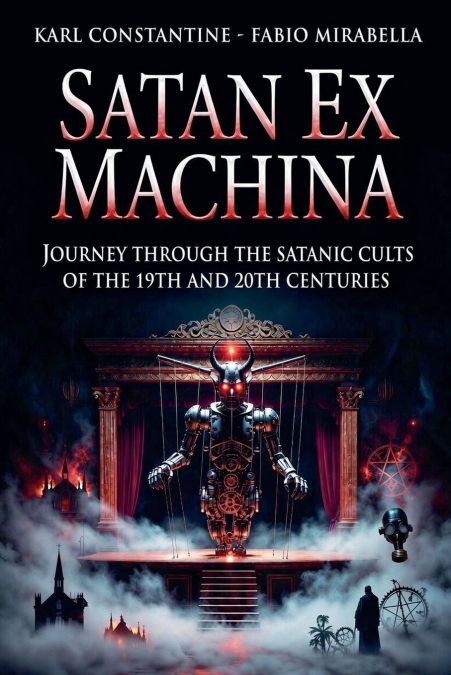
Satan Ex Machina: Journey Through the Satanic Cults of the XIX, XX and XXI Century is a rigorously researched and philosophically ambitious work that dismantles the myth of a unified, immortal Satanic conspiracy.The book is framed not as a sensational exposé, but as a 'work of rigorous, almost surgical humanism'. It is the product of a ten-year forensic journey by its authors, who were reportedly shaped by a 'childhood of shame they chose never to inflict on others'. It traces the evolution of the Satanic cabal myth from 1890s Paris salons to 21st-century WhatsApp groups and conspiracy theories like Pizzagate. The central argument is that this myth is not a revelation of hidden evil, but a 'philosophical autopsy of the Western imagination’s oldest ghost story'. The book meticulously deconstructs a series of alleged Satanic panics across three centuries, showing how each collapses into 'the same shabby components: a handful of isolated predators, a public craving for cosmic villainy, and a media ecosystem that profits from the inflation'. Specific historical touchstones examined include groups like the Narcosatánicos are examined with the same 'unflinching gaze' as more fashionable 21st-century myths, and that of the Church of the Final Judgement.Crucially, the book does not deny the existence of genuine abuse. It acknowledges 'repellent circles of abuse, small, squalid, and sometimes costumed in occult drag,' while refusing to grant them the status of a single, immortal conspiracy.The book’s 'most uncomfortable thesis' is that evil does not originate from external, interdimensional sources, but 'ascends, relentlessly, from the ordinary human heart'. The authors argue that conspiracism functions as a 'secular indulgence'-a way to absolve ourselves by delegating our own darkness to an external 'Satan' drawn from films, folklore, and tabloids. The true 'machinery of suffering' is identified as the banal, everyday indifference and predation that is 'too close, too visible' to satisfy our hunger for dramatic villains.Elegantly written, intellectually ferocious, and morally courageous. It is positioned as an 'act of intellectual mercy' in an era addicted to external enemies, one that 'does not flatter' or 'console,' but simply 'tells the truth'. Its conclusion is devastatingly inward-looking: the true satanic force is not found in dark-web forums or secret lodges, but 'the one we meet every morning in our own reflection'. The publisher boldly claims it may be 'one of the most important books of our young century'.