
Sandstorms And Deals

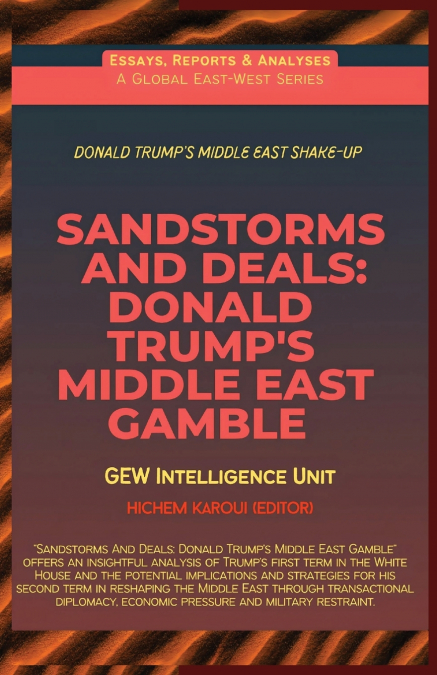
Sandstorms And Deals

GEW Intelligence Unit

49,23 €
IVA incluido
Disponible
Editorial:
Global East-West (London)
Año de edición:
2025
Materia
Relaciones internacionales
ISBN:
9781787953017
49,23 €
IVA incluido
Disponible

Selecciona una librería:

  • Librería Samer Atenea
  • Librería Aciertas (Toledo)
  • Kálamo Books
  • Librería Perelló (Valencia)
  • Librería Elías (Asturias)
  • Donde los libros
  • Librería Kolima (Madrid)
  • Librería Proteo (Málaga)

'Sandstorms And Deals' explores the prospects for Donald Trump’s return to the White House, signalling a potentially dramatic shift in America’s approach to the Middle East. Building on his first administration’s legacy, Trump’s second term promises to reshape regional dynamics through transactional diplomacy, economic pressure, and military restraint. This book examines the likely trajectory of Trump’s Middle East policy based on his campaign promises, previous records, and early signals from his transition team. Trump’s first term was defined by several signature Middle East initiatives: withdrawing from the Iran nuclear deal, relocating the US embassy to Jerusalem, brokering the Abraham Accords between Israel and several Arab states, and reducing American military footprint in the region. His 'America First' doctrine prioritised immediate US interests over traditional alliance structures and multilateral frameworks. Trump appears poised to double down on these approaches in his second term. His campaign rhetoric suggests an accelerated expansion of the Abraham Accords, potentially bringing Saudi Arabia into formal relations with Israel. This normalisation push aligns with Trump’s preference for deal-making and could reshape regional security architecture around containing Iran. Regarding the Israeli-Palestinian conflict, Trump’s second administration is likely to continue its strong pro-Israel stance while pursuing what his team has termed 'peace through strength.' The administration may revive elements of the 'Deal of the Century' approach, emphasizing economic development for Palestinians while sidelining traditional diplomatic frameworks for statehood. On Iran, Trump has signalled a return to 'maximum pressure' sanctions and isolation strategies. His administration appears determined to block Iran’s nuclear ambitions and regional proxy activities permanently. This hardline approach may increase tensions and complicate diplomatic efforts by European allies, potentially leading to greater regional polarization. Trump’s energy policy will significantly impact the region. His promised focus on American energy dominance and increased domestic production could affect oil markets and US relationships with Gulf partners. These states may need to offer more substantial concessions-whether in arms purchases, normalization with Israel, or regional security commitments-to maintain close ties with Washington. A defining characteristic of Trump’s approach is transactional diplomacy. Regional allies may face increased pressure to demonstrate tangible value to American interests through arms purchases, counter-terrorism cooperation, or economic deals benefiting US businesses. The military strategy will reflect Trump’s scepticism of open-ended commitments. While maintaining counter-terrorism operations, the administration may further reduce conventional troop deployments, emphasising air power, special operations, and partner capacity-building. The second Trump administration entered the Middle East, which was transformed by the Gaza conflict, shifting economic priorities, and evolving great power competition with China and Russia. How Trump navigates these complexities will determine whether his approach brings greater stability or volatility to this critical region. For regional leaders and international stakeholders, understanding Trump’s decision-making framework-prioritising direct US interests, favouring bilateral deals over multilateral frameworks, and evaluating relationships through an economic lens-will be essential for navigating this new chapter in American Middle East policy.

Artículos relacionados

  • Realism in Practice
    The purpose of this book is to appraise the current relevance and validity of realism as an interpretative tool in contemporary International Relations. All chapters of the book are animated by a theoretical effort to define the conceptual aspects of realism and attempt to establish whether the tradition still provides the necessary conceptual tools to scholars.The chapters add...
    Disponible

    20,36 €

  • Predicting gender violence in India
    Shritha K Vasudevan
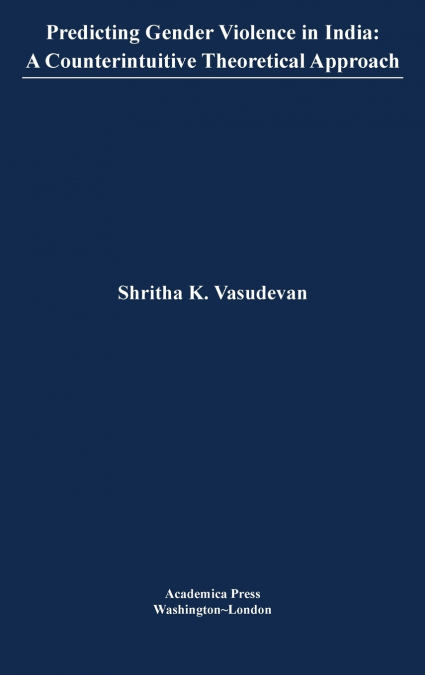
    In this provocative new book, Shritha Vasudevan argues that feminist international relations (IR) theory has inadvertently resulted in a biased worldview, the very opposite of what feminist IR set out to try to rectify. This book contests theoretical presumptions of Western feminist IR and attempts to reformulate it in contexts of non-Western cultures. Vasudevan deftly utilizes...
  • Contemporary security issues in Africa
    Isiaka Alani Badmus / Lere Amusan
    In volume, an emerging generation of African scholars examines specific states in Africa where instability is the order of the day. Considerations of African instability are highly relevant in today’s world, where one examines the types of regimes that were put in place after the Cold War and their effects on Africa. Multiparty systems introduced in Africa, rather than bringing...
  • Chronicles of the first and second chechen wars
    Ilya Milyukov
    Presented by Russian author and attorney Ilya Milyukov, Chronicles of the First and Second Chechen War presents the main events of the First (1994-1996) and Second (1999-2009) Wars in Chechnya, Russia’s deadliest conflicts since World War II. The First War began in December 1994 and lasted for one year and nine months, ending in August 1996. There were two major urban battles -...
  • Political instability in Africa
    Isiaka Alani Badmus / Lere Amusan
    This book offers broad-gauged analyses of the causes, nature, and changing patterns of armed conflict in Africa as well as the reasons for these patterns. It also situates conflicts that have been haunting the African continent since the time of decolonization within the various theoretical schools such as 'new war,' 'economic war,' 'neo-patrimonial,' and 'globalization.' It be...
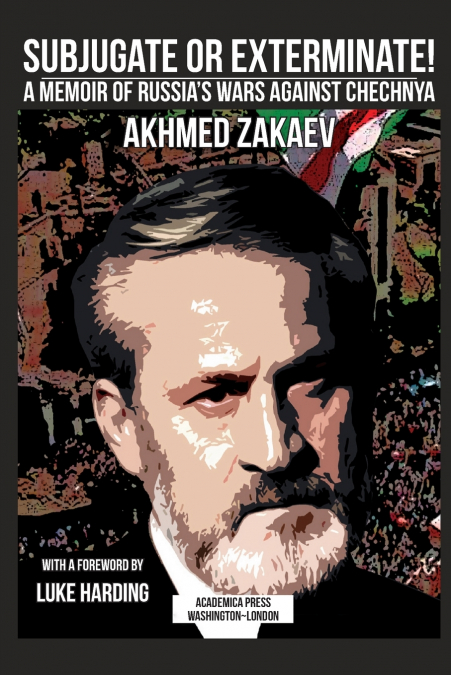
  • Subjugate or exterminate!
    Akhmed Zakaev / Arch Tait
    Foreword by Luke HardingAkhmed Zakaev is a symbol of the indomitable will of the Chechen nation. In this important memoir, he tells the story of the Chechen struggle as he experienced it, describing the conflict in human terms and providing a detailed documentary record of little known or badly understood events that will be of benefit to historians for generations to come.- Da...
    Disponible

    41,63 €

Otros libros del autor

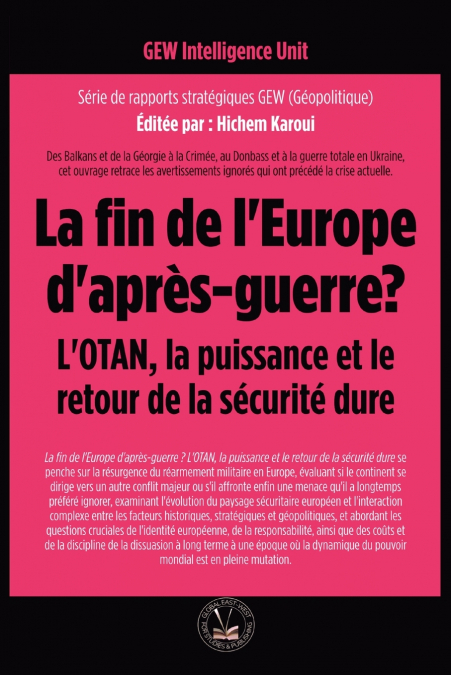
  • La fin de l’Europe d’après-guerre? L’OTAN, la puissance et le retour de la sécurité dure
    GEW Intelligence Unit
    'La fin de l’Europe d’après-guerre ? L’OTAN, la puissance et le retour de la sécurité dure' propose une analyse structurée en plusieurs parties du paysage sécuritaire européen en mutation après la fin de l’ordre de l’après-guerre froide.La première partie, intitulée 'Le démantèlement de l’ordre de l’après-guerre froide', replace la guerre en Ukraine dans une perspective plus la...
    Disponible

    67,01 €

  • The End Of Postwar Europe? NATO, Power, And The Return Of Hard Security
    GEW Intelligence Unit
    The End of Postwar Europe? NATO, Power, and the Return of Hard Security offers a structured, multi‑part analysis of Europe’s changing security landscape after the end of the post-Cold War order.Part I, 'The Unravelling of the Post-Cold War Order', situates the war in Ukraine within a longer trajectory: the reset with Russia, the illusion of a 'long holiday from history', and th...
    Disponible

    70,42 €

  • Powering The Future
    GEW Intelligence Unit
    Powering the Future opens a wide-angle lens on China’s emerging partnership with the Arab oil states, a relationship moving almost silently under the public radar. The book asks how the modern tide of crude and liquefied gas is refashioning the balance sheet of global energy and, in a larger sense, the balance of power itself. Quietly, almost on the same schedule as the country...
    Disponible

    59,63 €

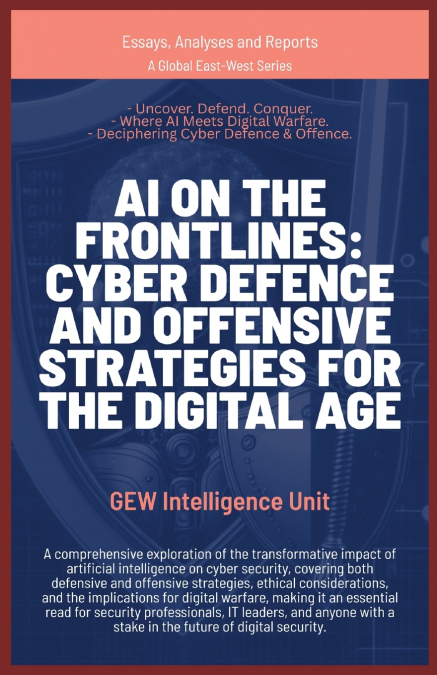
  • AI on the Frontlines
    GEW Intelligence Unit
    The emergence of Artificial Intelligence (AI) has drastically altered the conditions of warfare. AI now plays an integral role in every facet of a nation-state’s military/surveillance structure, from cybersecurity to espionage to covert operations. AI technologies are reshaping the science of cyber warfare. A single slip could mean dire consequences with the new world order whe...
    Disponible

    44,99 €

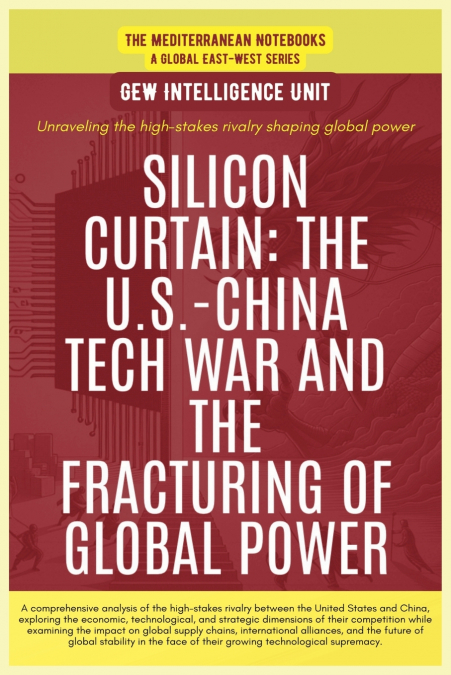
  • Silicon Curtain
    GEW Intelligence Unit
    The 21st century’s defining geopolitical contest is unfolding between the United States and China, two superpowers locked in a high-stakes rivalry that spans trade, technology, and global influence. Once economic partners, their relationship has devolved into a tense competition marked by tariffs, export controls, and a race to dominate critical technologies.This book dissects ...
    Disponible

    53,44 €

  • The Ethical Battlefield
    GEW Intelligence Unit
    The integration of artificial intelligence (AI) into military operations marks a pivotal shift in the nature of modern warfare, bringing unparalleled precision, efficiency, and ethical challenges. As military powers increasingly adopt AI-driven systems-ranging from autonomous weapons to advanced surveillance-debate has intensified over their impact, particularly when such techn...
    Disponible

    54,54 €