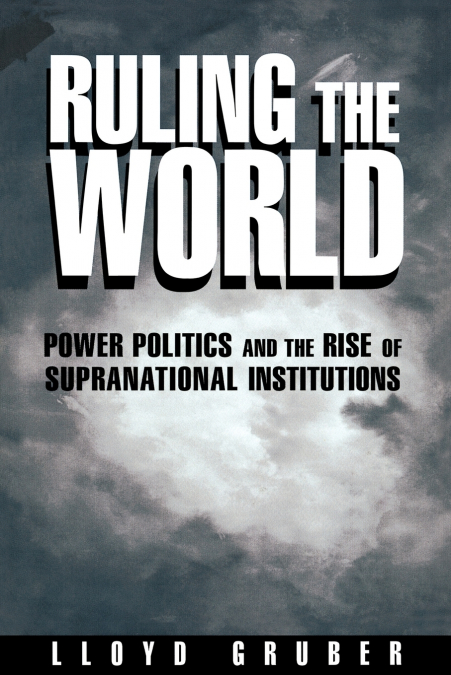

Ruling the World

Ruling the World

Lloyd Gruber

78,93 €
IVA incluido
Disponible
Editorial:
Princeton University Press
Año de edición:
2000
Materia
Relaciones internacionales
ISBN:
9780691010410
78,93 €
IVA incluido
Disponible

Selecciona una librería:

  • Librería Samer Atenea
  • Librería Aciertas (Toledo)
  • Kálamo Books
  • Librería Perelló (Valencia)
  • Librería Elías (Asturias)
  • Donde los libros
  • Librería Kolima (Madrid)
  • Librería Proteo (Málaga)

The last few decades have witnessed an extraordinary transfer of policy-making prerogatives from individual nation-states to supranational institutions. If you think this is cause for celebration, you are not alone. Within the academic community (and not only among students of international cooperation), the notion that political institutions are mutually beneficial--that they would never come into existence, much less grow in size and assertiveness, were they not 'Pareto-improving'--is today’s conventional wisdom. But is it true? In this richly detailed and strikingly original study, Lloyd Gruber suggests that this emphasis on cooperation’s positive-sum consequences may be leading scholars of international relations down the wrong theoretical path. The fact that membership in a cooperative arrangement is voluntary, Gruber argues, does not mean that it works to everyone’s advantage. To the contrary, some cooperators may incur substantial losses relative to the original, non-cooperative status quo. So what, then, keeps these participants from withdrawing? Gruber’s answer, in a word, is power--specifically the 'go-it-alone power' exercised by the regime’s beneficiaries, many of whom would continue to benefit even if their partners, the losers, were to opt out. To lend support to this thesis, Gruber takes a fresh look at the political origins and structures of European Monetary Unification and NAFTA. But the theoretical arguments elaborated in Ruling the World extend well beyond money and trade, touching upon issues of long-standing interest to students of security cooperation, environmental politics, nation-building--even political philosophy. Bold and compelling, this book will appeal to anyone interested in understanding how 'power politics' really operates and why, for better or worse, it is fueling much of the supranational activity we see today.

Artículos relacionados

  • Realism in Practice
    The purpose of this book is to appraise the current relevance and validity of realism as an interpretative tool in contemporary International Relations. All chapters of the book are animated by a theoretical effort to define the conceptual aspects of realism and attempt to establish whether the tradition still provides the necessary conceptual tools to scholars.The chapters add...
    Disponible

    20,36 €

  • Predicting gender violence in India
    Shritha K Vasudevan
    In this provocative new book, Shritha Vasudevan argues that feminist international relations (IR) theory has inadvertently resulted in a biased worldview, the very opposite of what feminist IR set out to try to rectify. This book contests theoretical presumptions of Western feminist IR and attempts to reformulate it in contexts of non-Western cultures. Vasudevan deftly utilizes...
  • Contemporary security issues in Africa
    Isiaka Alani Badmus / Lere Amusan
    In volume, an emerging generation of African scholars examines specific states in Africa where instability is the order of the day. Considerations of African instability are highly relevant in today’s world, where one examines the types of regimes that were put in place after the Cold War and their effects on Africa. Multiparty systems introduced in Africa, rather than bringing...
  • Chronicles of the first and second chechen wars
    Ilya Milyukov
    Presented by Russian author and attorney Ilya Milyukov, Chronicles of the First and Second Chechen War presents the main events of the First (1994-1996) and Second (1999-2009) Wars in Chechnya, Russia’s deadliest conflicts since World War II. The First War began in December 1994 and lasted for one year and nine months, ending in August 1996. There were two major urban battles -...
  • Political instability in Africa
    Isiaka Alani Badmus / Lere Amusan
    This book offers broad-gauged analyses of the causes, nature, and changing patterns of armed conflict in Africa as well as the reasons for these patterns. It also situates conflicts that have been haunting the African continent since the time of decolonization within the various theoretical schools such as 'new war,' 'economic war,' 'neo-patrimonial,' and 'globalization.' It be...
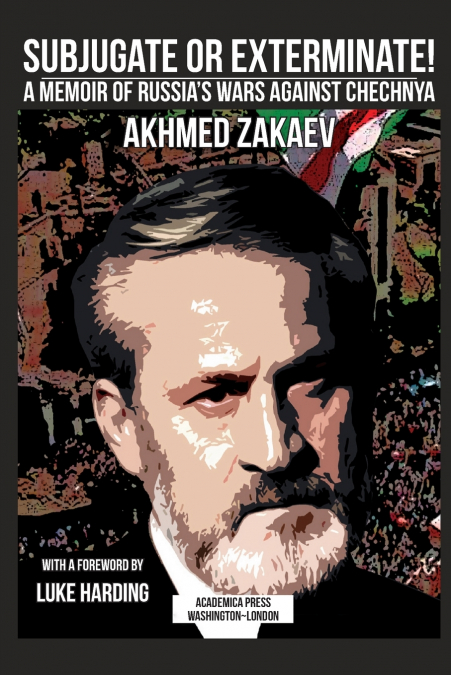
  • Subjugate or exterminate!
    Akhmed Zakaev / Arch Tait
    Foreword by Luke HardingAkhmed Zakaev is a symbol of the indomitable will of the Chechen nation. In this important memoir, he tells the story of the Chechen struggle as he experienced it, describing the conflict in human terms and providing a detailed documentary record of little known or badly understood events that will be of benefit to historians for generations to come.- Da...
    Disponible

    41,63 €