 Librería Samer Atenea
 Kálamo Books
 Librería Elías (Asturias)
 Librería Kolima (Madrid)
 Librería Proteo (Málaga)
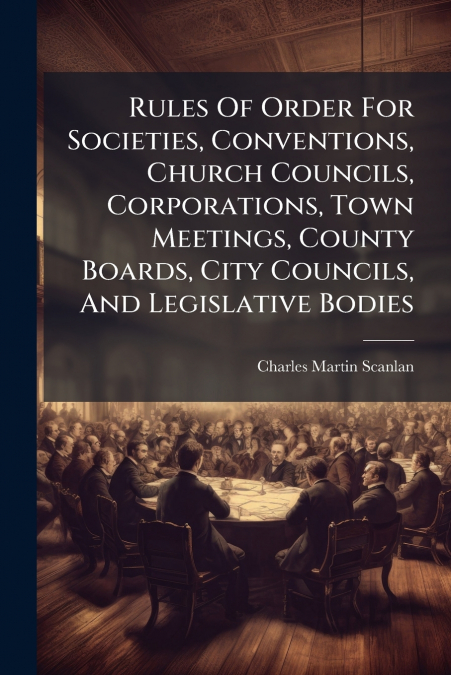
This comprehensive guide, 'Rules Of Order For Societies, Conventions, Church Councils, Corporations, Town Meetings, County Boards, City Councils, And Legislative Bodies', provides a clear and concise framework for conducting meetings and managing organizations effectively. Written by Charles Martin Scanlan, it offers practical advice on parliamentary procedure, ensuring that deliberations are fair, orderly, and productive. Covering a wide range of organizational settings, from church councils to legislative bodies, this book outlines the essential rules and protocols necessary for successful governance. It is an invaluable resource for anyone seeking to maintain order and facilitate meaningful discussions within their respective groups. Whether you are a seasoned leader or a new member, this guide equips you with the knowledge to navigate meetings with confidence and contribute to informed decision-making.This work has been selected by scholars as being culturally important, and is part of the knowledge base of civilization as we know it. This work was reproduced from the original artifact, and remains as true to the original work as possible. Therefore, you will see the original copyright references, library stamps (as most of these works have been housed in our most important libraries around the world), and other notations in the work.This work is in the public domain in the United States of America, and possibly other nations. Within the United States, you may freely copy and distribute this work, as no entity (individual or corporate) has a copyright on the body of the work.As a reproduction of a historical artifact, this work may contain missing or blurred pages, poor pictures, errant marks, etc. Scholars believe, and we concur, that this work is important enough to be preserved, reproduced, and made generally available to the public. We appreciate your support of the preservation process, and thank you for being an important part of keeping this knowledge alive and relevant.