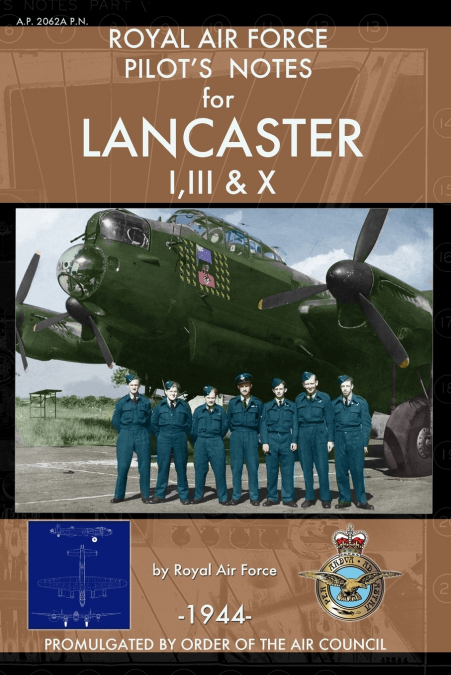

Royal Air Force Pilot’s Notes for Lancaster I, III & X

Royal Air Force Pilot’s Notes for Lancaster I, III & X

Royal Air Force

11,79 €
IVA incluido
Disponible
Editorial:
Periscope Film
Año de edición:
2013
ISBN:
9781937684525
11,79 €
IVA incluido
Disponible

Selecciona una librería:

  • Librería Samer Atenea
  • Librería Aciertas (Toledo)
  • Kálamo Books
  • Librería Perelló (Valencia)
  • Librería Elías (Asturias)
  • Donde los libros
  • Librería Kolima (Madrid)
  • Librería Proteo (Málaga)

Designed by Avro’s Roy Chadwick to replace the Manchester, the Lancaster four-engine bomber became the RAF’s main heavy bomber during WWII. The most successful night bomber of WWII, it flew over 150,000 sorties over occupied Europe and delivered over 600,000 long tons of bombs. The 'Lanc’s' large bomb bay meant that it could carry the largest bombs in RAF inventory including the 12,000 lb 'blockbuster' type called the 'Tallboy', the 'Grand Slam' 22,000 lb bomb, and (after receiving modifications) the 'bouncing bombs' for the attack on Germany’s Ruhr dams in 1943. The Lancaster carried a crew of seven: pilot, flight engineer, bombardier, radio operator, navigator and two gunners. The all-metal aircraft carried eight machine guns, and had a range of 3,000 miles, a ceiling of 23,500 feet, and a maximum speed of 280 mph.Over 7,300 Lancasters were built from 1941 through 1946. Of this number, 3,249 were lost in action. In addition to service with the R.A.F., Lancs flew for the Canadian and Australian air forces, in the Soviet Union, and after WWII for a variety of air forces worldwide. These pilot’s notes were standard issue for R.A.F. pilots and flight engineers circa 1944. They contain information about aircraft operation, controls, handling, and emergencies.

Artículos relacionados

  • Cessna 1974 Model 172 and Skyhawk Owner’s Manual
    Cessna Aircraft Company
    Cessna Pilot Operating Handbook for 1974 Cessna 172Table of Contents:Operating ChecklistDescription and Operating DetailsEmergency ProceduresOperating LimitationsCare of the AirplaneOperational DataOptional Systems ...
    Disponible

    17,52 €

  • Back to Somalia
    Glenn A. Bell
    WHAT DO NORTH KOREAN NUKES, SOMALI PIRATES, HELICOPTERS, JET AIRPLANES, SUBMARINES, AIRCRAFT CARRIERS, AND SAVANNAH HAVE IN COMMON? ANSWER: CAJUN Ethan Breaux, call sign Cajun, has been flying charters out of Bristol, England for two years. His life as a civilian pilot has been going very well after many years of flying Special Ops missions in Army helicopters. Cajun is sought ...
    Disponible

    20,34 €

  • Aeronautical Engines
    Biblioteca Aeronáutica
    Universal history has transmitted through generations the legacy of Sir Francis Bacon regarding knowledge... 'knowledge is power' states the famous phrase. In aviation, we adapt it and can assert that knowledge is safety. The more a pilot knows, the better prepared they will be to take appropriate actions, be informed for assertive decision-making, etc. In other words: learnin...
  • From Cessna to Boeing
    Biblioteca Aeronáutica
    The transition from one aircraft to another is not a problem ina pilot’s career if the change is gradual or of similar characteristics.However, when this change is made more abruptly, it results in amore difficult transition to understand and assimilate.It wouldn’t be difficult to change from a Cessna 152 to aCessna 172, to mention random models, but going from flying aCessna 1...
  • VFR Navigation
    Biblioteca Aeronáutica
    VFR Navigation is not just another navigation book; it is a constant reference manual that should be part of your flight bag throughout your career. In the following pages, we will endeavor to document the basic techniques of visual navigation for posterity, although they may soon become part of a glorious and challenging past. Nonetheless, they are experiences that no pilot wi...
  • FLIGHT TRAINING MANUAL
    Stewart E Maddigan
    FLIGHT TRAINING MANUAL - Flight Theory for Recreational Pilots.For the Recreational Aviation Australia (RAAus) Pilot Certificate and Endorsements.Designed to Integrate with the Flight Training Syllabus for Recreational Pilots.Thoroughly concise ’All in a Nutshell’ Theory Curriculum.Practice Exam Questions & Answers after each lesson.INTRODUCTION: The purpose of this Flight Trai...
    Disponible

    144,59 €

Otros libros del autor

  • WAR IN THE AIR MAP CASE 3
    Royal Air Force
    'The Air Raids that Shook Britain in the First World War', shown in a chronological series of Ordnance Survey maps, overlaid to show the path taken German Zeppelins.Zeppelin tactical numbers are shown along with weather information, number of bombs dropped, casualties - both killed and wounded - and, interestingly, monetary damage. Of immense value to both the air historian and...
    Disponible

    72,48 €

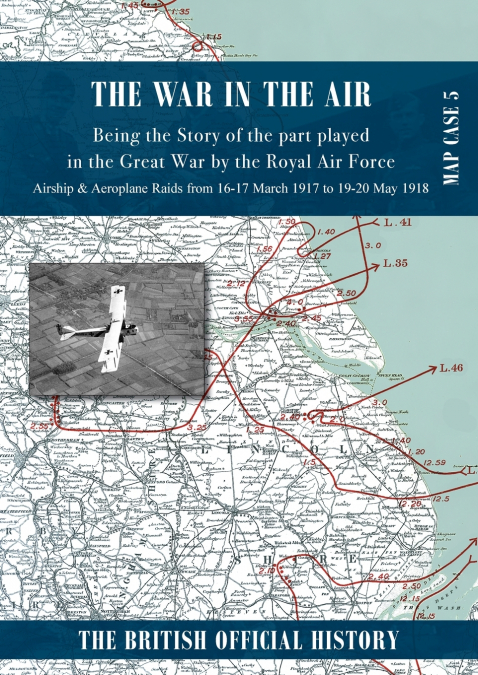
  • WAR IN THE AIR MAP CASE 5
    Royal Air Force
    A series of 28 Ordnance Survey maps, that are overlaid to show the path taken by German Zeppelins & Aircraft during air raids over England. Of immense value to both the Great War air historian, and local history expert. This volume covers AIRSHIP RAIDS from 16-17 March 1917 to 29. 5-6 August 1918, & AEROPLANE RAIDS from 25 May 1917 to 19-20 May 1918. Zeppelin tactical numbers a...
    Disponible

    72,71 €

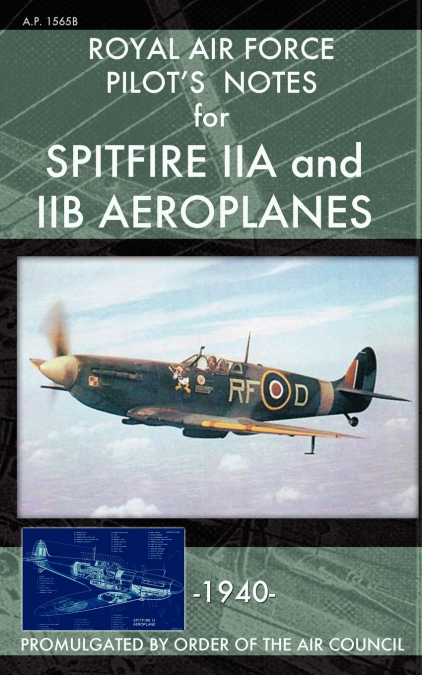
  • Royal Air Force Pilot’s Notes for Spitfire IIA and IIB Aeroplanes
    Royal Air Force
    The epitome of grace, beauty and design, the Supermarine Spitfire was one of the most deadly fighters of WWII. Manufactured in huge numbers - over 20,000 were built - the Spitfire was the only fighter airplane in production at thebeginning of WWII, that remained in production after the conflict. Many different variants were produced including the Seafire naval fighter. Nineteen...
    Disponible

    10,21 €

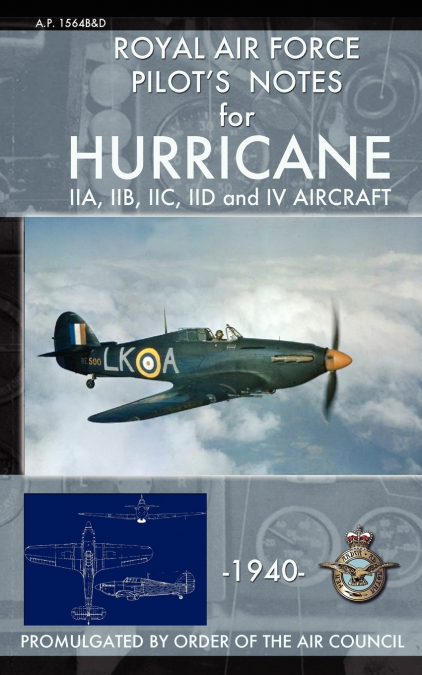
  • Royal Air Force Pilot’s Notes for Hurricane
    Royal Air Force
    The first monoplane fighter in the Royal Air Force, the Hurricane was designed by Sydney Camm in 1934 and first flew in 1935. A rugged,single-seat aircraft, the Hurricane was the first combat aircraft in theRAF capable of 300 mph in level flight. During the Battle of Britain,the Hurricane equipped more than three fifths of the RAF’s fightercommand, accounting for 32 squadrons...
    Disponible

    10,81 €

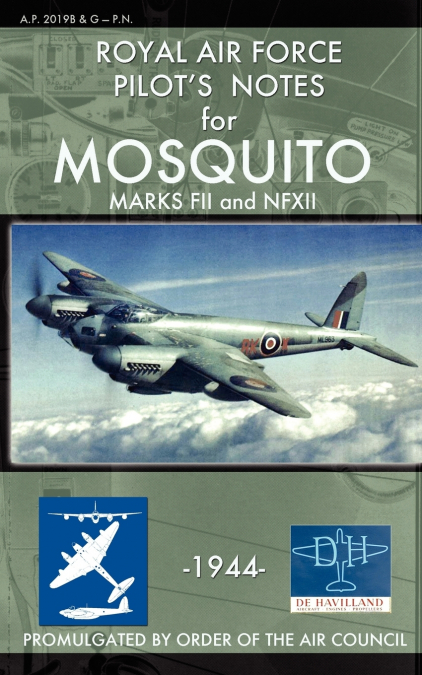
  • Royal Air Force Pilot’s Notes for Mosquito Marks FII and NFXII
    Royal Air Force
    When Britain’s brilliant aircraft designer Geoffrey de Havilland first proposed the Mosquito, the Air Ministry greeted the idea with skepticism. Powered by twin Merlin engines, the bomber would be constructed almost entirely of wood and handle like a fighter. Stripped of heavy defensive weapons and armor,its advantage was its light weight and high speed, which would allow it ...
    Disponible

    9,64 €

  • Royal Air Force Pilot’s Notes for Hornet FIII
    Royal Air Force
    Designed during WWII as a long-range fighter, the Hornet represented an evolution of the de Havilland Mosquito and was the fastest piston-powered fighter in Royal Air Force service. Like the Mosquito, the Hornet had a fuselage built largely of balsa and plywood, but boasted laminar flow wings and massive Rolls-Royce V12 engines with 12-foot diameter, four-bladed props. It cou...
    Disponible

    9,77 €