

 Librería Samer Atenea
 Kálamo Books
 Librería Elías (Asturias)
 Librería Kolima (Madrid)
 Librería Proteo (Málaga)
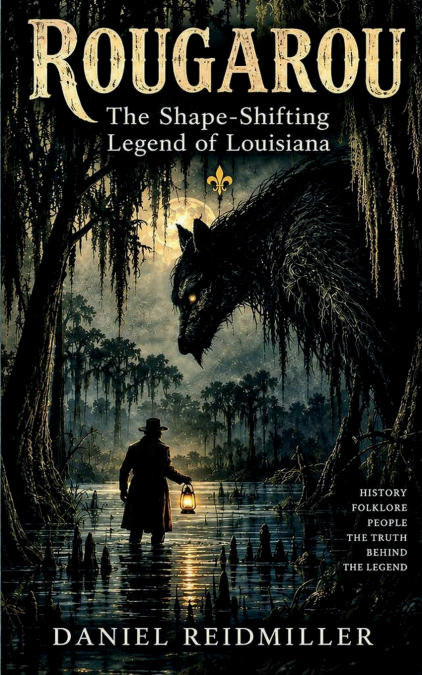
Deep in Louisiana’s folklore lives a creature whose name has been repeated for generations: the Rougarou.Often described today as Louisiana’s werewolf, the Rougarou has a far more complicated history. Its story reaches through French and French Canadian traditions, Cajun and Creole communities, Catholic influence, oral history, family warnings, swamps, bayous, changing place names, and generations of retelling. Somewhere along the way, folklore became legend, legend became monster, and the Rougarou acquired a history that is not always as old, or as simple, as modern accounts suggest.In Rougarou: The Shape-Shifting Legend of Louisiana, Daniel Reidmiller follows the story backward.Rather than beginning with the assumption that every tale describes the same creature, Reidmiller examines what the historical record actually preserves. He traces early terminology and traditions, explores the influence of the French loup-garou, examines Louisiana oral histories and archival collections, and looks closely at how geography, religion, family tradition, newspapers, books, television, tourism, and the internet have shaped the Rougarou familiar to us today.The investigation also asks the harder question: Is there anything behind the legend?Modern encounters are considered alongside known Louisiana wildlife, eyewitness reliability, environmental conditions, physical evidence, and the problems that arise when old folklore and modern cryptid reports become mixed together. Locations are treated cautiously, sources are followed as far back as possible, and an old story is not automatically accepted as an old record simply because it has been repeated for decades.This is neither an attempt to prove the Rougarou exists nor an effort to explain the legend away.It is an investigation into what we actually know, what Louisiana tradition tells us, what later storytellers added, and what remains unexplained.The Rougarou has changed considerably over the centuries.Finding out how it changed may be every bit as interesting as discovering what, if anything, has been hiding behind the name.








