pseud. M. A. E. L. Cross ((George Eliot
 Librería Samer Atenea
 Kálamo Books
 Librería Elías (Asturias)
 Librería Kolima (Madrid)
 Librería Proteo (Málaga)
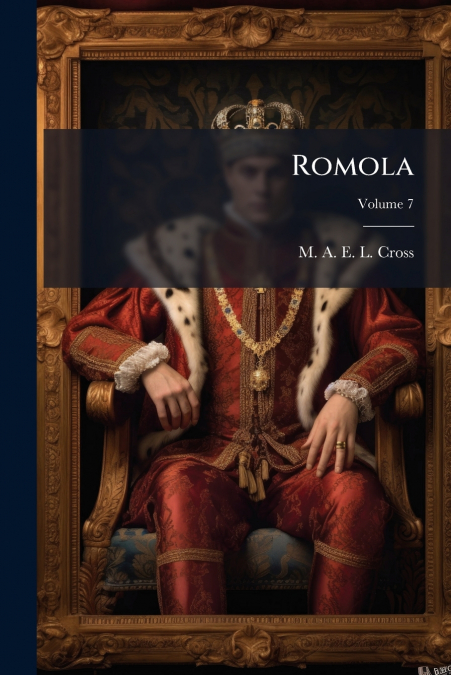
Set in the vibrant and tumultuous city of Florence during the late 15th century, 'Romola' Volume 7 by George Eliot (M. A. E. L. Cross) is a powerful historical novel that explores themes of love, betrayal, faith, and moral responsibility. The story centers on Romola de’ Bardi, a noblewoman of great intellect and compassion, whose life becomes entangled with the charismatic but ultimately fanatical religious reformer, Girolamo Savonarola. As Florence grapples with political intrigue and spiritual fervor, Romola finds herself torn between her loyalty to her family, her growing disillusionment with her marriage, and the compelling influence of Savonarola’s fiery sermons. Eliot masterfully portrays the complexities of human nature against the backdrop of a city undergoing profound social and religious change. 'Romola' is a compelling exploration of individual conscience and the enduring power of historical forces, showcasing Eliot’s signature blend of psychological insight and historical detail.This work has been selected by scholars as being culturally important, and is part of the knowledge base of civilization as we know it. This work was reproduced from the original artifact, and remains as true to the original work as possible. Therefore, you will see the original copyright references, library stamps (as most of these works have been housed in our most important libraries around the world), and other notations in the work.This work is in the public domain in the United States of America, and possibly other nations. Within the United States, you may freely copy and distribute this work, as no entity (individual or corporate) has a copyright on the body of the work.As a reproduction of a historical artifact, this work may contain missing or blurred pages, poor pictures, errant marks, etc. Scholars believe, and we concur, that this work is important enough to be preserved, reproduced, and made generally available to the public. We appreciate your support of the preservation process, and thank you for being an important part of keeping this knowledge alive and relevant.