Inicio > Tecnología, ingeniería, agricultura > Tecnología: cuestiones generales > Risk Importance Measures in the Design and Operation of Nuclear Power Plants
Risk Importance Measures in the Design and Operation of Nuclear Power Plants

Risk Importance Measures in the Design and Operation of Nuclear Power Plants

Risk Importance Measures in the Design and Operation of Nuclear Power Plants

Ivan Vrbanic / Ivica Basic / Pranab Samanta

153,83 €
IVA incluido
Disponible
Editorial:
ASME Press
Año de edición:
2017
Materia
Tecnología: cuestiones generales
ISBN:
9780791861394
153,83 €
IVA incluido
Disponible

Selecciona una librería:

  • Librería Samer Atenea
  • Librería Aciertas (Toledo)
  • Kálamo Books
  • Librería Perelló (Valencia)
  • Librería Elías (Asturias)
  • Donde los libros
  • Librería Kolima (Madrid)
  • Librería Proteo (Málaga)

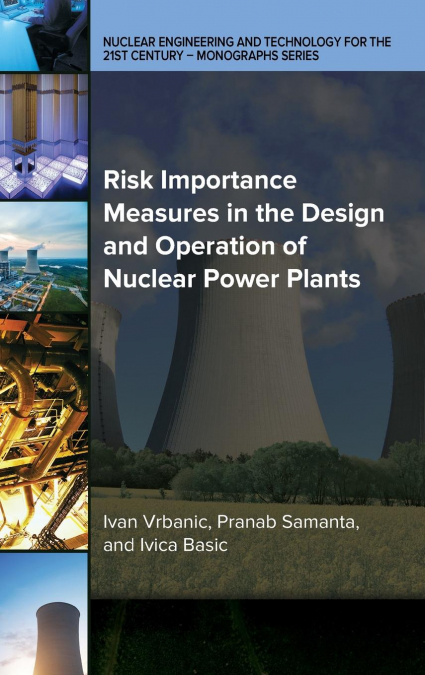
This monograph presents and discusses risk importance measures as quantified by the probabilistic risk assessment (PRA) models of nuclear power plants (NPPs) developed according to the current standards and practices. Usually, PRA tools calculate risk importance measures related to a single “basic event” representing particular failure mode. This is, then, reflected in many current PRA applications. The monograph focuses on the concept of “component-level” importance measures that take into account different failure modes of the component including common-cause failures (CCFs). In opening sections the role of risk assessment in safety analysis of an NPP is introduced and discussion given of “traditional”, mainly deterministic, design principles which have been established to assign a level of importance to a particular system, structure or component. This is followed by an overview of main risk importance measures for risk increase and risk decrease from current PRAs. Basic relations which exist among the measures are shown. Some of the current practical applications of risk importance measures from the field of NPP design, operation and regulation are discussed. The core of the monograph provides a discussion on theoretical background and practical aspects of main risk importance measures at the level of “component” as modeled in a PRA, starting from the simplest case, single basic event, and going toward more complex cases with multiple basic events and involvements in CCF groups. The intent is to express the component-level importance measures via the importance measures and probabilities of the underlying single basic events, which are the inputs readily available from a PRA model and its results. Formulas are derived and discussed for some typical cases. The formulas and their results are demonstrated through some practical examples, done by means of a simplified PRA model developed in and run by RiskSpectrum® tool, which are presented in the appendices. 3

Artículos relacionados

  • Science and the Big Issues of Our Time
    Martin Gellender
    Within the last few generations, our world has been shaped by technological change enabled by scientific advances. This is particularly evident to the 'baby boomer' generation, who have lived through and witnessed huge changes in society over the course of their lifetimes. Although many have little education in science, or have forgotten what they learned in high school, they u...
    Disponible

    26,58 €

  • Statics+++
    James W Dally / Robert J Bonenberger
    This textbook has been prepared to support a course offering for Statics at the University of Nevada at Reno.  Statics provides the first exposure of engineering students to the study of mechanics.  While Statics is a relatively simple subject, many students find it difficult, and they often perform far below our expectations.  In an effort to improve the curriculum, several me...
    Disponible

    101,22 €

  • Technical Writing, Presentational Skills, and Online Communication
    Raymond Greenlaw
    This book addresses four main topics: professional ethics, technical writing, presentation skills, and online writing. These topics are woven throughout the book and some of them are the main subjects of one or more chapters. The overarching theme of this book is to provide well-tested, best-practice techniques and strategies for main topic areas while focusing on information t...
  • Project Management Techniques and Innovations in Information Technology
    John Wang
    Managing cost, time, and quality of a project can be a challenging task for any project manager, but especially in times of an ever-changing and burgeoning field of IT. Project Management Techniques and Innovations in Information Technology offers a vital compendium of the latest research, case studies, best practices, and methodologies within the field of IT project management...
  • Phenomenology, Organizational Politics, and IT Design
    Information systems are researched, published on, and utilized as an extremely broad and vital sector of current technology development, usually studied from the scientific or technological viewpoints therein. Phenomenology, Organizational Politics, and IT Design: The Social Study of Information Systems offers a new look at the latest research and critical issues within the fie...
  • Geotechnical Applications for Earthquake Engineering
    Disaster preparedness and response management is a burgeoning field of technological research, and staying abreast of the latest developments within the field is a difficult task. Geotechnical Applications for Earthquake Engineering: Research Advancements has collected chapters from experts from around the world in a variety of applications, frameworks, and methodologies, and p...