 Librería Samer Atenea
 Kálamo Books
 Librería Elías (Asturias)
 Librería Kolima (Madrid)
 Librería Proteo (Málaga)
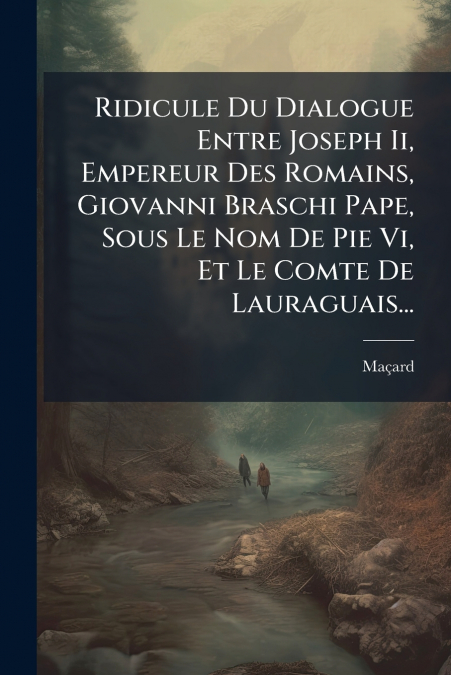
'Ridicule Du Dialogue Entre Joseph II, Empereur Des Romains, Giovanni Braschi Pape, Sous Le Nom De Pie VI, Et Le Comte De Lauraguais...' is a satirical work presenting a fictional dialogue between Emperor Joseph II and Pope Pius VI, mediated by the Comte de Lauraguais. This French text offers a critical perspective on the political and religious tensions of the late 18th century. The dialogue format allows for a sharp and often humorous examination of the power dynamics between the Holy Roman Empire and the Papacy, reflecting the Enlightenment-era debates regarding the role of the church and state.Maçard’s work provides valuable insights into the intellectual climate of the period and offers a glimpse into the controversies surrounding these significant historical figures. The book’s enduring appeal lies in its ability to shed light on the complex relationships between political authority, religious doctrine, and individual ambition.This work has been selected by scholars as being culturally important, and is part of the knowledge base of civilization as we know it. This work was reproduced from the original artifact, and remains as true to the original work as possible. Therefore, you will see the original copyright references, library stamps (as most of these works have been housed in our most important libraries around the world), and other notations in the work.This work is in the public domain in the United States of America, and possibly other nations. Within the United States, you may freely copy and distribute this work, as no entity (individual or corporate) has a copyright on the body of the work.As a reproduction of a historical artifact, this work may contain missing or blurred pages, poor pictures, errant marks, etc. Scholars believe, and we concur, that this work is important enough to be preserved, reproduced, and made generally available to the public. We appreciate your support of the preservation process, and thank you for being an important part of keeping this knowledge alive and relevant.