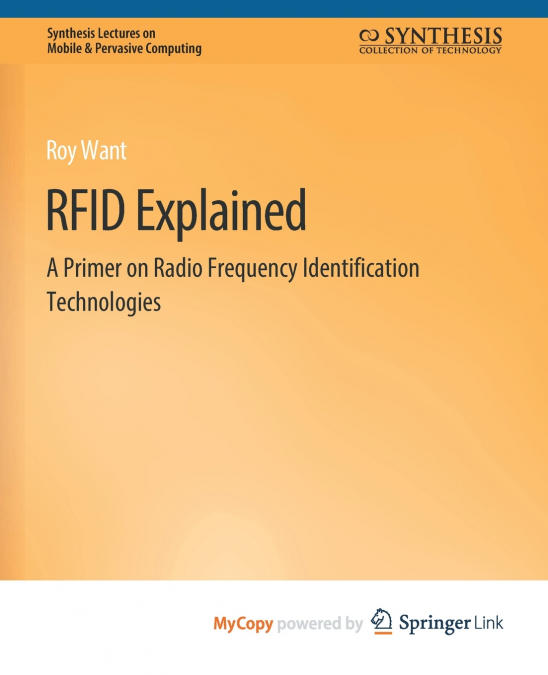

RFID Explained

RFID Explained

Roy Want

50,06 €
IVA incluido
Disponible
Editorial:
Springer Nature B.V.
Año de edición:
2007
Materia
Matemáticas
ISBN:
9783031036026
50,06 €
IVA incluido
Disponible

Selecciona una librería:

  • Librería Samer Atenea
  • Librería Aciertas (Toledo)
  • Kálamo Books
  • Librería Perelló (Valencia)
  • Librería Elías (Asturias)
  • Donde los libros
  • Librería Kolima (Madrid)
  • Librería Proteo (Málaga)

This lecture provides an introduction to Radio Frequency Identification (RFID), a technology enabling automatic identification of objects at a distance without requiring line-of-sight. Electronic tagging can be divided into technologies that have a power source (active tags), and those that are powered by the tag interrogation signal (passive tags); the focus here is on passive tags. An overview of the principles of the technology divides passive tags into devices that use either near field or far field coupling to communicate with a tag reader. The strengths and weaknesses of the approaches are considered, along with the standards that have been put in place by ISO and EPCGlobal to promote interoperability and the ubiquitous adoption of the technology. A section of the lecture has been dedicated to the principles of reading co-located tags, as this represents a significant challenge for a technology that may one day be able to automatically identify all of the items in your shopping cart in a just few seconds. In fact, RFID applications are already quite extensive and this lecture classifies the primary uses. Some variants of modern RFID can also be integrated with sensors enabling the technology to be extended to measure parameters in the local environment, such as temperature & pressure. The uses and applications of RFID sensors are further described and classified. Later we examine important lessons surrounding the deployment of RFID for the Wal-Mart and the Metro AG store experiences, along with deployments in some more exploratory settings. Extensions of RFID that make use of read/write memory integrated with the tag are also discussed, in particular looking at novel near term opportunities. Privacy and social implications surrounding the use of RFID inspire recurring debates whenever there is discussion of large scale deployment; we examine the pros and cons of the issues and approaches for mitigating the problems. Finally, the remaining challenges of RFID are considered and we look to the future possibilities for the technology. Table of Contents: Introduction / Principles of Radio Frequency Identification / RFID Industry Standards / Reading Collected RFID Tags / Applications of RFID Tagging / RFID Incorporating Sensing / Deployment and Experience with RFID Systems / Privacy, Kill Switches, and Blocker Tags / Opportunities for RFID Integrated with Memory / Challenges, Future Technology, and Conclusion

Artículos relacionados

  • Wearable Electronics and Embedded Computing Systems for Biomedical Applications
    Wearable electronics and embedded computing systems have been receiving a great deal of interest over the last two decades in research and commercial fields, with a special focus on biomedical applications. The key benefits introduced by these systems include their small size, lightweight, low-power consumption, and, of course, wearability. Major human-centered applications are...
    Disponible

    67,84 €

  • John and Betty’s Journey Into Complex Numbers
    Matt Bower
    Set in the genre of a children’s book, John and Betty trace the evolutionof complex numbers and explore their operations. From integers, tofractions, to surds, complex numbers are made to seem like an obviousextension. Incorporating graphing on the complex number plane andculminating in De Moivre’s Theorem, the logic of complex numbers ismade to seem intuitive and simple. John ...
    Disponible

    19,23 €

  • Special Functions
    Historically, the notion of entropy emerged in conceptually very distinct contexts. This book deals with the connection between entropy, probability, and fractional dynamics as they appeared, for example, in solar neutrino astrophysics since the 1970's (Mathai and Rathie 1975, Mathai and Pederzoli 1977, Mathai and Saxena 1978, Mathai, Saxena, and Haubold 2010).The original ...
    Disponible

    75,85 €

  • VALUE DISTRIBUTION IN P-ADIC ANALYSIS
    ALAIN ESCASSUT / ESCASSUT ALAIN
     The book first explains the main properties of analytic functions in order to use them in the study of various problems in p-adic value distribution. Certain properties of p-adic transcendental numbers are examined such as order and type of transcendence, with problems on p-adic exponentials. Lazard's problem for analytic functions inside a disk is explained. P-adic meromo...
  • WORLDWIDE LOTTERY GAMES In Naturally Optimized Systems
    Cornelia Lala / Corneliu Lala
    Worldwide Lottery Games In Naturally Optimized Systems Pick 5 has been developed on the authors’ initiative, based on the belief that nothing in the Universe happens by chance because there are laws governing everything, and by increasing our knowledge, we can triumph over mere chance. This is a book for players and/or groups of players (syndicates) who want to play to more th...
    Disponible

    28,34 €

  • ENTENDIENDO LAS PROBABILIDADES Y CALCULÁNDOLAS
    Catalin Barboianu / Rafael Martilotti
    La vida cotidiana está llena de situaciones que exigen tomar decisiones. Y en estos casos comparamos y hacemos estimaciones de probabilidades, a veces casi sin darnos cuenta, especialmente en el momento de decidir. Pero las probabilidades no son números simples asociados objetiva o subjetivamente a los eventos, como nos podría parecer, y el cálculo y el uso que le damos están e...
    Disponible

    31,57 €