
Inicio > Humanidades > Historia > Historia militar > REPORT ON THE PFALZ BIPLANE, TYPE D.XV., February 1920Reports on German Aircraft 19
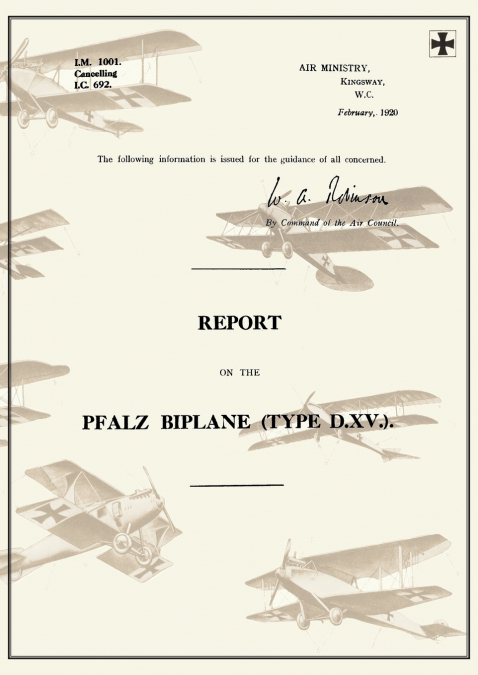
REPORT ON THE PFALZ BIPLANE,  TYPE D.XV., February 1920Reports on German Aircraft 19

REPORT ON THE PFALZ BIPLANE, TYPE D.XV., February 1920Reports on German Aircraft 19


18,35 €
IVA incluido
Disponible
Editorial:
Naval & Military Press
Año de edición:
2014
Materia
Historia militar
ISBN:
9781783310661
18,35 €
IVA incluido
Disponible

Selecciona una librería:

  • Librería Samer Atenea
  • Librería Aciertas (Toledo)
  • Kálamo Books
  • Librería Perelló (Valencia)
  • Librería Elías (Asturias)
  • Donde los libros
  • Librería Kolima (Madrid)
  • Librería Proteo (Málaga)

The D.XV was last of the series of biplane fighters and notably different from their earlier aircraft, with both mainplanes clear of the fuselage and without flying wires. The lower wing was the smaller of the two both in span and chord and had elliptical tips. The upper wing was square tipped and fitted with ailerons. Both were single piece from tip to tip. Outward leaning N-form struts defined the D.XV as a single bay biplane; groups of short struts from the mid and upper fuselage joined it to the upper wing and similar groups attached the lower plane.The D.XV had a 185 hp (138 kW) 6-cylinder water-cooled inline engine BMW IIIa with a rectangular radiator filling the upper nose above the drive-shaft of the two blade propeller. Aft, the fuselage was rounded in cross-section with the single open cockpit behind the upper wing’s trailing edge. The horizontal tail was mounted at mid-fuselage, D-shaped in plan and with balanced elevators. The fin was triangular and carried a short, curved, balanced rudder. The D.XV’s fixed conventional undercarriage was of the fixed axle type, the axle ends supported on pairs of V-struts and wire cross-braced; there was a tall tail skid. Armament, twin Spandau machine-guns.The D.XV was developed over the summer of 1918 and versions with unbalanced ailerons (D.XVf) and overhung, balanced ailerons (D.XV (Spezial). The 180 hp (134 kW) Daimler DIIIa engine was also considered. The Pfalz took part in the third D-type, held in October 1918. It was judged to have high performance and manoeuvrability though tail heavy and hard to land. It was one of the last German fighters accepted for production, getting its type approval on 4 November 1918, just a few days before the Armistice. Because it was approved for production so late, the Pfalz XV never reached operational status. Nonetheless, several were built and finished, and there were 74 completed fuselages in the Pfalz works when these were inspected by the Allies in the autumn of 1919.


Artículos relacionados

  • Waterloo Betrayed
    Stephen M. Beckett / Stephen MBeckett
    THIS BOOK HAS BEEN SUPERCEDEDSee Operations of the Armée du Nord : 1815, The Analysis for the definitive guide of French operations in 1815.   Discover why Napoleon really lost the Waterloo Campaign Napoleon was betrayed during 1815 There is no doubt of this. The Traitors admitted as much, and the Allied powers documented their acts. In the immediate aftermath of Napoleon's...
  • The Price They Paid
    Michael Putzel
    The Price They Paid is the stunning and dramatic true story of a legendary helicopter commander in Vietnam and the flight crews that followed him into the most intensive helicopter warfare ever-and how that brutal experience has changed their lives in the forty years since the war ended. ...
    Disponible

    11,07 €

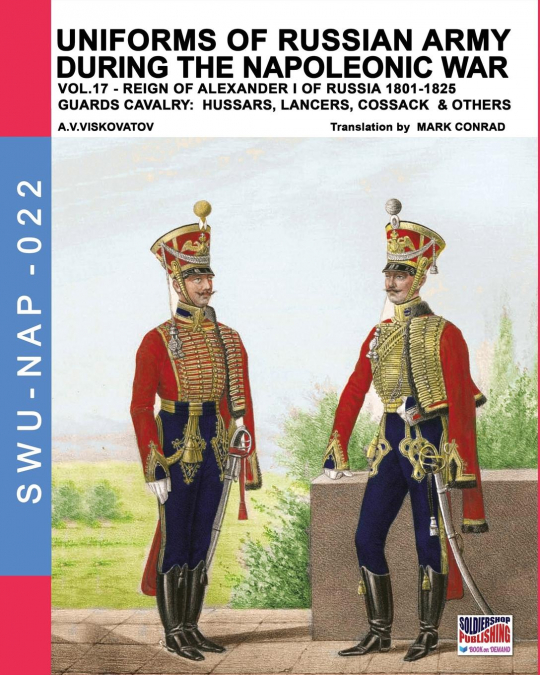
  • Uniforms of Russian army during the Napoleonic war vol.17
    Aleksandr Vasilevich Viskovatov / Mark Conrad
    This volume is related to the Russian Army during the zar Alexander I era, and are about the Guard cavalry regiments (part 1). Compiled at Saint Petersburg during the year from 1837 and 1851, the Historical Description of the Clothing and Arms of the Russian Army has had an enormous impact and great importance for the study on the history of Russian costume and uniformology dev...
    Disponible

    40,78 €

  • Cyber Warfare and Cyber Terrorism
    ...
  • Armed Robotic Systems Emergence
    Robert j. Bunker / Robert jBunker
    The fielding of armed robotic systems--droids and drones that are teleoperated, semi-autonomous, and even autonomous--has been slowly but surely transitioning from pure science fiction into military reality on the battlefields of the early 21st century. These systems currently have no artificial intelligence (AI) whatsoever and, in most cases, are simply operated by soldiers (a...
    Disponible

    8,64 €

  • SNIPER ONE
    DAN MILLS
    ...
    Disponible

    18,71 €