 Librería Samer Atenea
 Kálamo Books
 Librería Elías (Asturias)
 Librería Kolima (Madrid)
 Librería Proteo (Málaga)
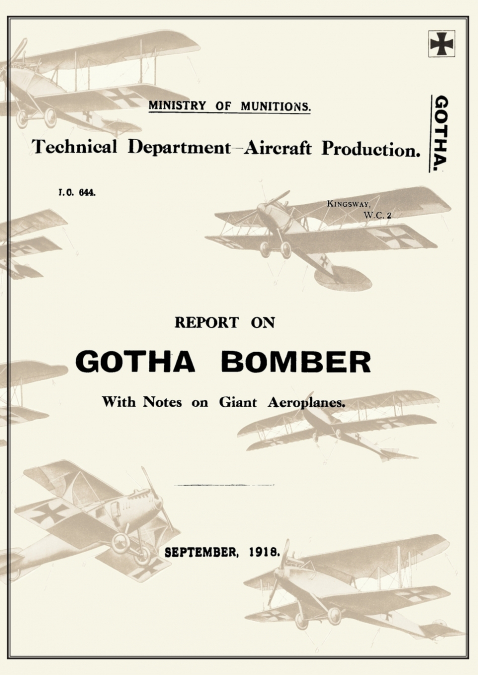
The Gotha Bomber was produced in the autumn of 1916 when the limitations of the Zeppelin as a raider had become obvious. The German High Command ordered that 30 Gotha bombers were to be ready for a daylight raid on London on February 1st, 1917, but the machines were not ready until May. The first daylight raid on London was carried out by 14 Gothas on June 13th, 1917. On July 7th, 22 Gothas raided London. Night raids began in August of 1917 and continued until May 1918 when they were abandoned because of the increasingly heavy losses. At peak employment, in April 1918, 36 G.Vs were in service.Operational use of the G.IV demonstrated that the incorporation of the fuel tanks into the engine nacelles was a mistake. In a crash landing the tanks could rupture and spill fuel onto the hot engines. This posed a serious problem because landing accidents caused 75% of operational losses. Gothaer produced the G.V, which housed its fuel tanks in the center of the fuselage. The smaller engine nacelles were mounted on struts above the lower wing.[Read more]The Gotha’s pilot seat was offset to starboard with the bomb bay immediately behind. This allowed for a connecting walkway on the port side allowing crew members to move between the three gun stations. The Gotha included an important innovation in the form of a 'gun tunnel' whereby the underside of the rear fuselage was arched, allowing placement of a rearward facing machine gun protecting from attack from below, removing the blind spot.The G.V entered service in August 1917. It offered no performance improvement over the G.IV. The G.V was up to 450 kg (990 lb) heavier than the G.IV due to additional equipment and the use of insufficiently seasoned timber. Inferior quality fuel prevented the Mercedes D.IVa engines from producing the rated 190 kW (260 hp). For these reasons, the G.V generally operated at much lower altitudes than the G.IV.In February 1918, Gothaer tested a compound tail unit with biplane horizontal stabilizers and twin rudders. The new tail unit, known as the Kastensteuerung, improved the aircraft’s marginal directional control on one engine. The resulting G.Va subvariant incorporated the new tail as well as a slightly shorter forward fuselage with an auxiliary nose landing gear. All 25 G.Va aircraft were delivered to Bogohl 3, the new designation for the former Kagohl 3.The G.Va was followed by the G.Vb, which carried an increased payload and operated at a maximum takeoff weight of 4,550 kg (10,030 lb). To reduce the danger of flipping over during landing, Gothaer introduced the Stossfahrgestell ('shock landing gear'), a tandem two-bogie main landing gear. The Stossfahrgestell proved so good that it was fitted to all G.V’s in Bogohl 3. Some G.Vb aircraft also had Flettner servo tabs on the ailerons to reduce control forces.Idflieg ordered 80 G.Vb aircraft, the first being delivered to Bogohl 3 in June 1918. By the Armistice, all 80 aircraft were built but the last batch did not reach the front and was delivered direct to the Allied special commission.