 Librería Samer Atenea
 Kálamo Books
 Librería Elías (Asturias)
 Librería Kolima (Madrid)
 Librería Proteo (Málaga)
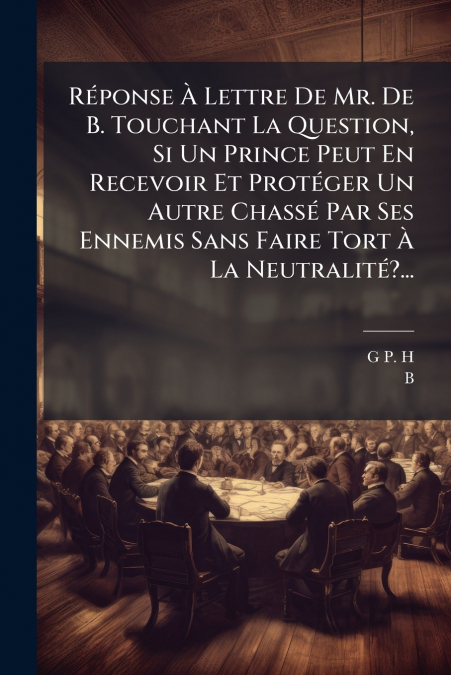
Réponse À Lettre De Mr. De B. Touchant La Question, Si Un Prince Peut En Recevoir Et Protéger Un Autre Chassé Par Ses Ennemis Sans Faire Tort À La Neutralité?..., authored by G P. H; B (de.), delves into a complex political and legal question pertinent to 17th-century Europe. The work examines the circumstances under which a prince may offer refuge and protection to another prince exiled by enemies, without compromising a position of neutrality. This treatise offers valuable insights into the prevailing theories and practices of international relations and the delicate balance of power during a tumultuous period in European history.The author scrutinizes the moral, ethical, and legal dimensions of neutrality, providing a nuanced perspective on the obligations and limitations faced by rulers in an era defined by frequent conflicts and shifting alliances. This historical document provides a unique lens through which to examine the foundations of modern international law and the enduring challenges of maintaining peace and stability among nations.This work has been selected by scholars as being culturally important, and is part of the knowledge base of civilization as we know it. This work was reproduced from the original artifact, and remains as true to the original work as possible. Therefore, you will see the original copyright references, library stamps (as most of these works have been housed in our most important libraries around the world), and other notations in the work.This work is in the public domain in the United States of America, and possibly other nations. Within the United States, you may freely copy and distribute this work, as no entity (individual or corporate) has a copyright on the body of the work.As a reproduction of a historical artifact, this work may contain missing or blurred pages, poor pictures, errant marks, etc. Scholars believe, and we concur, that this work is important enough to be preserved, reproduced, and made generally available to the public. We appreciate your support of the preservation process, and thank you for being an important part of keeping this knowledge alive and relevant.