José Masdevall / Imprenta Real (Madrid)
 Librería Samer Atenea
 Kálamo Books
 Librería Elías (Asturias)
 Librería Kolima (Madrid)
 Librería Proteo (Málaga)
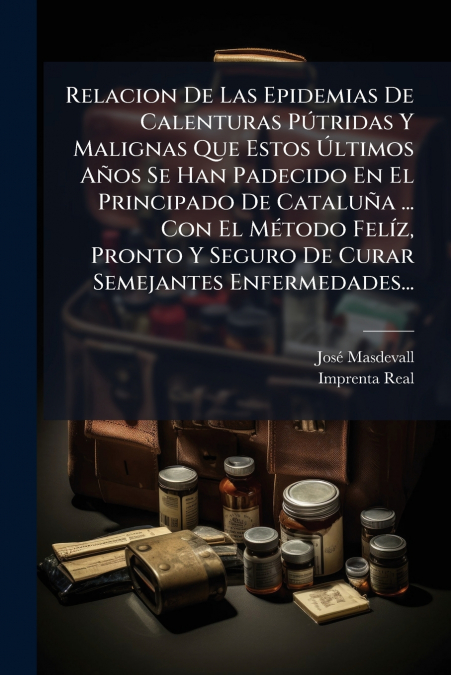
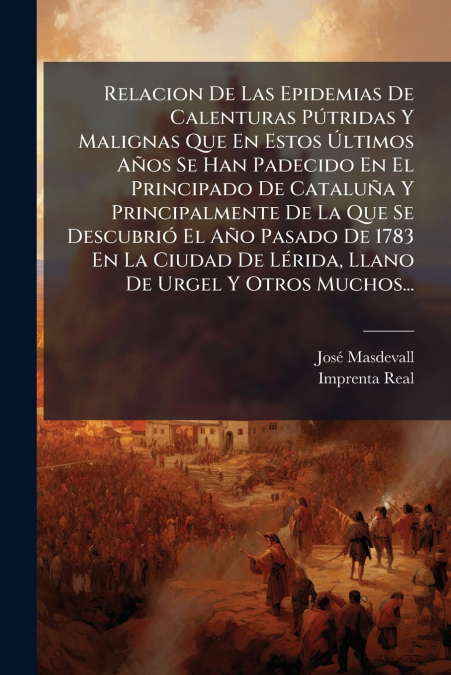
This historical work, 'Relacion De Las Epidemias De Calenturas Pútridas Y Malignas Que En Estos Últimos Años Se Han Padecido En El Principado De Cataluña Y Principalmente De La Que Se Descubrió El Año Pasado De 1783 En La Ciudad De Lérida, Llano De Urgel Y Otros Muchos...', documents the epidemics of putrid and malignant fevers that struck the Principality of Catalonia in the years leading up to 1783. Focusing particularly on the outbreak discovered in 1783 in the city of Lérida, the plain of Urgel, and many other locations, the book provides a detailed account of these devastating public health crises. Authored by José Masdevall and printed by the Imprenta Real in Madrid, this book offers invaluable insights into the medical and social conditions of 18th-century Spain. It serves as a crucial resource for historians and medical professionals interested in the history of epidemics and public health measures.This work has been selected by scholars as being culturally important, and is part of the knowledge base of civilization as we know it. This work was reproduced from the original artifact, and remains as true to the original work as possible. Therefore, you will see the original copyright references, library stamps (as most of these works have been housed in our most important libraries around the world), and other notations in the work.This work is in the public domain in the United States of America, and possibly other nations. Within the United States, you may freely copy and distribute this work, as no entity (individual or corporate) has a copyright on the body of the work.As a reproduction of a historical artifact, this work may contain missing or blurred pages, poor pictures, errant marks, etc. Scholars believe, and we concur, that this work is important enough to be preserved, reproduced, and made generally available to the public. We appreciate your support of the preservation process, and thank you for being an important part of keeping this knowledge alive and relevant.