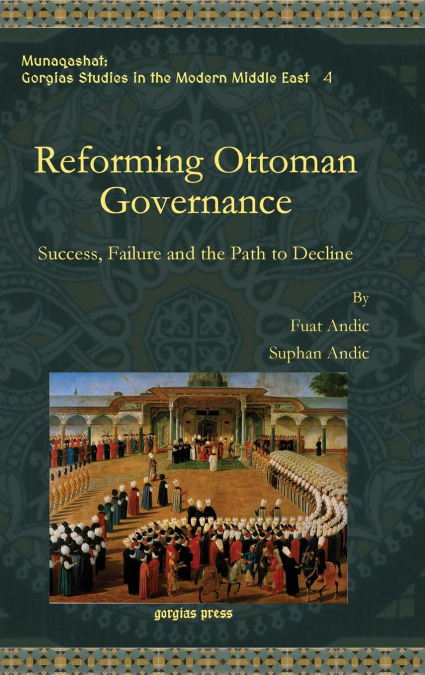

Reforming Ottoman Governance

Reforming Ottoman Governance

Reforming Ottoman Governance

Fuat M. Andic / Suphan Andic

244,71 €
IVA incluido
Consulta disponibilidad
Editorial:
Gorgias Press
Año de edición:
2014
ISBN:
9781463202361

Selecciona una librería:

  • Librería Samer Atenea
  • Librería Aciertas (Toledo)
  • Kálamo Books
  • Librería Perelló (Valencia)
  • Librería Elías (Asturias)
  • Donde los libros
  • Librería Kolima (Madrid)
  • Librería Proteo (Málaga)

The book is the history of reform attempts in the Ottoman Empire and the internal and external difficulties in implementing them. Imperialist aggression towards the Empire and bloody janissary revolts hampered the reforms, and although some successes in governance were achieved, there were many failures, and these contributed to the demise of the Empire at the end of the First World War.Reforms began in 1718 during the period known as the Tulip Era, which ended in 1730 with a bloody janissary uprising. Sultan Selim III, who reigned from 1789 to 1807, then tried to engage with domestic and military reform. His reform efforts conflicted with the interests of both the janissaries and the religious leaders and made the sultan a victim of another janissary uprising. Mahmud II, successor to Selim III, strove to change the paradigm of governance with his personal administration. His most daring action was the eradication of the unruly janissary organisation.The concept of a constitutional monarchy penetrated the Empire, first in the form of Tanzimat in 1839, and subsequently with the issuance of a constitution in 1876. The sultan of the time, Abdülhamid II, became convinced that he could run the Empire alone and suspended the constitution. He was dethroned by a military coup in 1909. The janissaries had disappeared from the Empire, but their mentality had not. A new constitution was declared by amateur politicians and military officers, members of a revolutionary committee known as ’Union and Progress’, also known in the West as the ’Young Turks’. They were well intentioned, but faced two disastrous wars, one in Libya, the other in the Balkans. Their administration quickly degenerated into a dictatorship and they had hardly enough time to carry out any meaningful reforms. In 1914 the Ottoman Empire entered the First World War together with Germany, the death knell of an empire that had lasted seven hundred years. 3
Artículos relacionados

  • Key to Countering Islamic Fundamentalism
    Maryam Rajavi
    Testimony before U.S. House Foreign Affairs Committee's subcommittee on Terrorism, non-Proliferation, and Trade discussing ISIS and Islamic fundamentalism. The book contains Maryam Rajavi's full testimony as well as the question and answer by representatives. During the hearing, Maryam Rajavi who is the president-elect of Iran's parliament-in-exile, the National Council of Resi...
    Disponible

    13,94 €

  • IRAN-A Writ of Deception and Cover-up
    NCRI- U.S. Representative Office / NCRI- U.SRepresentative Office
    Based on reliable information obtained by the Mujahedin-e Khalq (MEK) network inside Iran, a top-secret committee is in charge of drafting the answers to the International Atomic Energy Agency (IAEA) regarding the Possible Military Dimensions (PMD) of Tehran's nuclear program. Top officials from the Islamic Revolutionary Guards Corps (IRGC) and the Ministry of Defense Armed...
    Disponible

    5,44 €

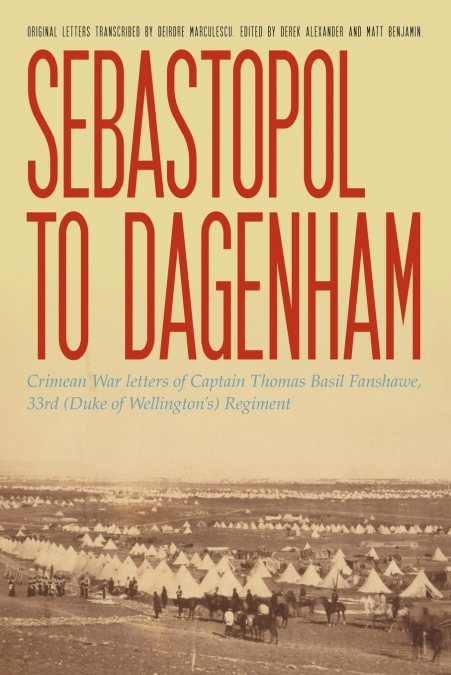
  • Sebastopol to Dagenham
    Thomas Basil Fanshawe
    'Sebastopol appears to be a succession of forts which the Russians are strengthening every day. A great number of the men are sick of the whole concern. No one looks forward to another winter out here with any degree of satisfaction'.Captain Thomas Basil Fanshawe served with the 33rd (Duke of Wellington's) Regiment at Sebastopol during the Crimean War. The letters h...
    Disponible

    23,05 €

  • THEN AND NOW
    Hussein Shabka
    The rise and fall of civilizations has been a fact of history since before it was recorded. It is a normal process. So what is the particular significance of Egypt’s descent from a wealthy, organized, sophisticated society into the chaotic milieu that reigns today? Perhaps it relates to the nature of the yawning gap that exists between that sophistication that endured for more ...
    Disponible

    33,86 €

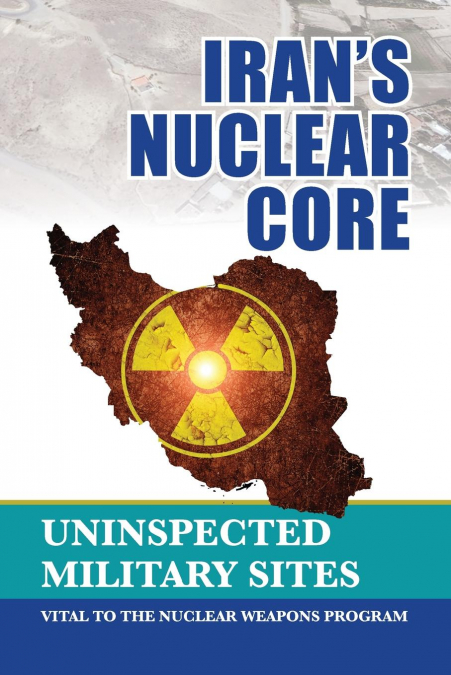
  • Iran’s Nuclear Core
    NCRI- U.S. Representative Office / NCRI- U.SRepresentative Office
    Iran's Nuclear Core details how the nuclear weapons program is at the heart, and not in parallel, to the civil nuclear program of Iran. The program is run by the Islamic Revolutionary Guards Corp (IRGC) since the beginning, and the main nuclear sites and nuclear research facilities have been hidden from the eyes of the United Nations nuclear watchdog.The manuscript details ...
    Disponible

    23,24 €

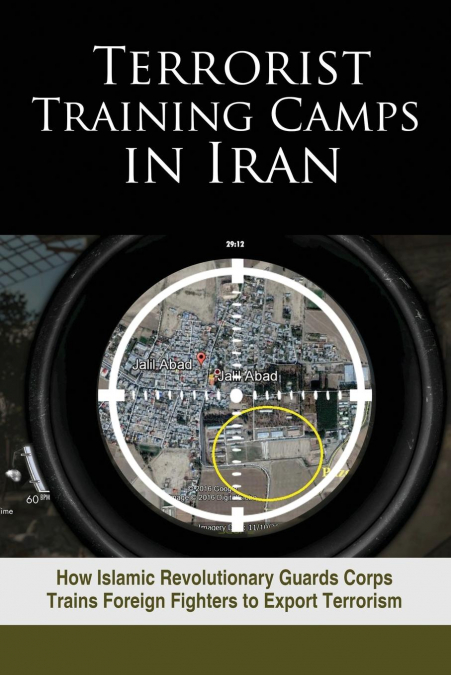
  • Terrorist Training Camps in Iran
    NCRI- U.S. Representative Office / NCRI- U.SRepresentative Office
    The book details how  Islamic Revolutionary Guards Corps trains foreign fighters in 15 various camps in Iran to export terrorism. The IRGC has created a large directorate within its extraterritorial arm, the Quds Force, in order to expand its training of foreign mercenaries as part of the strategy to step up its meddling abroad in Syria, Iraq, Yemen, Bahrain, Afghanistan and el...
    Disponible

    23,24 €