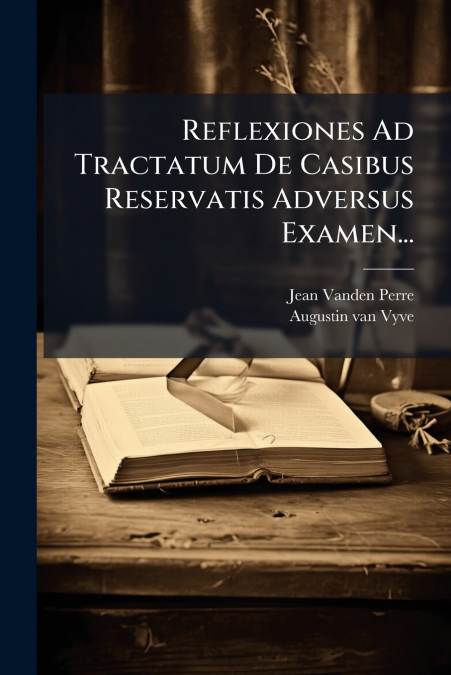
Jean Vanden Perre / Augustin van Vyve
 Librería Samer Atenea
 Kálamo Books
 Librería Elías (Asturias)
 Librería Kolima (Madrid)
 Librería Proteo (Málaga)
Reflexiones Ad Tractatum De Casibus Reservatis Adversus Examen..., written in Latin by Jean Vanden Perre and Augustin van Vyve, delves into the complex area of reserved cases within Catholic canon law. This work offers detailed reflections on the treatment of sins reserved for special consideration, providing an invaluable resource for theologians and legal scholars interested in the historical development of moral theology and ecclesiastical jurisprudence.The text explores the nuances of confession, penance, and the specific circumstances under which certain sins are ‘reserved,’ requiring absolution by a higher ecclesiastical authority. Its enduring value lies in its detailed examination of the principles and practices governing the Catholic Church’s approach to sin, reconciliation, and the administration of sacraments. This historical work provides insight into the intersection of law, morality, and religious practice.This work has been selected by scholars as being culturally important, and is part of the knowledge base of civilization as we know it. This work was reproduced from the original artifact, and remains as true to the original work as possible. Therefore, you will see the original copyright references, library stamps (as most of these works have been housed in our most important libraries around the world), and other notations in the work.This work is in the public domain in the United States of America, and possibly other nations. Within the United States, you may freely copy and distribute this work, as no entity (individual or corporate) has a copyright on the body of the work.As a reproduction of a historical artifact, this work may contain missing or blurred pages, poor pictures, errant marks, etc. Scholars believe, and we concur, that this work is important enough to be preserved, reproduced, and made generally available to the public. We appreciate your support of the preservation process, and thank you for being an important part of keeping this knowledge alive and relevant.
![Court-Hand Restored [1879]]( https://distri.podiprint.com/imagenes/978/1/6/1/6/1/9/6/9781616196899_f_675x675.jpg "Court-Hand Restored [1879]")
![Commentary to the Germanic Laws and Mediaeval Documents [1915]]( https://distri.podiprint.com/imagenes/978/1/5/8/4/7/7/0/9781584770053_f_675x675.jpg "Commentary to the Germanic Laws and Mediaeval Documents [1915]")