Inicio > Derecho > Teoría general del derecho > Reconsidering Constitutional Formation II Decisive Constitutional Normativity
Reconsidering Constitutional Formation II Decisive Constitutional Normativity

Reconsidering Constitutional Formation II Decisive Constitutional Normativity

Ulrike Müßig

75,25 €
IVA incluido
Disponible
Editorial:
Springer Nature B.V.
Año de edición:
2018
Materia
Teoría general del derecho
ISBN:
9783030103040
75,25 €
IVA incluido
Disponible

Selecciona una librería:

  • Librería Samer Atenea
  • Librería Aciertas (Toledo)
  • Kálamo Books
  • Librería Perelló (Valencia)
  • Librería Elías (Asturias)
  • Donde los libros
  • Librería Kolima (Madrid)
  • Librería Proteo (Málaga)

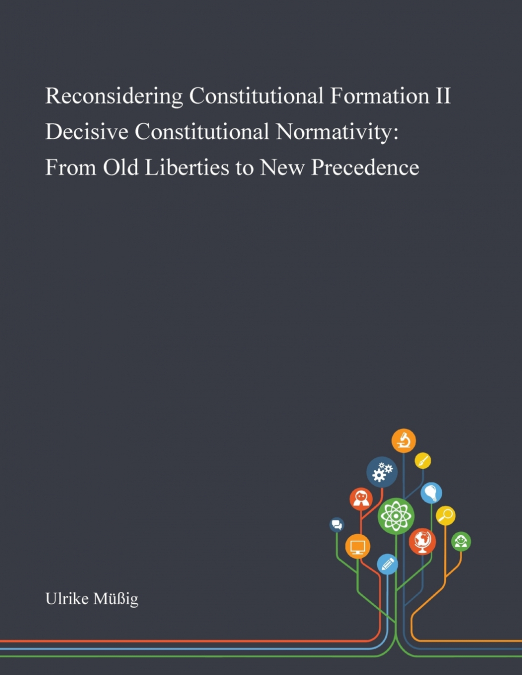
This second volume of ReConFort, published open access, addresses the decisive role of constitutional normativity, and focuses on discourses concerning the legal role of constitutional norms. Taken together with ReConFort I (National Sovereignty), it calls for an innovative reassessment of constitutional history drawing on key categories to convey the legal nature of the constitution itself (national sovereignty, precedence, justiciability of power, judiciary as constituted power).In the late 18th and early 19th centuries, constitutional normativity began to complete the legal fixation of the entire political order. This juridification in one constitutional text resulted in a conceptual differentiation from ordinary law, which extends to alterability and justiciability. The early expressions of this ’new order of the ages’ suggest an unprecedented and irremediable break with European legal tradition, be it with British colonial governance or the French ancien régime. In fact, while the shift to constitutions as a hierarchically ’higher’ form of positive law was a revolutionary change, it also drew upon old liberties. The American constitutional discourse, which was itself heavily influenced by British common law, in turn served as an inspiration for a variety of constitutional experiments - from the French Revolution to Napoleon’s downfall, in the halls of the Frankfurt Assembly, on the road to a unified Italy, and in the later theoretical discourse of twentieth-century Austria. If the constitution states the legal rules for the law-making process, then its Kelsian primacy is mandatory.Also included in this volume are the French originals and English translations of two vital documents. The first - Emmanuel Joseph Sieyès’ Du Jury Constitutionnaire (1795) - highlights an early attempt to reconcile the democratic values of the French Revolution with the pragmatic need to legally protect the Revolution. The second - the 1812 draft of the Constitution of the Kingdom of Poland - presents the ’constitutional propaganda’ of the Russian Tsar Alexander I to bargain for the support of the Lithuanian and Polish nobility. These documents open new avenues of research into Europe’s constitutional history: one replete with diverse contexts and national experiences, but above all an overarching motif of constitutional decisiveness that served to complete the juridification of sovereignty. (www.reconfort.eu)

Artículos relacionados

  • EU General Data Protection Regulation (GDPR)
    IT Governance Privacy Team
    An in-depth guide to complying with the EU GDPR.Now in its second edition, EU GDPR – An Implementation and Compliance Guide is a clear and comprehensive guide to this new data protection law, providing a detailed commentary on the Regulation, and setting out the obligations of data  processors and controllers in clear and comprehensible terms.Read this book to learn: How the ...
    Disponible

    30,10 €

  • Banking Laws and Regulations in Nigeria
    Bello Mohammed Magaji
    Banking Law and Regulations in Nigeria: Selected Themes essentially deals with the laid down rules or code of conduct meant to control and set standards for banking business. Indeed, the main aim of the ongoing banking reforms in Nigeria, started in 2004, is to ensure banks’ conformity to the laid down banking rules and regulations. The eleven-chapter book contains vital and ri...
    Disponible

    41,17 €

  • States and the Interpretation of Treaties
    Dimitris Liakopoulos
    States and the Interpretation of Treaties opens with a provocative reconsideration of a debate on the subject of comparative international legal obligations by the United Nations’s International Law Commission. In this book, distinguished Tufts University legal scholar Dimitris Liakopoulos identifies and explores relevant considerations in the work of the Commission and offers ...
  • The role of customs in international treaties
    Dimitris Liakopoulos
    The Role of Customs in International Treaties concentrates on issues of friction between member states of the United Nations. In view of the role played by the United Nations in resolving international disputes, Dimitris Liakopoulos hypothesizes that 'practical guides' based on custom often catalyze the positions taken by states, courts, scholars, and other actors, constituting...
  • Debtor protection in American and European Union bankruptcy law
    Dimitris Liakopoulos
    In Debtor Protection in American and European Union Bankruptcy Law, international law scholar Dimitris Liakopulos raises a delicate issue at the foundations of the modern banking system by analyzing US bankruptcy law with a focus on the concept of automatic stay. His work identifies legal sources and authorities having repercussions in terms of operational protection. It then e...
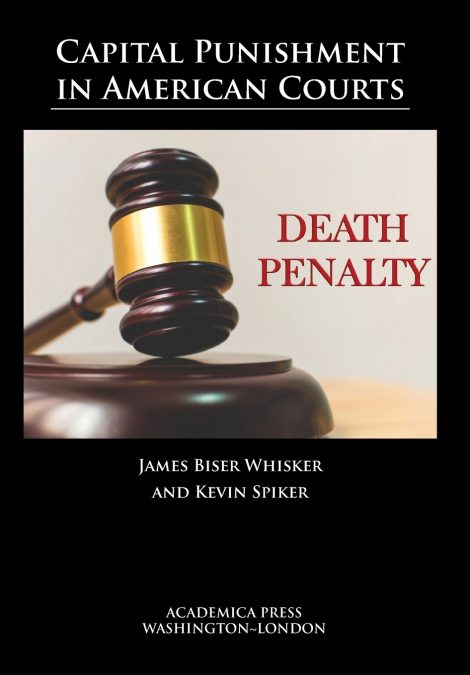
  • Capital punishment in American courts
    James Biser Whisker / Kevin Spiker
    In the 400 years since the first known execution was carried out for treason in Virginia, American jurisdictions have debated both the appropriateness and methods of capital punishment. Over that time, courts have placed varying restrictions on its application, excluding categories of citizens (for example the insane or the underaged) and evaluating and excluding methods of exe...

Otros libros del autor

  • Reconsidering Constitutional Formation II Decisive Constitutional Normativity
    Ulrike Müßig
    This second volume of ReConFort, published open access, addresses the decisive role of constitutional normativity, and focuses on discourses concerning the legal role of constitutional norms. Taken together with ReConFort I (National Sovereignty), it calls for an innovative reassessment of constitutional history drawing on key categories to convey the legal nature of the consti...
  • Reconsidering Constitutional Formation II Decisive Constitutional Normativity
    Ulrike Müßig
    This second volume of ReConFort, published open access, addresses the decisive role of constitutional normativity, and focuses on discourses concerning the legal role of constitutional norms. Taken together with ReConFort I (National Sovereignty), it calls for an innovative reassessment of constitutional history drawing on key categories to convey the legal nature of the consti...
    Disponible

    82,42 €

  • Reconsidering Constitutional Formation I National Sovereignty
    Ulrike Müßig
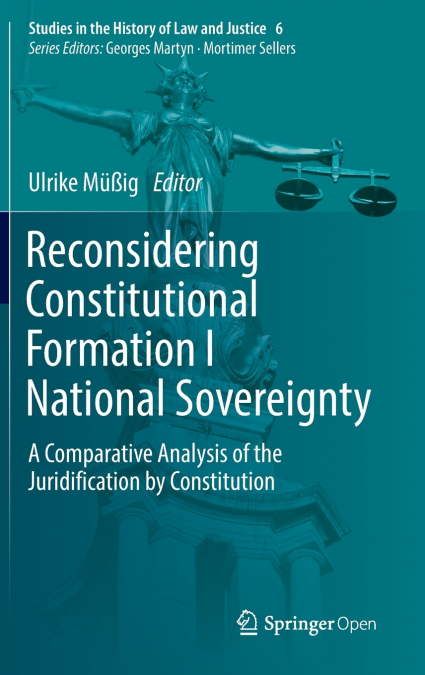
    This open access book can be downloaded from link.springer.comLegal studies and consequently legal history focus on constitutional documents, believing in a nominalist autonomy of constitutional semantics. Reconsidering Constitutional Formation in the late 18th and 19th century, kept historic constitutions from being simply log-books for political experts through a functional a...
    Disponible

    74,82 €

  • Reconsidering Constitutional Formation II Decisive Constitutional Normativity
    Ulrike Müßig
    This second volume of ReConFort, published open access, addresses the decisive role of constitutional normativity, and focuses on discourses concerning the legal role of constitutional norms. Taken together with ReConFort I (National Sovereignty), it calls for an innovative reassessment of constitutional history drawing on key categories to convey the legal nature of the consti...
  • Reconsidering Constitutional Formation I National Sovereignty
    Ulrike Müßig
    This open access book can be downloaded from link.springer.comLegal studies and consequently legal history focus on constitutional documents, believing in a nominalist autonomy of constitutional semantics. Reconsidering Constitutional Formation in the late 18th and 19th century, kept historic constitutions from being simply log-books for political experts through a functional a...