
Inicio > > Redes y comunicaciones informáticas > Reconfigurable Computing
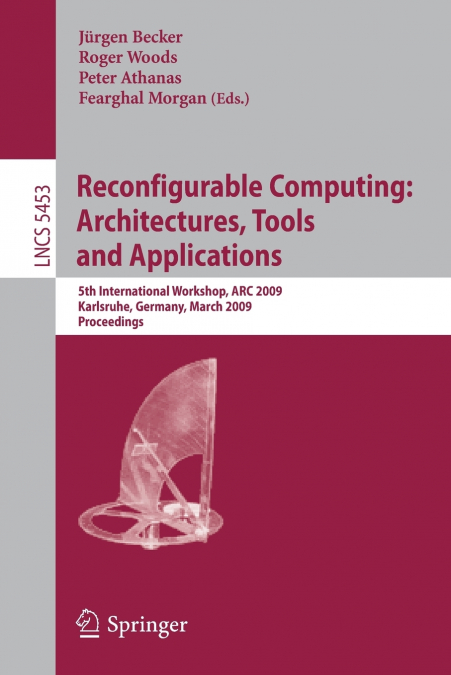
Reconfigurable Computing

Reconfigurable Computing


65,74 €
IVA incluido
Disponible
Editorial:
Springer Nature B.V.
Año de edición:
2009
Materia
Redes y comunicaciones informáticas
ISBN:
9783642006401
65,74 €
IVA incluido
Disponible

Selecciona una librería:

  • Librería Samer Atenea
  • Librería Aciertas (Toledo)
  • Kálamo Books
  • Librería Perelló (Valencia)
  • Librería Elías (Asturias)
  • Donde los libros
  • Librería Kolima (Madrid)
  • Librería Proteo (Málaga)

Recon?gurable computing (RC) technologies o?er the promise of substantial performance gains over traditional architectures by customizing, sometimes at run-time, the topology of the underlying architecture to match the speci?c needs of a given application. Contemporary con?gurable architectures allow for the de?nition of architectures with functional and storage units that match the s- ci?c needs of a given computation, in terms of function, bit-width and control structures. Compared to standard microprocessor architectures, advantages are possible in terms of power consumption on a broad range of di?erent application ?elds. Moreover, the ?exibility enabled by recon?guration is also seen as a basic technique for overcoming transient failures in emerging device structures. Techniques for achieving recon?gurable systems are numerous and require the joint development of recon?gurable hardware systems to support the dynamic behavior, e.g., suitable programming models, tools and languages, to support the recon?guration process during run-time as well as during design-time. This includes veri?cation techniques that can demonstrate formally correct recon?- ration sequences at each stage. While there are many problems, the existence and development of technologies such as recent multi- and many-core processor arc- tectures, dynamically recon?gurable and multi-grain computing architectures, as well as application-speci?c processors suggest that there is a very strong need for adaptive and recon?gurable systems.
Artículos relacionados

  • Next Generation Search Engines
    Recent technological progress in computer science, Web technologies, and the constantly evolving information available on the Internet has drastically changed the landscape of search and access to information. Current search engines employ advanced techniques involving machine learning, social networks, and semantic analysis. Next Generation Search Engines: Advanced Models for ...
  • Collaboration and the Semantic Web
    Collaborative working has been increasingly viewed as a good practice for organizations to achieve efficiency. Organizations that work well in collaboration may have access to new sources of funding, deliver new, improved, and more integrated services, make savings on shared costs, and exchange knowledge, information and expertise. Collaboration and the Semantic Web: Social Net...
  • Resource Allocation in Next-Generation Broadband Wireless Access Networks
    With the growing popularity of wireless networks in recent years, the need to increase network capacity and efficiency has become more prominent in society. This has led to the development and implementation of heterogeneous networks. Resource Allocation in Next-Generation Broadband Wireless Access Networks is a comprehensive reference source for the latest scholarly research o...
  • Advanced Topics in Information Technology Standards and Standardization Research, Volume 1
    Kai Jakobs
    ...
  • Data Warehouses and OLAP
    ...
  • Selected Readings on Database Technologies and Applications
    Terry Halpin
    Education and research in the field of database technology can prove problematic without the proper resources and tools on the most relevant issues, trends, and advancements. Selected Readings on Database Technologies and Applications supplements course instruction and student research with quality chapters focused on key issues concerning the development, design, and analysis ...