
Inicio > > Redes y comunicaciones informáticas > Recommender Systems and the Social Web
Recommender Systems and the Social Web

Recommender Systems and the Social Web

Fatih Gedikli

68,09 €
IVA incluido
Disponible
Editorial:
Springer Nature B.V.
Año de edición:
2013
Materia
Redes y comunicaciones informáticas
ISBN:
9783658019471
68,09 €
IVA incluido
Disponible

Selecciona una librería:

  • Librería Samer Atenea
  • Librería Aciertas (Toledo)
  • Kálamo Books
  • Librería Perelló (Valencia)
  • Librería Elías (Asturias)
  • Donde los libros
  • Librería Kolima (Madrid)
  • Librería Proteo (Málaga)

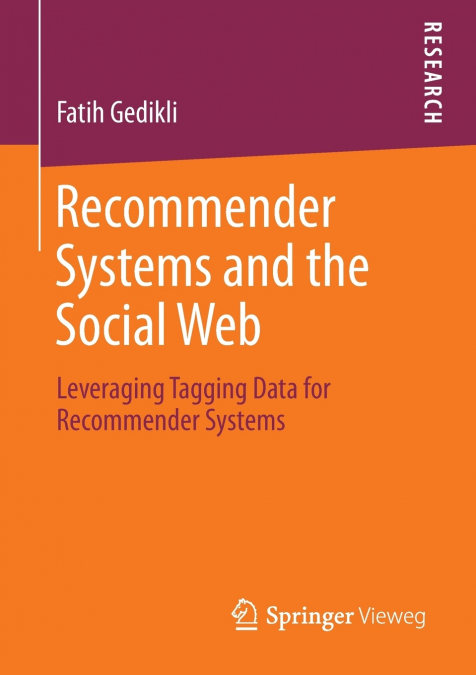
​There is an increasing demand for recommender systems due to the information overload users are facing on the Web. The goal of a recommender system is to provide personalized recommendations of products or services to users. With the advent of the Social Web, user-generated content has enriched the social dimension of the Web. As user-provided content data also tells us something about the user, one can learn the user’s individual preferences from the Social Web. This opens up completely new opportunities and challenges for recommender systems research. Fatih Gedikli deals with the question of how user-provided tagging data can be used to build better recommender systems. A tag recommender algorithm is proposed which recommends tags for users to annotate their favorite online resources. The author also proposes algorithms which exploit the user-provided tagging data and produce more accurate recommendations. On the basis of this idea, he shows how tags can be used to explain to the user the automatically generated recommendations in a clear and intuitively understandable form. With his book, Fatih Gedikli gives us an outlook on the next generation of recommendation systems in the Social Web sphere.

Artículos relacionados

  • Next Generation Search Engines
    Recent technological progress in computer science, Web technologies, and the constantly evolving information available on the Internet has drastically changed the landscape of search and access to information. Current search engines employ advanced techniques involving machine learning, social networks, and semantic analysis. Next Generation Search Engines: Advanced Models for ...
  • Collaboration and the Semantic Web
    Collaborative working has been increasingly viewed as a good practice for organizations to achieve efficiency. Organizations that work well in collaboration may have access to new sources of funding, deliver new, improved, and more integrated services, make savings on shared costs, and exchange knowledge, information and expertise. Collaboration and the Semantic Web: Social Net...
  • Resource Allocation in Next-Generation Broadband Wireless Access Networks
    With the growing popularity of wireless networks in recent years, the need to increase network capacity and efficiency has become more prominent in society. This has led to the development and implementation of heterogeneous networks. Resource Allocation in Next-Generation Broadband Wireless Access Networks is a comprehensive reference source for the latest scholarly research o...
  • Advanced Topics in Information Technology Standards and Standardization Research, Volume 1
    Kai Jakobs
    ...
  • Data Warehouses and OLAP
    ...
  • Selected Readings on Database Technologies and Applications
    Terry Halpin
    Education and research in the field of database technology can prove problematic without the proper resources and tools on the most relevant issues, trends, and advancements. Selected Readings on Database Technologies and Applications supplements course instruction and student research with quality chapters focused on key issues concerning the development, design, and analysis ...